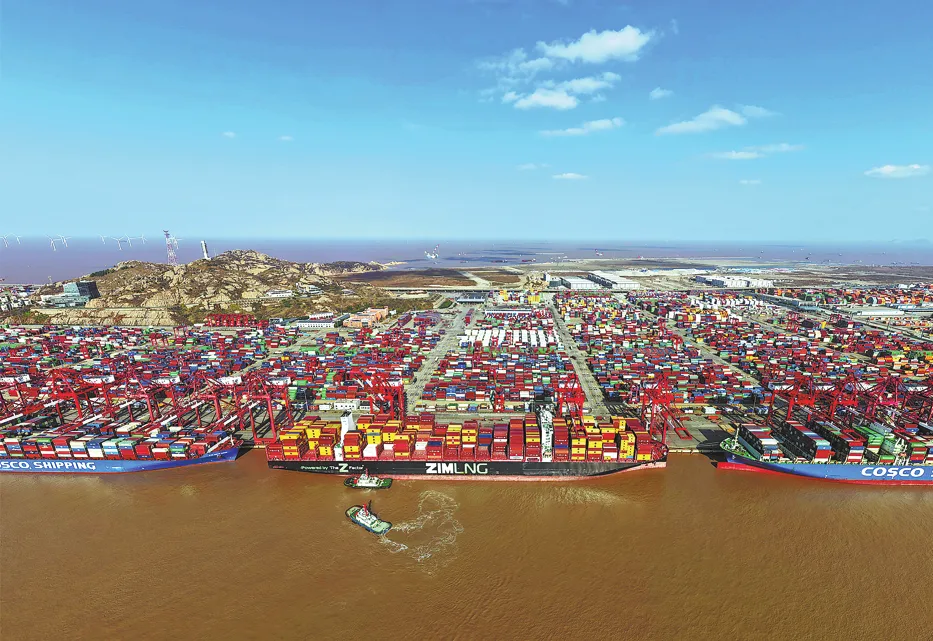
In 2025, China will account for around a third of international maritime transport, consolidating its position as the global leader in the sector. The country is also home to eight of the ten largest ports in the world by cargo volume, according to data released by the Ministry of Transport.
The information was presented by Vice Minister of Transport, Li Xinghu, during a press conference held in Beijing on June 30 to release the balance of the 14th Five-Year Plan (2021–2025). According to the ministry, waterway transport already represents more than half of China’s integrated transport system, highlighting the priority given to the sector in the national modernization strategy.
In 2025, Chinese ports handled 18.3 billion tons of cargo and 354 million TEUs (20-foot container equivalent unit), both the largest volumes in the world. The merchant fleet controlled by Chinese companies also reached 490 million tons of deadweight, maintaining the country’s global leadership in the sector.
Throughout the 14th Five-Year Plan, China incorporated 469 new berths for vessels weighing more than 10,000 tons, bringing the total to 3,061. In the same period, the network of high-capacity waterways grew by 2,500 kilometers, reaching around 18,500 kilometers.
Different modals
Integration between different modes of transport has also advanced. In 2025, Chinese ports handled 13.49 million TEUs through the intermodal system between railways and waterways, almost double the figure recorded in 2020.
The balance of the Five-Year Plan also highlights the consolidation of three large port complexes: the Bohai Sea region, the Yangtze River Delta and the Guangdong-Hong Kong-Macao Greater Bay Area, considered strategic for integrating Chinese industrial production into the main international maritime routes.
The plan’s investments prioritized the integration between waterways, railways, highways and ports, with the aim of reducing logistical costs, increasing the efficiency of goods transport and expanding connectivity between the different regions of the country. Furthermore, they accelerated the automation of Chinese ports.
Currently, China operates 60 automated port terminals, including 30 container terminals, equivalent to around 27% of the global total. According to the Ministry of Transport, the automated terminals at the ports of Shanghai and Qingdao are among the most efficient in the world.
Investments made throughout the 14th Five-Year Plan expanded China’s logistics capacity at a time of reorganization of global supply chains. With an increasingly integrated and automated port infrastructure, the country reinforces its role in international maritime trade and expands its capacity to serve both the domestic market and global trade routes.
China’s Five-Year Plan
The Five-Year Plan is China’s main economic and social planning instrument. Prepared under the coordination of the Communist Party of China and approved by the National People’s Congress, it serves as a strategic guideline for public policies, state investments and development goals across the country.
The plan establishes medium-term objectives based on economic, social, environmental and technological indicators, which are broken down into national and regional goals. Its implementation involves ministries, local governments and state-owned companies, which adapt the general guidelines to the conditions of each province within a system of centralized coordination and results-based evaluation.
The five-year plans have a guiding and binding nature for the public sector, especially in strategic areas. Each plan also fits into an ongoing sequence of long-term development goals.
Among its functions is to guide the allocation of public resources and investments in areas considered strategic, such as infrastructure, industry, technological innovation, energy transition, environment and foreign trade.
In the transport sector, the plan prioritizes the integration between railways, waterways, highways and ports, with a focus on reducing logistics costs, increasing efficiency and strengthening connectivity between industrial regions and international routes.
The five-year plans are part of the development model adopted in China since 1953 and integrate the system of socialism with Chinese characteristics, a concept used by the country’s authorities to define its political-economic model. Within this framework, the recent period is described as a phase of socialist modernization, which combines long-term planning, the central role of the State in economic coordination, technological expansion and development goals guided by efficiency and growth.
Source: www.brasildefato.com.br