Published 02/25/2026 12:44 | Edited 02/25/2026 14:01
The creation of the New Development Bank was more than an institutional milestone. It was a political statement — an assertion that the Global South would no longer be a passive recipient of externally imposed development models, but rather an active architect of its own future. – Dilma Rousseff, July/2025
1. Remembering
Previously, when analyzing the creation of an alternative to the current international financial architecture (AFI) by BRICS, I highlighted that one of the main objectives of this initiative is to reduce dependence on the US dollar. The reasons justifying this direction include: (a) mitigating sanctions risks, (b) reducing transaction costs and (c) promoting a global financial system.
This movement is a historical necessity in the face of a world in transition where the reality that presents itself points to a relative decline of the current hegemony, the rise of new poles of power – China as the beacon of this emergence – and the BRICS engineering this new world order that is more just, equitable and supportive.
I showed that between advances, periods of stagnation and some setbacks, the BRICS has been building, brick by brick, its own alternative through national initiatives and joint arrangements, anchored in the “BRICS Pay” project, which seeks to articulate already consolidated instant payment systems – such as PIX, in Brazil, UPI (India) and PayShap (South Africa) – into a common infrastructure aimed at reducing dependence on the dollar in intra-BRICS transactions.
In addition to other structures still in the testing, improvement and implementation phase, the configuration of the alternative to the AFI has the New Development Bank (NDB) as its structuring axis, a topic to which I return in this article.
2. The genesis – a little history
To a certain extent, we can link the creation of the NDB to the non-aligned movement that, at the Bandung Conference in 1955, demanded autonomy, solidarity and economic development among the “peripheral” nations of the global south.
In 2009, the then BRIC (still without the “S”) was formalized, amid the consequences of the 2007/2008 crisis, which exposed, among other aspects, the systemic weaknesses of Western capitalism in its financialized phase and, simultaneously, highlighted the greater resilience of the main emerging economies, creating a favorable political situation for Brazil, Russia, India and China to start claiming greater space in global economic and financial governance.
The following year, 2010, the G-20 (Seoul) approved a set of reforms that increased the representation of emerging countries in the IMF. But the US Congress’s veto on the ratification of the agreement exposes the structural limits of the reform of the Bretton Woods institutions. It is clear to BRICS that any substantial transformation of the financial system would not come from within existing structures, but would require the construction of its own institutional alternatives.
During the 4th BRICS Summit (2012) – now with the “S” for South Africa – the topic began to be officially debated. That year, the leaders of the “bloc” instructed their respective finance ministers to examine the feasibility of creating their own development bank, capable of financing infrastructure and sustainable development without the conditionalities imposed by the International Monetary Fund – IMF – and the World Bank.
The Declaration by BRICS leaders on the establishment of the BRICS-led Development Bank, approved at the Durban Summit (South Africa, 2013), explains that national authorities agreed to create the New Development Bank. The agreement comes after the presentation of the finance ministers’ report and the conviction that the idea is “viable and feasible”.
3. Surge o “Banco do BRICS”
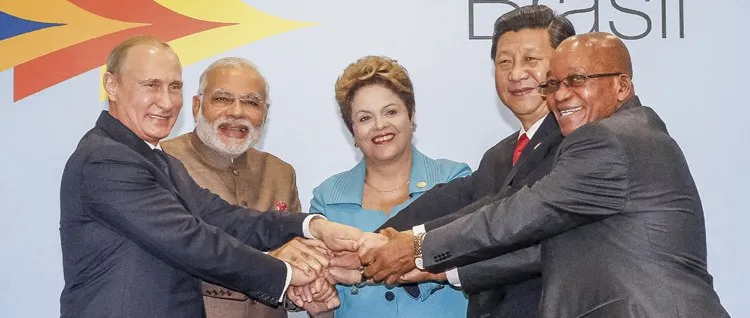
The city of Fortaleza, capital of the northeastern state of Ceará, was the stage for the 6th BRICS Summit. Held in July 2014, it marked the creation of the New Development Bank (NDB) and the Contingent Reserve Arrangement (CRA).
Paragraphs 11 and 12 of the Fortaleza Declaration specifically address the topic, which I cite in summary:
- The BRICS, as well as other emerging economies and developing countries, continue to face severe financing constraints to address infrastructure gaps and sustainable development needs;
- With this in mind, the leaders announce the signing of the “Agreement” constituting the New Development Bank, with the purpose of mobilizing resources for infrastructure and sustainable development projects in the BRICS and other emerging and developing economies;
- The Bank will have initial authorized capital of 100 billion dollars and subscribed capital of 50 billion, divided equally among the founding members; and,
- The headquarters will be in Shanghai (China); the first chairman of the Board of Governors will be from Russia; the representative of Brazil will be the first president of the Board of Directors; India appoints the Bank’s first president; and the African Regional Center will be established in South Africa.
It is worth highlighting a fundamental institutional characteristic which was the adoption of egalitarian governance where each founding country holds 20% of the shares and voting power, without the right of unilateral veto, in practice a radical contrast with the structure of the IMF and the World Bank, where the USA maintains veto power over strategic decisions.
4. NDB’s DNA – General strategies
During its ten years of operation, the “BRICS Bank” followed two General Strategies — 2017/2021 and 2022/2026 — which functioned as the institution’s five-year plans. Briefly, these strategies pursued the following objectives:
In the first strategic phase (2017–2021), the NDB focused on establishing itself as the BRICS development bank, structuring governance, operational capacity and access to capital markets, with an emphasis on infrastructure and sustainable development in the founding countries.
During this period, priorities focused on energy, transport, water and sanitation projects, consolidating environmental and social policies and creating a credit history that would qualify it to operate on a larger scale.
The General Strategy 2022–2026 marks the transition from the consolidation phase to an expansion stage, in which the NDB seeks to become a leading provider of infrastructure and sustainable development solutions for emerging economies and developing countries, with greater diversification of projects and instruments, including the expansion of non-sovereign operations with “subnational” entities, state-owned entities and the private sector.
There is a reinforcement of the alignment with the SDGs – Sustainable Development Goals defined by the UN -, the commitment to environmental and social sustainability and the expansion of operations beyond the BRICS, with new members and more intense cooperation with other multilateral banks.
Here the concrete goals are presented, namely: a) approve 30 billion dollars in financing; b) ensure that 40% of projects contribute to the climate; c) achieve 30% of operations in local currency, 30% in non-sovereign operations, 20% in co-financing and 40% of women in professional and managerial positions.
These objectives aim to strengthen the NDB as a credit instrument aimed at the financial autonomy of emerging countries and the construction of an alternative to the financial architecture dominated by the dollar and large Western banks.
5. Transition platform
In this first decade, the NDB proved to be the “bloc’s” most significant initiative to challenge the global financial architecture established at Bretton Woods, with numbers that accredit it as the central pillar of an alternative under construction.
By the end of 2024, the bank had approved approximately $40 billion in more than 120 projects. The active portfolio comprises 92 projects (24.7 billion dollars) distributed mainly in the transport (13.1 billion), energy (2.9 billion) and water and sanitation (2.4 billion) sectors. The project approval rate — 62.5% — contrasts with the IBRD’s exclusionary bureaucracy, demonstrating the technical feasibility of more agile governance.
Currently, around 25% of the NDB’s portfolio is made up of operations in the national currencies of member countries, and the goal is to reach 30% by 2026. In September 2024, the bank issued 1 billion South African rands (approximately US$57 million) on the local capital market, which received offers in excess of 2 billion rands. This initiative reinforces the strategy of increasing the use of local currencies in financing and reducing dependence on the dollar in economies in the Global South.
As the president of the NDB, Dilma Rousseff, emphasizes at the 10th Annual Meeting, the meaning of these operations is first and foremost political: the bank proves that it is possible to finance infrastructure, energy transition and social inclusion with governance based on equality between members, respect for national priorities and affirmation of the sovereignty of the Global South, in contrast to the conditional models of the Bretton Woods institutions.
6. Tensions, contradictions and challenges of a laboratory under pressure
However, the NDB’s trajectory is neither linear nor free from contradictions. Since 2022, the bank has confronted the central dilemma of any multilateral institution born on the periphery of the capitalist system: operating within the rules of the game it intends to contest.
A classic example is the “Russian question” which exposed the limits of institutional autonomy. Following the outbreak of the conflict in Ukraine and the avalanche of Western sanctions — which hit approximately two-thirds of the Russian banking system measured by assets — the NDB was forced to declare “formal” compliance with all restrictions imposed on Russia.
The new presidency, assumed by Dilma Rousseff in 2023, inherited the mission of keeping the institution functional without collapsing under pressure from the Western financial system. This meant, in practice, the suspension of new loans to Moscow, although the country maintains 20% of the shares and the right to have a say in strategic decisions.
This formal submission to sanctions exposes the limits of the current arrangement, but at the same time fuels the urgency of consolidating financing and settlement instruments that escape the coercion capacity of the current financial system.
The expansion of members – Bangladesh (2021), United Arab Emirates, Uruguay and Egypt (2023), in addition to Algeria, Uzbekistan, Colombia and Ethiopia in the final phase – expands the radius of action and legitimizes the NDB as a bank of the Global South. The challenge is to build operational convergences around “de-dollarization”, from financing to development with sovereignty.
Conclusion: from the laboratory to the systemic alternative
The NDB demonstrated that it is viable to build a multilateral financial institution on the margins of the dominant architecture — without neoliberal conditionalities, without unilateral veto power and with equal governance among the nations of the Global South.
This alternative is still in the consolidation phase, but it already shifts, in practice, part of the financial gravitation of the Global South outside the exclusive orbit of Bretton Woods, with cumulative effects on the hegemony of the dollar.
The transition from laboratory for architecture full depends on three convergent vectors:
– The consolidation of BRICS Pay as a payments infrastructure that reduces dependence on SWIFT and the dollar in intra-bloc commercial transactions;
– Fulfillment of the target of 30% of operations in local currencies and their qualitative expansion to reserve instruments; and,
– The ability to resist the pressures of the Western financial system without fragmenting the bloc’s internal cohesion.
The NDB together with the CRA, BRICS Pay, new exchanges – grains in particular – and investment platforms is, today, the most concrete proof that another financial architecture is possible.
Of course, the possibility needs to materialize, and, for this to happen, the next five years of the 2027-2031 Strategy will be decisive in determining how robust this institutional body will be.
Source: vermelho.org.br