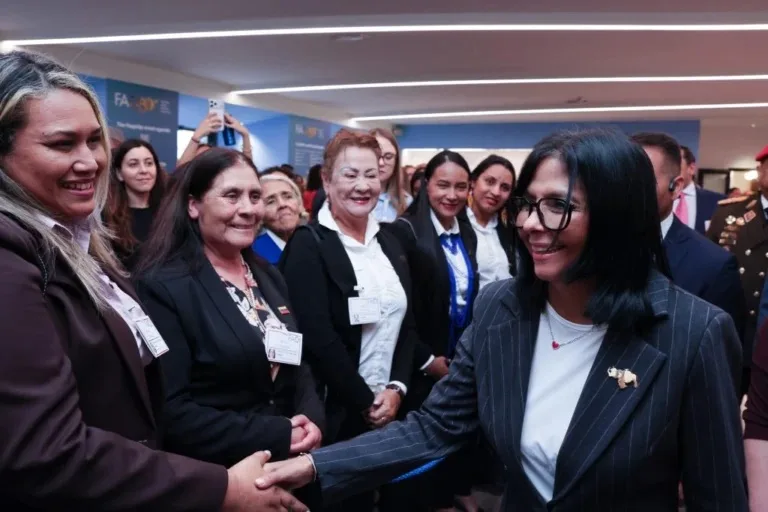
The interim president of Venezuela, Delcy Rodríguez, announced this Monday (12) the launch of the Venezuela Alimenta Plan, an initiative that seeks to coordinate the country’s various production processes with the aim of moving towards the eradication of hunger. The announcement was made at a meeting of the Food and Agriculture Organization of the United Nations (FAO).
“From this platform, I want to announce the Venezuela Feeds Plan, which aims to integrate all food production processes to achieve this supreme objective: zero hunger”, declared the South American leader, during her participation in the plenary session of the FAO World Food Forum, in Rome, Italy.
Delcy Rodríguez highlighted that Venezuela has proven experience in policies aimed at combating hunger. He also stated that the country is close to achieving this goal again, following political stabilization and the imposition of unilateral sanctions.
“Venezuela has a proven track record in eradicating hunger, recognized by the FAO. We are very close to achieving this feat again, with more robust social food programs and a great national effort”, she stated, indicating the eradication of hunger by the year 2030 as a goal.
She further stated that the country has overcome the shortages caused by external financial aggression to consolidate full food sovereignty and that it will formally present to the National Assembly a new Law for the Local Economy, a regulatory instrument designed to articulate the community, municipal and business sectors with the capabilities of the large national agri-food industry.
Currently, Venezuela has a state social protection network that guarantees daily nutritional assistance to more than 2.5 million children through the School Food Program (PAE), in addition to direct food coverage for more than 5 million Venezuelan families.
Energy and sustainable agricultural sovereignty
Delcy Rodríguez emphasized that the Bolivarian government’s strategy seeks to transform the country’s energy and oil wealth into a lever for agricultural development, emphasizing the urgency of the transition to a regenerative agriculture model that preserves soils and watersheds.
She also praised the recognition given by FAO, in the International Year of Women Farmers, to María Cantalicia de Torres, a farmer from the Venezuelan Andes and guardian of native potato seeds, as a “Food Hero”, representing the crucial role of rural women in preserving biodiversity and food sovereignty.
The World Food Forum, which brings together representatives from more than 130 countries and includes the participation of high-level delegations, runs until October 16. During the forum, developing countries will join their voices to demand the elimination of unilateral coercive measures and to promote international cooperation based on solidarity, social justice and respect for the sovereignty of nations.
with information from teleSur
Source: www.brasildefato.com.br