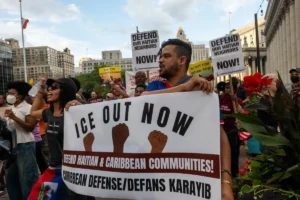
This Thursday (17), members of several educators’ organizations are mobilizing in Asunción and other parts of Paraguay, demanding better salaries, increased public investment in the sector, solutions to infrastructure problems and institutional support. They are also protesting against an agreement signed between the Ministry of Education and Sciences (MEC) and the Paraguayan Federation of Educators (FEP), which protesters consider an attempt to break union unity.
The strike, which includes marches to the Ministry of Economy and Finance, will keep up to 60% of the country’s public schools closed, according to union estimates.
The agreement between the Executive Branch and the FEP (Peruvian Teachers’ Federation) includes a 5% salary adjustment for the 2027 budget, with an addendum of US$47 million sent to the National Congress. Teachers demand a raise of 8% or more.
The package also includes US$9 million for teacher salary increases and 40 billion Paraguayan guaranis (more than US$6.7 million) destined to settle a historic debt owed by the Ministry of Education and Culture (MEC) to the Social Security Institute (IPS), accumulated since 2015.
Rejection of terms and enforcement claims
Although the signing of the agreement guaranteed the support of the FEP management, led by Silvio Piris, to set the minimum wage at 4,488,000 Paraguayan guaranis (around US$760), other sectors of the teaching class classified the negotiation as an “abrupt” and unilateral decision.
“Agreements are not made based on impositions. The government sought to impose the agreement on other unions without providing them with details so they could analyze them”, denounced Rafael Resquín, president of the Paraguayan Educators’ Union (UNE).
Resquín warned that the budget working groups suffered systematic delays throughout the year and that the mobilizations will seek to prevent the ratification of the agreed amounts through direct actions before parliamentary committees.
Teaching career and parliamentary lobbying
The signing of the addendum was attended by President Santiago Peña, Vice President Pedro Alliana and the Minister of Education, Luis Ramírez, who guaranteed that the agreement prioritizes the continuity of the school calendar.
The government promised to structure the design of the teaching career between the last quarter of this year and the first half of 2027, directing future salary increases towards continuous evaluation and meritocracy mechanisms.
The FEP itself clarified that it will not give up on the initial demand for an 8% adjustment and, therefore, will continue negotiations with legislators to increase the percentage defined during the discussion of the National Expenses Budget for 2027.
The marches that began in the capital, at Plaza Batallón 40, seek to exert political pressure in front of the government’s economic headquarters, while the conflict moves to the legislative headquarters.
Source: www.brasildefato.com.br