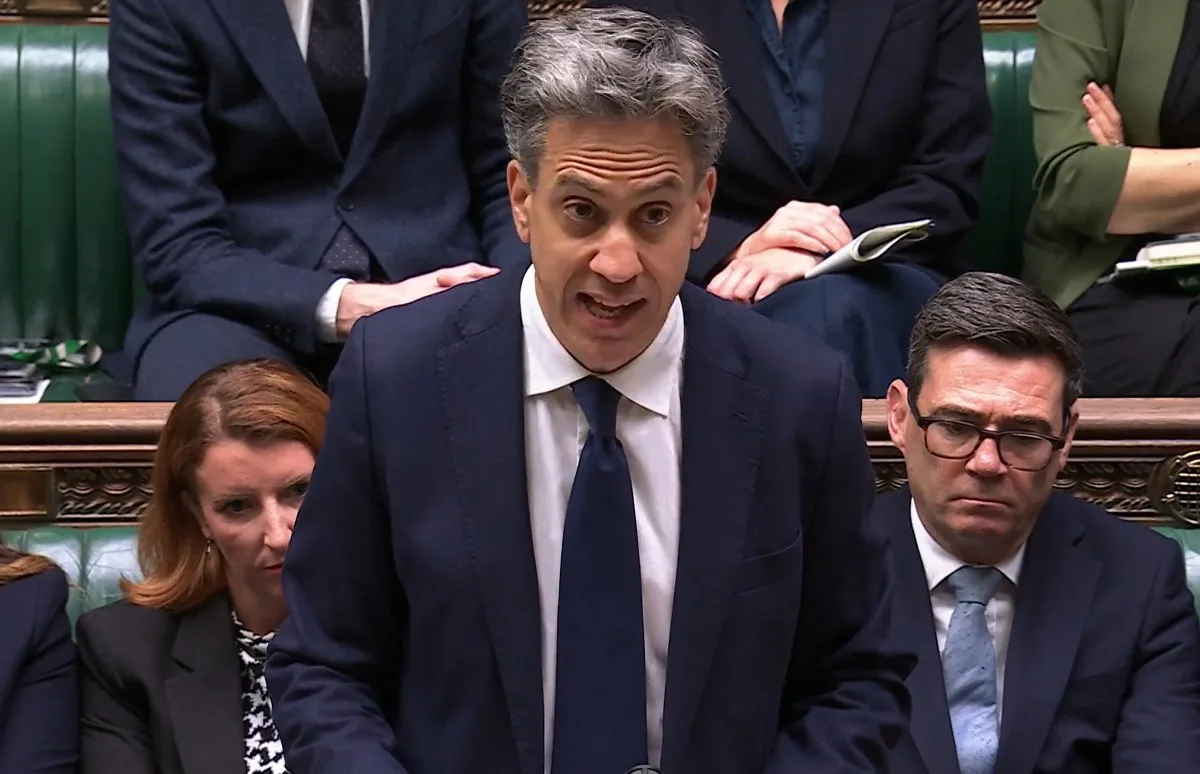
The United Kingdom announced this Tuesday (8) that it will ban the import of goods produced in illegal Israeli settlements in the occupied West Bank. Chancellor Ed Miliband detailed the measure in a session of the House of Commons, announcing sanctions against companies and individuals that provide services to the settlements.
When presenting the decision, Miliband criticized the Benjamin Netanyahu government. “The British government agrees that there is ethnic cleansing of Palestinians in areas of the West Bank, perpetrated by terrorist settlers,” he told parliamentarians. The chancellor also highlighted that London considers the Israeli occupation of Palestinian territory as a whole to be illegal. According to him, there is “a deep sense of shame for what unfolded in Palestine under the eyes of the international community”.
The veto affects products such as olive oil and wine exported from the settlements. The sanctions affect companies and people who support colonial expansion, prohibiting any advertising of illegal settlements. Furthermore, the government will deny export licenses for weapons that contribute to the occupation.
Final legislation could take a few months to be published, according to British parliamentarians, but Miliband has promised that sanctions will be immediate. Currently, around 770,000 settlers live in the occupied Palestinian territories. In the last four years alone, more settlements have been authorized than in the previous two decades.
Wide reach
The British measure is not isolated. Also this Tuesday (8), France announced that it will begin the process of banning products from settlements.
“France will put an end to its trade with Israeli settlements in Palestine, along with 11 other countries that have also made similar commitments,” wrote French Foreign Minister Jean-Noël Barrot in X. In addition to France and the United Kingdom, Spain, Ireland, Portugal, Poland, Denmark, Finland, Iceland, Norway and Sweden joined the rejection.
Barrot justified the decision. “Why are we doing this? Because the West Bank is about to explode. There is a frantic expansion of settlements, an increase in violence against Palestinians by extremist settlers and terrorist acts,” he said. The action is progressing outside the European Union, which, until now, has not achieved a qualified majority for a decision by the bloc. The main resistance force comes from Germany. Last year, France recognized the Palestinian state at a summit held before the United Nations (UN) General Assembly in New York.
In the early hours of this Tuesday (8), Israel reacted. The country’s Finance Minister, Bezalel Smotrich, even called for the expulsion of the British ambassador, while the official account of the Israeli Foreign Ministry personally attacked Miliband online. Last week, Foreign Minister Gideon Saar had warned that if France acted against Israel, there would be retaliation. President Isaac Herzog called the ban a “serious miscalculation.”
In the United States, Ambassador to Israel Mike Huckabee suggested that the Donald Trump administration could retaliate. He called the ban “discrimination against Jewish people,” citing Florida as one of the states that could directly retaliate against the United Kingdom. “The British have lost their minds,” Huckabee summed up.
Prime Minister Andy Burnham spoke with Donald Trump last Monday (7), taking the opportunity to discuss the government’s plans in the region. The British cabinet said the phone call served to emphasize “the importance of a two-state solution.” Internally, the measure has the support of more than 140 Labor deputies, while opinion polls indicate that support from the British population is majority.
The consequences of diplomatic tension reached the Falkland Islands. Israel’s Minister of National Security, Itamar Ben-Gvir, called on Netanyahu to recognize Argentine sovereignty over the archipelago and adopt sanctions against London.
“Not only are the British content to occupy the territory, but they also drill for oil there and steal money from the Argentine people,” he wrote in a post on X.
The island, located at the southern tip of South America, has been the subject of dispute for decades. In 1965, the UN General Assembly approved a resolution that classified the Falklands as a territory in a “pending colonial situation”, calling on Argentina and the United Kingdom to negotiate. Since then, the Decolonization Committee has renewed the request several times, which is routinely ignored by London.
Source: www.brasildefato.com.br