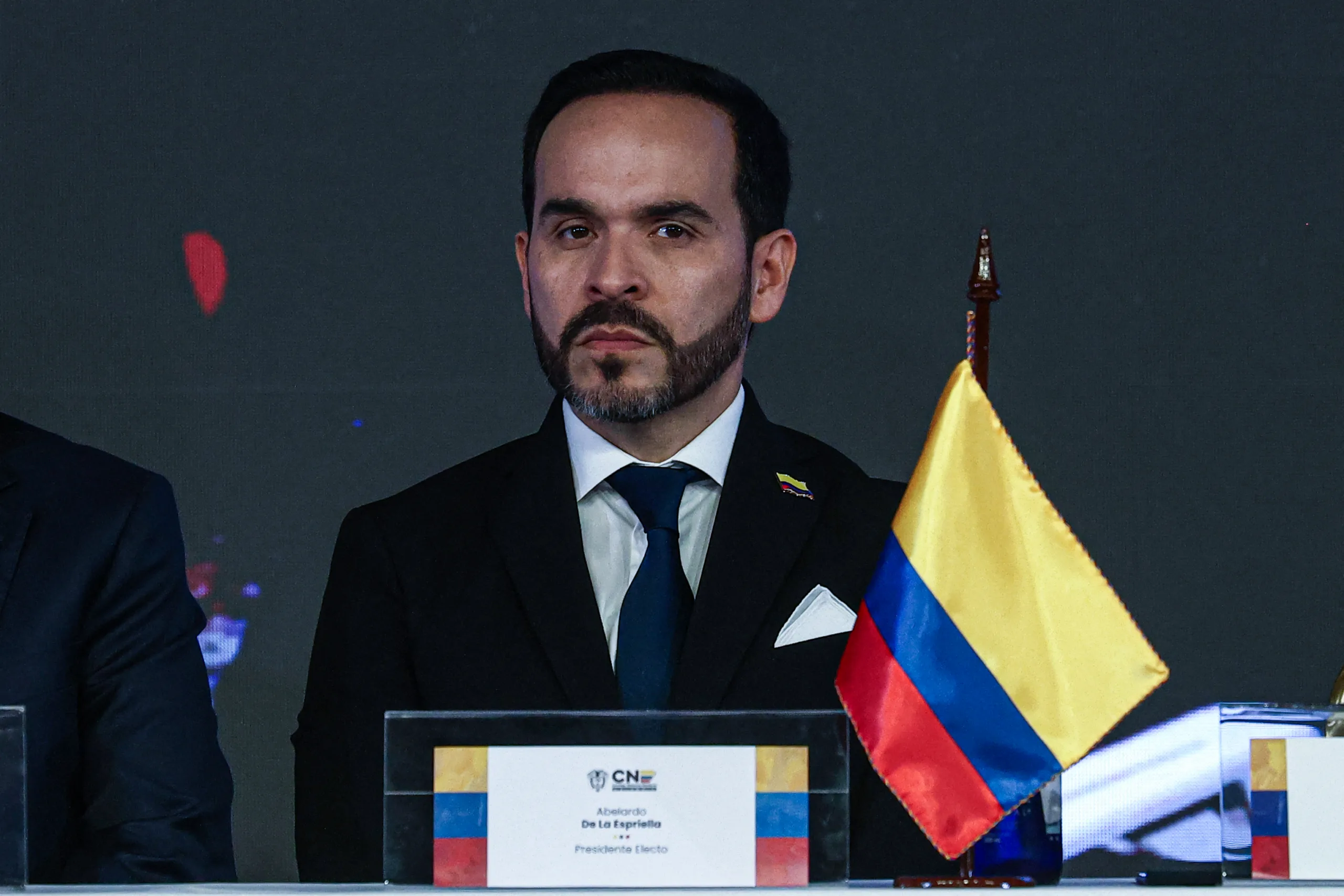
The 20 “Peace Broadcasters”, operated by Colombia’s Public Media System, interrupted their regular journalistic programming this week and began broadcasting only musical content from Bogotá, after the right-wing government of Abelardo de la Espriella ordered the suspension of journalistic and opinion programming in Colombian public media.
The imposed silence is a response to a directive issued by the entity’s new manager, Ángela María Mora, and guided by De la Espriella for a restructuring of content and infrastructure. The far-right president has expressed his intention to dismantle the Peace Agreement signed between the Executive Branch and the FARC-EP at the end of 2016, as well as some of the bodies responsible for its implementation, such as the Special Jurisdiction for Peace (JEP).
By deciding to dismantle a policy incorporated as a mandate in the Colombian Constitution, the mission of providing information to citizens, essential to safeguarding democracy, is being neglected.
The suspension of programming directly harms the most vulnerable social sectors: the thousands of victims of the internal armed conflict, peasants and signatories of peace treaties, whose realities, demands and productive projects generally do not find space or representation in traditional media agendas.
The suspension of news and opinion programming on radio and television was formalized after a meeting between Mora and the Minister of Information and Communication Technologies (ICT), Alexandra Falla. In this context, the right-wing government announced the end of what it defined as the State’s “propaganda apparatus”, in order to prioritize programming supposedly with a greater cultural and territorial presence, although to date it has been dedicated to broadcasting music and is not being used, for example, to share useful information about assistance to communities affected by the earthquake.
The “Peace Broadcasters” were conceived in point 6.5 of the Peace Agreement signed between the Colombian State and the FARC, with the aim of publicizing the progress of implementation, promoting the pedagogy of coexistence and offering informative spaces to the communities most impacted by the armed conflict, in municipalities such as El Tambo (Cauca) and Ituango (Antioquia).
“This was not organized nor is it intended to serve a political or ideological cause; it is intended to be a tool for communities, and we are making every effort, together with journalists and communities, to preserve, protect and ensure that it fulfills this purpose”, said Álvaro García, manager of RTVC (Public Social Communication System).
In turn, content coordinators and regional journalists warn that the suspension of territorial broadcasts goes against a constitutional commitment that transcends different periods of government.
“We were told that this is a temporary measure. However, our silence constitutes a direct violation of the Peace Agreement by the State. In municipalities like El Tambo, we are the voice and listener of the communities. We are committed to the signatories of the peace agreement, the victims of the conflict and social organizations”, explained Jessica Molano, content director at El Tambo radio.
They also expressed concern about the job security of around 105 fixed-term workers and highlighted the risk that broadcasters would lose their community focus in hard-to-reach regions.
Freedom of expression is in danger
The organizational structure of the public media operator (historically regulated by RTVC) is based on Decree 3912, of November 24, 2004, a regulation issued by the Presidency of the Republic that established the organization of the company as a company between public entities subject to the State Industrial and Commercial Companies regime.
In accordance with this regulatory framework, Radio Submanagement (article 6) has among its mandatory legal functions: planning, defining and contracting programming services for educational, informative, opinion and musical content for public network broadcasters.
Furthermore, it was tasked with carrying out studies to define the needs, preferences and expectations of radio listeners in the territories; monitor and verify the correct transmission of radio programming, ensuring the quality of audio recording and the administration of the national sound collection. Furthermore, it gives the General Management (Article 3) powers to direct the daily administration of the company, define working relationships, form working groups and hire professional, technical or artistic consultants to achieve its objectives.
In response to the situation, the Foundation for Press Freedom (FLIP) confirmed that it is monitoring the case and warned that it represents a danger to freedom of expression.
The “Peace Broadcasters”, developed by RTVC and Rádio Nacional de Colombia, were designed to operate with local content, education and monitoring of public policies in the territories, consolidating an information scheme with national and regional coverage.
In this way, De la Espriella begins to put into practice his plan to undermine the Peace Agreement and dismantle concrete achievements of the government of former president Gustavo Petro, such as — as announced by him — ending peace negotiations, bombing armed groups instead of dialoguing, resuming the fumigation of illicit plantations instead of involving peasant families in voluntary replacement programs and reducing the very State that now allows him to deal with the earthquake, despite improvisations and institutional disorganization.
The Peace Agreement outlined concrete agreements and measures in these thematic areas: 1) Towards a new Colombian countryside. Comprehensive Rural Reform, 2) Political Participation, 3) End of conflict, 4) Solution to the illicit drug problem, 5) Victims and 6) Mechanisms for ratification of the agreement.
Source: www.brasildefato.com.br