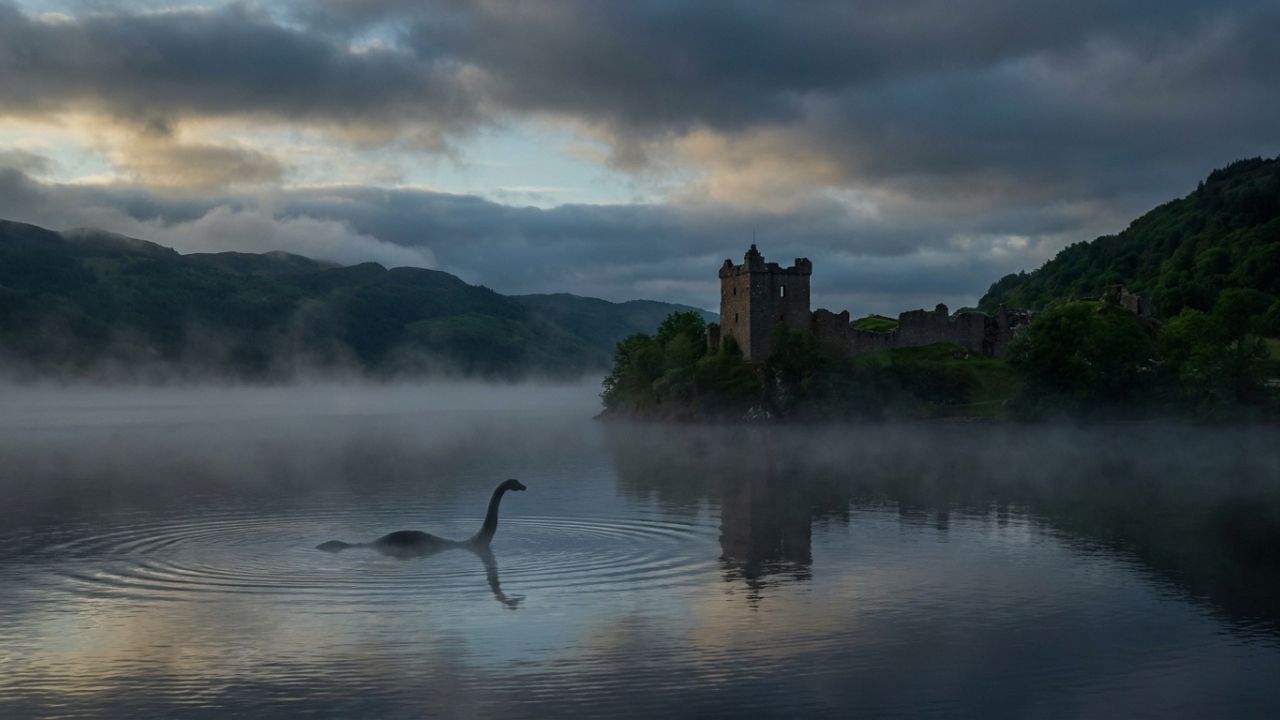
For nearly a century, the Loch Ness Monster has fascinated millions of people around the world. Stories of a mysterious creature lurking beneath the dark waters of Scotland’s most famous lake have inspired books, documentaries, scientific expeditions, and countless debates. While many believe “Nessie” is simply a myth, others remain convinced that something unusual lives in the depths of Loch Ness.
What makes this legend so enduring is not just the possibility of discovering an unknown animal. It is the combination of folklore, eyewitness accounts, unexplained photographs, advanced scientific investigations, and humanity’s endless fascination with mysteries that refuse to disappear.
So, what is the truth about the Loch Ness Monster? The answer is far more interesting than a simple yes or no.
🏞️ Where Is Loch Ness?
Loch Ness is located in the Scottish Highlands, southwest of the city of Inverness. Stretching approximately 23 miles (37 kilometers) long and reaching depths of more than 750 feet (230 meters), it is one of the largest freshwater lakes in the United Kingdom by volume.
The lake contains an enormous amount of water, more than all the lakes in England and Wales combined. Its dark appearance comes from high concentrations of peat washed down from the surrounding hills, making underwater visibility extremely limited.
These natural conditions have made Loch Ness the perfect setting for mysterious sightings. Even large objects can disappear into the murky water within just a few feet of the surface.
📜 Legends Older Than Modern History
Although the Loch Ness Monster became famous during the twentieth century, stories about mysterious creatures in the lake date back much further.
One of the earliest accounts appears in the sixth century. According to historical writings, the Irish missionary Saint Columba reportedly encountered a “water beast” while traveling through Scotland. The creature was said to have attacked a swimmer before retreating after Columba made the sign of the cross.
Whether this account represents history, religious symbolism, or folklore remains debated. However, it demonstrates that tales of mysterious creatures in Loch Ness existed long before photography or modern media.
Local legends over the centuries continued to describe unusual animals inhabiting Scottish lochs, adding layers to the growing mythology.
📸 The Photograph That Changed Everything
The modern legend truly exploded in 1934 with the publication of what became known as the “Surgeon’s Photograph.”
The black-and-white image appeared to show a long neck emerging from the surface of the water, resembling a prehistoric reptile. Newspapers around the world published the photograph, turning the Loch Ness Monster into an international sensation.
For decades, many considered it the strongest evidence that Nessie existed.
However, in the 1990s, participants admitted the image had been staged. The “monster” was actually a small model attached to a toy submarine.
Even after the hoax was exposed, the photograph had already cemented Nessie as one of the world’s greatest mysteries.
👀 Thousands of Reported Sightings
Since the 1930s, more than a thousand reported sightings have been recorded.
Witnesses have described many different appearances, including:
- A long neck rising from the water.
- One or more humps moving across the surface.
- Large wakes without visible boats.
- Dark shapes swimming beneath the lake.
- Massive creatures disappearing before they could be photographed clearly.
Interestingly, these reports often contradict one another. Some describe a reptilian animal, while others mention something resembling a giant seal, fish, or even floating logs.
This inconsistency makes it difficult for scientists to identify a single explanation for every sighting.
🔬 Scientific Expeditions Search for Answers
Loch Ness has attracted some of the largest wildlife investigations ever conducted.
Beginning in the 1960s, researchers deployed sonar systems capable of scanning large portions of the lake. Several unusual underwater echoes were recorded, sparking excitement among believers.
Later investigations used increasingly advanced technologies, including:
- High-resolution sonar.
- Underwater cameras.
- Autonomous robotic vehicles.
- Satellite navigation.
- Thermal imaging.
- Environmental DNA analysis.
Despite decades of searching, no expedition has produced definitive evidence of a giant unknown animal living permanently in the lake.
Scientists emphasize that extraordinary claims require extraordinary evidence, and so far, such evidence has not appeared.
🧬 Environmental DNA Brings New Clues
One of the most sophisticated investigations occurred in 2018.
Researchers collected hundreds of water samples throughout Loch Ness and analyzed environmental DNA, tiny genetic traces left behind by every living organism through skin cells, waste, mucus, and other biological material.
The results identified thousands of species, including:
- Fish.
- Birds.
- Amphibians.
- Mammals.
- Microorganisms.
- Plants.
No DNA belonging to large reptiles or prehistoric marine animals was detected.
Interestingly, scientists found a surprisingly large amount of eel DNA throughout the lake. This finding led some researchers to suggest that unusually large European eels could explain at least some reported sightings.
Although giant eels remain speculative, they are considered far more plausible than surviving dinosaurs.
🦕 Could Nessie Be a Dinosaur?
Perhaps the most popular theory suggests that the Loch Ness Monster is a surviving plesiosaur, a marine reptile that lived during the age of dinosaurs.
The resemblance between reported sightings and artistic reconstructions of plesiosaurs is certainly striking.
However, scientists point to several major problems with this hypothesis.
First, plesiosaurs became extinct approximately 66 million years ago.
Second, they were marine animals, while Loch Ness is a freshwater lake.
Third, the lake itself formed after the last Ice Age, meaning it is only around 10,000 years old.
Finally, maintaining a breeding population of large reptiles would require dozens, if not hundreds, of individuals. Such a population would almost certainly leave physical evidence, including bones, carcasses, or DNA.
For these reasons, paleontologists generally reject the dinosaur theory.
🌲 Natural Explanations for the Mystery
Many scientists believe that multiple natural phenomena contribute to Nessie reports.
Some of the most common explanations include:
Floating Logs
Trees saturated with water can remain submerged for years before suddenly rising to the surface as trapped gases build inside them.
Large Fish
Atlantic salmon, sturgeon, and exceptionally large eels can appear much larger than expected under certain viewing conditions.
Boat Wakes
Intersecting waves may create the illusion of moving humps traveling across the lake.
Optical Illusions
Fog, changing light, rain, and reflections can dramatically distort distances and object sizes.
Human Psychology
When people expect to see something mysterious, the brain naturally fills in missing details, a phenomenon known as expectation bias.
Rather than one single explanation, different sightings may result from different natural causes.
🎥 The Role of Media and Pop Culture
The Loch Ness Monster owes much of its global fame to newspapers, television, films, and now social media.
Every new blurry photograph or eyewitness report quickly spreads online, generating millions of views.
Documentaries often revisit the mystery with dramatic music and suspenseful storytelling, even while acknowledging the lack of conclusive evidence.
Nessie has also become an enduring symbol of mystery in popular culture, appearing in:
- Children’s books.
- Animated movies.
- Television series.
- Video games.
- Advertising campaigns.
- Tourist souvenirs.
For many visitors, the legend itself is more important than proving whether the creature exists.
💼 The Economic Impact of the Legend
The Loch Ness Monster has become one of Scotland’s most recognizable tourist attractions.
Every year, hundreds of thousands of visitors travel to the Highlands hoping to glimpse Nessie or simply experience the famous lake.
The local economy benefits through:
- Hotels.
- Restaurants.
- Boat tours.
- Museums.
- Gift shops.
- Guided excursions.
The legend supports millions of dollars in tourism revenue annually, making Nessie valuable even without physical proof.
Many local businesses celebrate the mystery while acknowledging that its greatest power lies in imagination.
🤔 Why People Still Believe
Even in an age of satellites, drones, and artificial intelligence, belief in the Loch Ness Monster remains surprisingly strong.
Part of this persistence comes from the enormous size and depth of the lake. Much of Loch Ness has never been observed continuously, leaving room for speculation.
Another factor is human curiosity. Throughout history, new species have occasionally been discovered in remote regions, reminding us that nature still holds surprises.
Finally, mysteries capture our imagination in ways that simple answers rarely do. The possibility, however small, that something unknown exists beneath the water keeps the legend alive.
🌍 What Scientists Say Today
The overwhelming scientific consensus is that there is no credible evidence supporting the existence of a large unknown creature living in Loch Ness.
Most researchers conclude that sightings can be explained by combinations of natural phenomena, mistaken identification, hoaxes, and psychological perception.
At the same time, scientists recognize the value of continued exploration. Research conducted while searching for Nessie has improved our understanding of freshwater ecosystems, environmental DNA, and underwater mapping technologies.
In this way, the search has contributed to science even without discovering a monster.
⭐ Final Verdict
The truth about the Loch Ness Monster lies somewhere between folklore and scientific investigation. While decades of research have failed to uncover convincing evidence of a giant hidden creature, the mystery continues to captivate people around the world.
Nessie represents more than a legendary monster. It symbolizes humanity’s desire to explore the unknown, question assumptions, and keep an open mind about the natural world.
Whether the Loch Ness Monster is an elaborate legend, a collection of misunderstood natural events, or something yet to be explained, one fact is undeniable. Nearly a hundred years after becoming a global sensation, Nessie remains one of history’s most fascinating mysteries, reminding us that sometimes the greatest adventures begin with a simple question: What if?