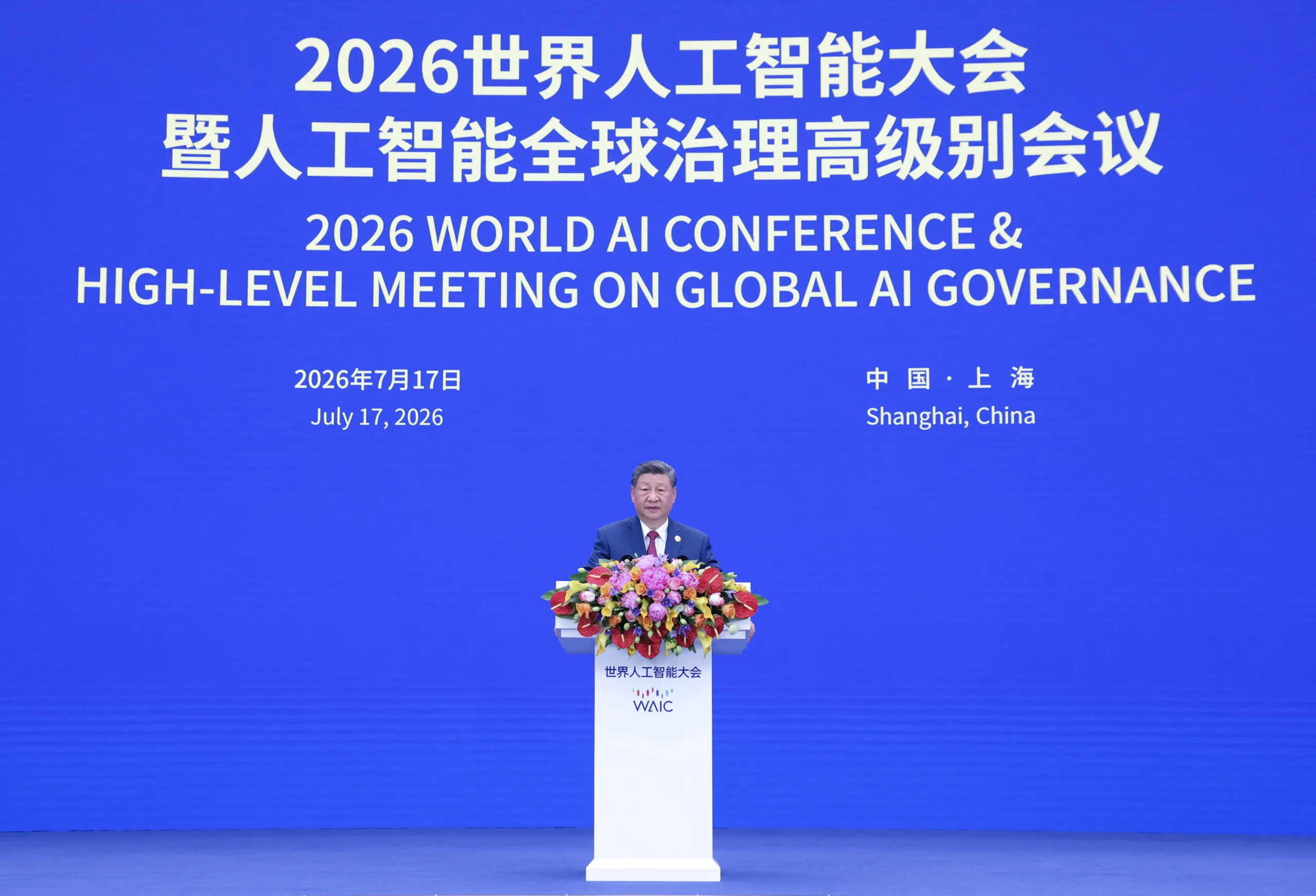
Chinese President Xi Jinping defended this Friday (17) “broad international cooperation” for countries in the Global South to strengthen their capabilities in artificial intelligence, to “close the digital and AI divide”, promote sustainable development and “avoid causing new historical injustice”. The speech opened this year’s World Artificial Intelligence Conference and the High-Level Meeting on Global AI Governance in Shanghai.
The conference, held annually since 2018, this year brought together the President of Kazakhstan, Kassym-Jomart Tokayev; the prime ministers of Cambodia, Hun Manet, and Thailand, Anutin Charnvirakul; and the UN Secretary-General, António Guterres. The opening also marked the signing of the agreement to create the World Organization for Cooperation in Artificial Intelligence, proposed by China in last year’s edition.
Training, regional centers and disaster alerts
Xi announced that, “to further support the global development of AI and promote global AI training”, over the next five years, China will offer 5,000 places in AI training programs and seminars to developing countries. He also announced that the country will build international cooperation centers in AI applications with Asean (Association of Southeast Asian Nations), the Arab League, the African Union, Celac (Community of Latin American and Caribbean States), OCX (Shanghai Cooperation Organization) and Brics.
The third measure is the extension of MAZU, a disaster early warning system based on artificial intelligence, to 30 countries. The acronym in English means Universal Alert for Multiple Hazards without Gaps, but the name, in Mandarin, is also that of the goddess of the seas who protects fishermen and sailors. Versions of the tool were donated to Djibouti and Mongolia during last year’s conference.
“China believes that all countries should adopt a people-centered approach and develop AI for positive and good. We should ensure that AI is an important driver of shared prosperity and common security. We should join forces to build a fair and equitable system for global AI governance,” Xi said of China’s approach to AI.
Challenges faced with increasing inequality
The Chinese president said that it is necessary to “join forces to build a fair and reasonable system of global AI governance”, and asked “How can we make AI for all a reality when inequality continues to increase?”.
As a result, Xi presented four observations. The first is taking advantage of “rarely seen historic opportunities to encourage open source, openness, collaboration and sharing.”
Secondly, the Chinese leader defended the need to “strengthen our awareness of risks and ensure that AI is safe and controllable”. AI must be “a trusted tool for humanity”, with laws, technological monitoring and warning and response systems that keep it “always under human control”. At the same point, Xi condemned the generalization of the concept of national security in the field of AI and the superimposition of “the security of one country over that of others”.
This is a criticism that China frequently makes towards the United States. In October last year, amid the trade war between the two countries, China’s Ministry of Commerce said in a statement that, “for a long time, the United States has excessively extended the concept of national security, abusing export controls, taking discriminatory actions against China, and imposing unilateral extraterritorial jurisdiction measures on various products, including semiconductor equipment and chips.”
The third observation argues that the development of AI does not erode the diversity of civilizations and that the values of technology are shaped “with the common values of humanity”. The fourth calls for the practice of “true multilateralism”, with recognition of the role of the UN and the construction, as soon as possible, of a global governance framework based on consensus.
Xi recalled that 2026 marks the beginning of the 15th Five-Year Plan and stated that the core industries of the country’s smart economy are already worth at least 1 trillion yuan (around R$780 billion).
The AI Conference in China
In the 2025 edition of the conference, Prime Minister Li Qiang proposed the creation of the global cooperation organization founded this Friday (17). In the same speech, the prime minister defended overcoming “bottlenecks” such as “the lack of cutting-edge computing chips” and restrictions on exchanges between companies and talent, in reference to the same barriers now criticized by Xi.
Li Qiang also criticized technological individualism when defending the collective construction of knowledge about AI. “Individual innovations are like scattered sparks, which can easily go out, while collective wisdom can ignite one another and set the prairie on fire,” said the premier, alluding to the Chinese proverb reinterpreted by Mao Zedong in 1930 in the letter “One spark can set the whole prairie on fire”.
Source: www.brasildefato.com.br