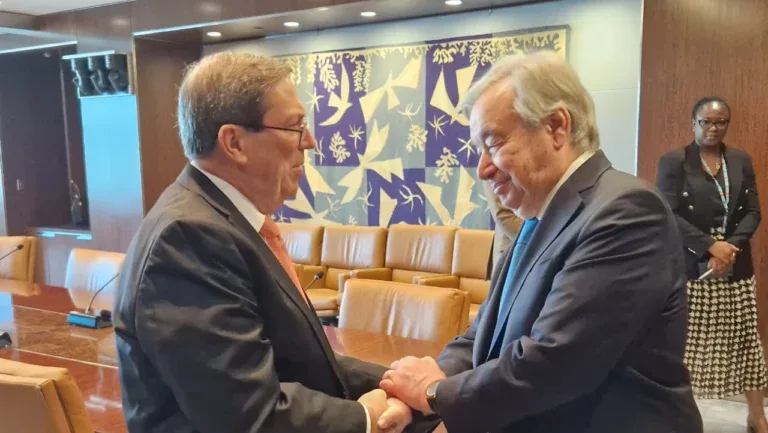
The Minister of Foreign Affairs of Cuba, Bruno Rodríguez Parrilla, recently met in New York with the Secretary-General of the United Nations, António Guterres, on which occasion he explained the reality that the Cuban people face daily due to unilateral coercive measures by the USA.
Rodríguez Parrilla denounced to Guterres the consequences of the strangulation policy promoted by the United States Government, characterized by a criminal energy siege, the intensification of the blockade and the application of secondary sanctions.
The meeting with Guterres took place as part of the Cuban representative’s visit to the US country for the United Nations General Assembly debate entitled “Need to put an end to the commercial and financial blockade imposed by the United States of America against Cuba”.
During the debate, the Caribbean nation’s chancellor reiterated that Cuba does not represent a threat to US national security and reported that the damage caused by the blockade between March 2025 and February 2026 totaled US$8.103 billion, bringing the accumulated cost to US$178.7 billion at current prices.
He explained that this policy generates unbearable blackouts that affect access to drinking water, food shortages and a deterioration in health that has raised infant mortality to 9.9 per 1,000 live births.
Regarding the survival probability of children with cancer, which fell from 85% to 65%, he said: “The trend coincides with the most difficult moments of the US lockdown,” adding that “the lockdown suffocates and kills.”
Cuba’s foreign minister declared at the United Nations that “the United States government is waging a multidimensional war against Cuba, which has become more brutal in the last seven months.” He added: “The energy embargo and naval blockade, which are acts of war, were added to this.”
The Minister of Foreign Affairs also denounced the existence of a multidimensional war that includes the harassment of US military oil tankers near the largest of the Antilles, in addition to threats of military intervention.
The request to examine the issue in plenary was supported by a majority of 136 votes in favor, overcoming the objections and procedural maneuvers presented by the US delegation, which, together with other countries, presented only nine votes against and 30 abstentions.
Source: www.brasildefato.com.br