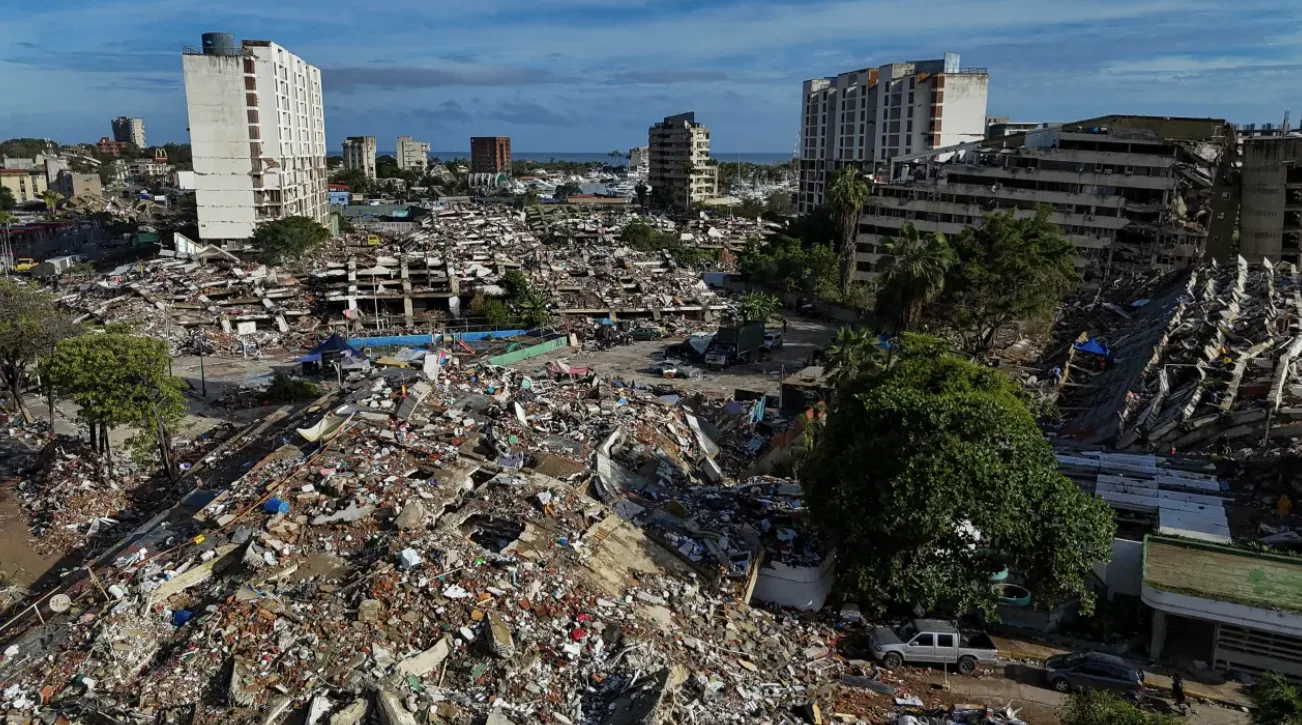
In Venezuela, the deaths from last Wednesday’s historic earthquakes (24) are already numbered in the thousands. There are 1,943, according to the most recent data confirmed by the president of the country’s National Assembly, Jorge Rodríguez. The number of injured has already exceeded 10,000, while the missing could reach around 50,000, according to projections by the United Nations (UN).
In the recent history of the neighboring country, no other tragedy has been of such magnitude. On the streets of the capital, Caracas, and in places like La Guaira — where Brazil even set up a hospital unit to assist with care —, solidarity shares space with the atmosphere of consternation.
A week after the two earthquakes of magnitudes 7.5 and 7.2, the answers are only provisional. It is not difficult to imagine that, despite the government’s efforts and international aid, it will take years for some of the missing to be found, as recognized by the UN, and for the structure to be reconstructed.
All of this would be especially difficult due to the tragedy itself. But, in the case of Venezuela, the problem is even bigger: for years the country has been plagued by sanctions that suffocate the economy, known as Unilateral Coercive Measures. How does maintaining the United States blockade, which already affects the Venezuelan structure, cause even more disruption at this time of unparalleled crisis?
For Laura Capote, from the Continental Operative Secretariat of ALBA Movimentos, “although the different rescue and emergency forces in Venezuela are working to ensure that the greatest number of people can leave alive, the Venezuelan people would have better conditions”, if it were not for the sanctions.
“The possible deteriorations, in terms of response capacity, are consequences of a blockade that has intensified against the Venezuelan people, in particular, and has deepened since the kidnapping of President Nicolás Maduro,” explains Capote.
For her, the signs of solidarity coming from the United States have a hypocritical streak. “Six months ago, what the United States was doing was bombing the city of Caracas, without caring that people were dying in the attacks,” he says.
Sanctions against Venezuela
Shortly after the earthquakes, the Donald Trump administration announced that it would suspend economic sanctions against the South American country for four months. Even so, the measure is limited “to transactions related to victim relief operations”, according to Washington. In practice, the mechanism will allow the processing and transfer of values to or from Venezuela. The decision includes the creation of a US$150 million fund to support international humanitarian organizations.
The European Union (EU), however, did not want to hear about unlocking. He preferred to separate things. Last Friday (26), the European bloc decided to help mitigate the effects of the earthquakes, but maintained the sanctions. Member countries are already sending humanitarian aid, while the Copernicus service has been activated to map disasters. “This is something separate from any other issue and any other policy”, summarized the European Commission spokesperson, Paula Pinho.
The United States has applied an extensive list of sanctions to Venezuela since 2006. That year, the George W. Bush government banned the sale of US-made weapons and military material to the country governed by Hugo Chávez. The argument was that Caracas was not cooperating in the fight against terrorism.
Years later, under the first Trump administration, Washington began to financially sanction names linked to the Venezuelan government. In the meantime, Barack Obama’s administration began to categorize Venezuela as a “threat to national security”, ordering the freezing of assets and bank accounts of members of the Venezuelan government.
Maduro’s first re-election, in 2018, made Washington tighten sanctions: Venezuelan government assets under US jurisdiction were frozen, while the oil company PDVSA and the Central Bank began to be sanctioned. Former President Joe Biden even softened the measures, in an attempt to compensate for losses in US oil imports in the context of the war in Ukraine. Back in power, Trump put an end to the licenses granted to international oil companies to operate in Venezuela, seeking to isolate the Venezuelan government once and for all.
To get an idea of the size of the damage, a survey of the Global South Insights and the Tricontinental Institute, based on research by Venezuelan actuary Yosmer Arellán, estimates that, with the sanctions, the South American country lost oil revenues equivalent to 213% of its GDP between January 2017 and December 2024. The loss reached a total of US$226 billion. The choice of Venezuelan oil as the main target was not for nothing: until 2017, oil revenue corresponded to 95% of the neighboring country’s export earnings.
With the restriction on exports, the Venezuelan State’s revenue was in short supply. Add to this the limitation on imports, in a tightening of siege that deteriorates Caracas’ ability to act in normal situations. In a context of humanitarian crisis like the current one, the power to respond to emergencies is almost exhausted.
Mark Weisbrot, American economist and co-director of the Center for Economic and Political Research, explains that a direct consequence of the sanctions has to do with the fact that banks tend to refuse or delay transactions to Venezuela, even those that may have been authorized. Financial institutions avoid running the risk of new sanctions.
“O Government Accountability Office [órgão de fiscalização] of the United States found that even humanitarian organizations were facing all kinds of difficulties operating in Venezuela because of the sanctions”, asserts Weisbrot, in conversation with the Brazil in fact.
“There are not as many hospitals, clinics, water and sanitation systems functioning. There is not as much fuel available, nor heavy equipment or spare parts. And a large part of the professional workforce, including healthcare, has left the country”, explains the economist.
Imperialist rule
United States unilateral sanctions form one of the most powerful tools of American foreign policy. Dominance over resources that should go to other countries has serious social consequences.
“In the first year of Trump’s sanctions, between 2017 and 2018, there was an increase of 40 thousand deaths, most likely attributable to the sanctions, because the economy at that time was improving and there was no other reason for it. And probably hundreds of thousands of people died as a result of these sanctions”, points out Mark Weisbrot.
Some numbers point to the extent of frozen values, which are in various parts of the world. “The Bank of England has around US$4 billion in gold that should be returned to Venezuela. The IMF issues what are called Special Drawing Rights (SDRs), which can be converted into cash. And Venezuela has around US$5 billion of that in the International Monetary Fund, and should have access to these resources”, ponders the economist.
According to Weisbrot, there is no reason to maintain the sanctions. “They are illegal, of course, and have been since the beginning, especially since 2015, and even before that. They are completely illegal under international law and under treaties that we have signed, including the Charter of the Organization of American States”, he denounces.
Impaired service
In 2021, UN special rapporteur Alena Douhan visited Venezuela and exposed the devastating effect of sanctions on health. In 2020 alone, during the pandemic, sanctions prevented the purchase of blood reagents for 2.5 million patients. Around 180,000 surgical operations could not be performed due to a mere lack of antibiotics and anesthetics. Only 20% of hospital equipment was in working condition, as Venezuela experienced difficulties in acquiring replacement parts.
The EU, in turn, has applied sanctions to Venezuela since November 2017. The measures include an embargo on weapons and equipment for repression, as well as the imposition of travel bans and freezing of individuals’ assets.
Last week’s earthquakes came at an especially critical time. Even though the Venezuelan Ministry of Health has activated a network of eight public hospitals in the metropolitan region of Caracas, in addition to private clinics, the sanctions have contributed and continue to contribute to a state close to collapse. Shortly before, in May, the Venezuelan Medical Federation (FMV) pointed out that 90% of the country’s hospitals were out of stock or abandoned. With supply issues, it is not uncommon for patients to bring their own medical supplies. If they have.
The horizon in Venezuela, among the ruins, is difficult to see. The Delcy Rodríguez government recognizes the importance of international aid. But the risk of “the possibility that the earthquake will be used as justification for the arrival of foreign intervention” cannot be ruled out, according to Laura Capote. “This is a major concern, at least to be aware of”, he points out.
Weisbrot, in turn, recognizes that momentary relief is important and maintains that this should be the time to put a definitive end to Washington’s unilateral measures. “In the US Congress and the Progressive Caucus [a ala mais à esquerda dos congressistas do Partido Democrata] There has been a growing movement of opposition to the imposition of these deadly and illegal sanctions. As the world becomes more multipolar, there will be more resistance to this”, points out Weisbrot.
Source: www.brasildefato.com.br