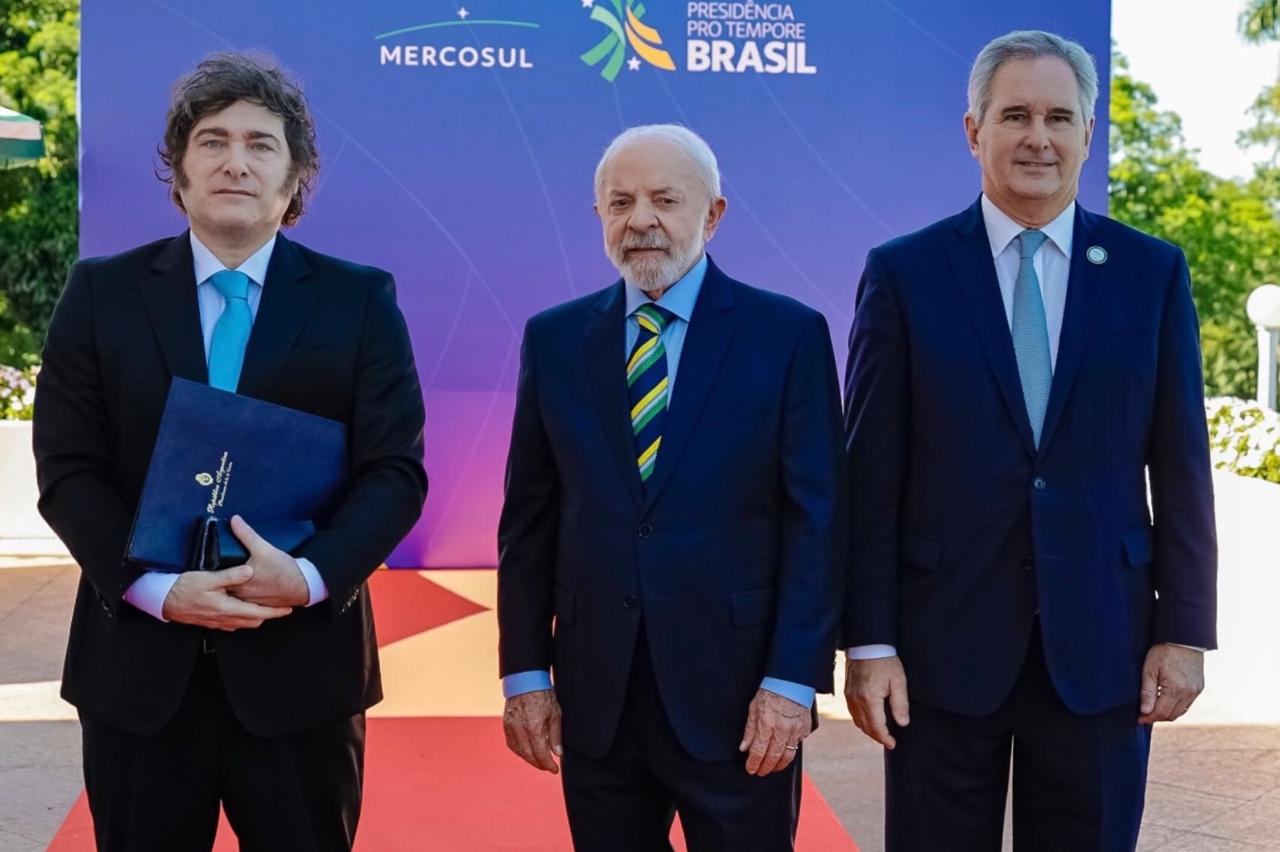
President Luiz Inácio Lula da Silva (PT) will participate, starting next Tuesday 30th, in the 68th Mercosur summit, in Asunción, Paraguay. The meeting marks the end of the Paraguayan presidency of the bloc and the transfer of the post to Uruguay.
Lula must find a political scenario resistant to multilateralism, given the presence of leaders such as Santiago Peña (Paraguay) and Javier Milei (Argentina), more accustomed to the political platform of American President Donald Trump.
In addition to those mentioned, presidents Yamandú Orsi (Uruguay), Rodrigo Paz (Bolivia), Daniel Noboa (Ecuador) and José Antonio Kast (Chile) must be present.
Planalto has not yet confirmed whether Lula will have bilateral meetings, but the Chilean government has already expressed interest in a meeting between Kast and the Brazilian president.
The main agenda of the meeting should be the agreement between Mercosur and the European Union (EU). After decades of negotiation, the treaty entered into force, but is still under provisional application. The European Parliament and the EU Court of Justice must still speak out about pockets of resistance coming from countries like France.
In any case, Washington’s more hostile stance towards multilateral agreements could catapult agreements between the South American bloc and other economies. Last week, Itamaraty confirmed that the United Kingdom can formalize an agreement with Mercosur.
Another country interested in forming a partnership with Mercosur is Japan, whose prime minister, Sanae Takaishi, had a recent meeting with Lula, on the sidelines of the G7 summit in France.
Presidency of Paraguay
Under the leadership of Santiago Peña, Paraguay focused on expanding trade agreements, countering the risk of the group’s disintegration. According to Mercosur, more than 360 technical and ministerial meetings were held in recent months.
Paraguay also promoted customs digitalization. As it is not among the bloc’s main economies – positions occupied by Brazil and Argentina –, Assunção managed to reactivate the Fund for Mercosur Structural Convergence (Focem), which serves as an instrument for compensation and regional development.
Despite the integrative bias, Paraguay did not escape the desire to liberalize the bloc, focusing its management on expanding treaties with extra-regional markets.
Venezuela
The humanitarian tragedy in Venezuela, which is facing the consequences of this month’s historic earthquakes, could be the agenda of the meeting. The country has been suspended from Mercosur since 2016. At the meeting in Asunción, leaders are expected to discuss support mechanisms for earthquake victims.
Source: www.brasildefato.com.br