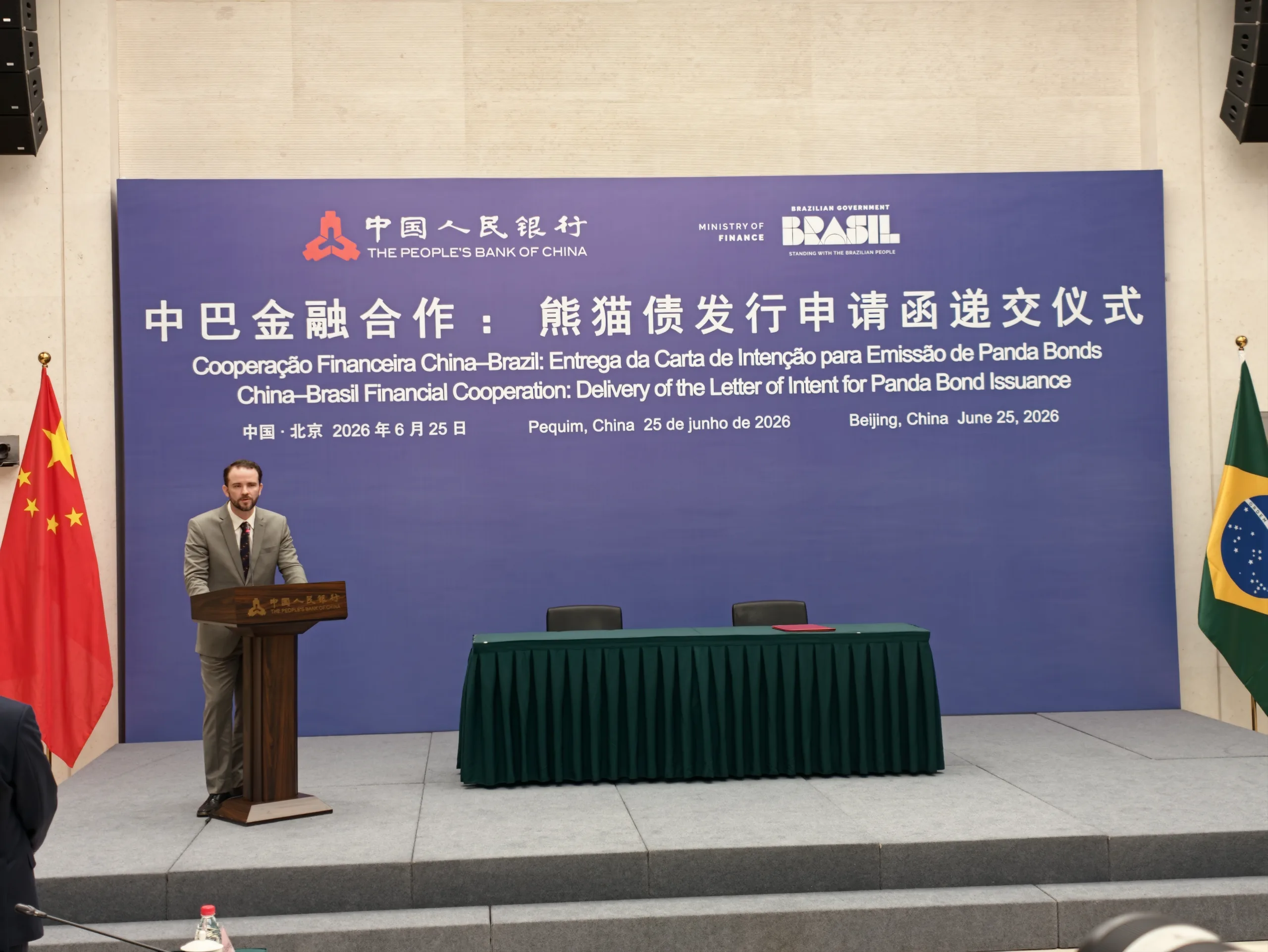
Finance Minister Dario Durigan stated that Brazil should start issuing the first panda bonds in the next two to three months. The statement was made at a press conference at the Brazilian Embassy in Beijing this Friday (26), one day after the formal delivery of the letter of intent to the president of the People’s Bank of China, Pan Gongsheng.
Panda bonds are debt in yuan, the Chinese currency, issued on the Chinese market by governments, companies or institutions outside China. Which means that the Brazilian government, in this case, will borrow money directly from Chinese investors. Brazil is the first country in Latin America to formalize this type of issuance.
“I hope that, in the next two, three months, we will issue the first issue,” Durigan said at the press conference. The government plans to raise up to 5 billion yuan (about R$4 billion).
Lower interest
The main advantage of issuing in the Chinese market is the cost. Interest on panda bonds is between 1.70% and 2.05% per year, less than half of what the Brazilian Treasury paid on recent issues in dollars, which reached 5.2% in five years and 7.5% in thirty years.
Pakistan issued its first sovereign panda bond in May and paid 2.5% per year, well below the interest it pays on dollar issues, according to the CGTN.
“What I notice is that, when we issue abroad, we end up paying less interest than when we issue domestically. So, if I can burden the National Treasury less by issuing abroad, why not do it?”, asked Durigan.
Diversification and path for companies
“Our objective is to diversify the matrix of those who hold Brazilian debt. In particular, look at the price”, stated the minister. Durigan explained that, by having references in different markets, the government is able to “test prices and see how the country’s credibility is in the rest of the world”.
Sovereign issuance also opens the way for Brazilian companies. By fixing Brazil’s price on the Chinese market, companies like Suzano, Vale and WEG can issue their own panda bonds more easily.
Suzano, from the cellulose sector, was the first Brazilian company to issue panda bonds, raising 1.2 billion yuan (around R$960 million) in October 2025, with interest rates between 2.55% and 2.90% per year.
In the debt market, the interest that a government pays works as a floor for all companies in the country: if the government manages to pay 2%, a company pays that 2% plus an additional amount for its risk. By issuing panda bonds, the Brazilian government is creating this floor in China, and other companies start to take on debt there from a cheaper basis.
Next steps
Before issuance, the National Treasury will complete presentation rounds to Chinese banks interested in purchasing the bonds. “I’ve just started doing this, so I’ve been with the major Chinese banks, which are the major banks in the world as well,” Durigan said.
The minister stated that the government has already filed the request with the People’s Bank of China and that the Chinese authorities “anticipate that everything is in order”.
Source: www.brasildefato.com.br