Every night, the Moon rises as one of the most familiar sights in the sky. It has inspired myths, guided travelers, influenced calendars, and fascinated scientists for centuries. To the casual observer, the Moon appears unchanged, faithfully circling Earth just as it always has. Yet a remarkable process is unfolding right now, one that is invisible to the naked eye but measurable with extraordinary precision.
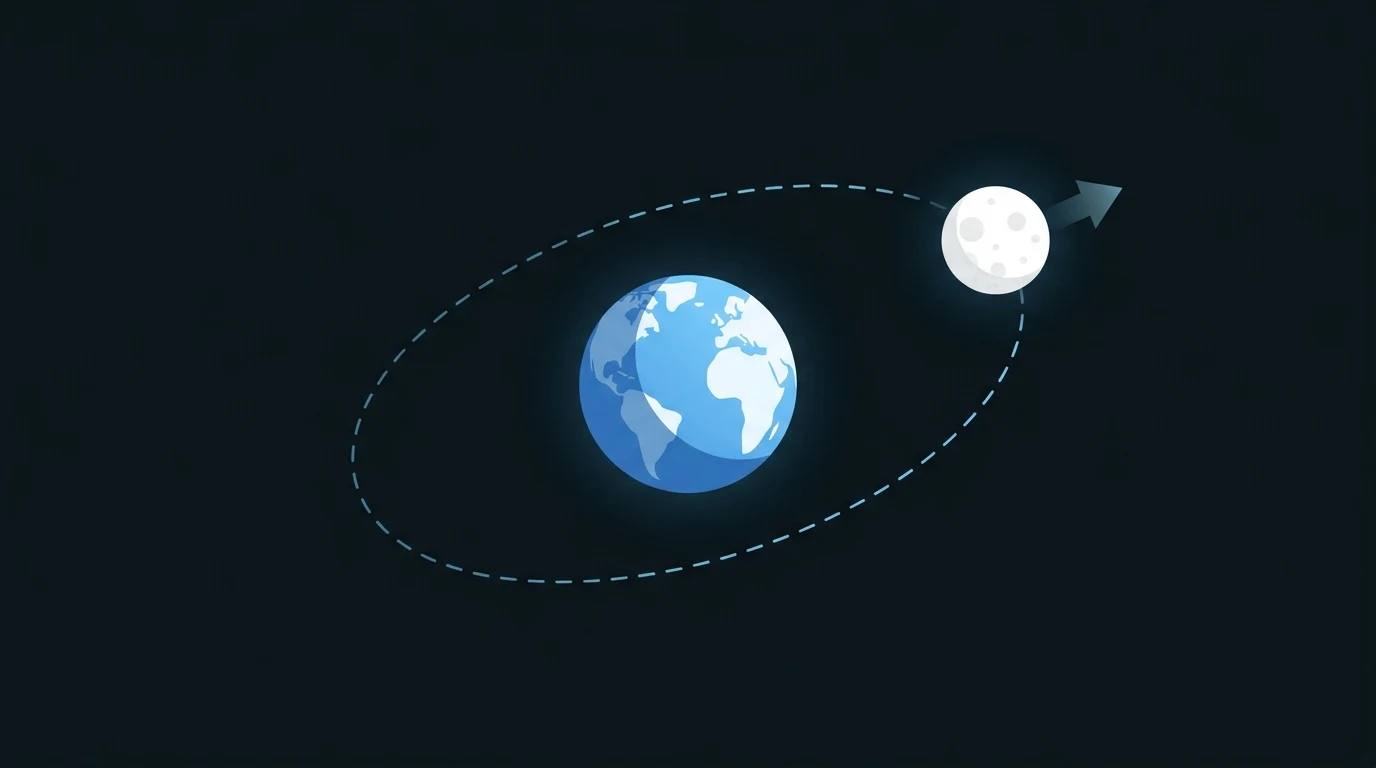
The Moon is slowly moving away from Earth.
This is not a theory or a speculative prediction. Scientists have directly measured the increasing distance between Earth and its natural satellite. The Moon is currently receding at an average rate of about 3.8 centimeters, or roughly 1.5 inches, every year.
That may seem insignificant. After all, 3.8 centimeters is about the width of two stacked coins. However, when this tiny annual movement is multiplied over millions and billions of years, the consequences become enormous.
The Moon was once dramatically closer to Earth than it is today. In the distant future, it will be even farther away. This gradual migration affects the length of Earth’s days, the strength of ocean tides, and the long-term evolution of the Earth-Moon system.
The story of the Moon’s retreat is a tale of gravity, energy, motion, and time. It is one of the most fascinating examples of how celestial bodies shape one another across vast stretches of cosmic history.
🌊 The Key Player: Earth’s Tides
To understand why the Moon is moving away, we first need to understand tides.
Most people know that the Moon influences Earth’s oceans. The Moon’s gravity pulls on our planet, creating bulges in the oceans. These bulges are what we experience as tides.
One side of Earth faces the Moon and experiences a gravitational pull that draws water outward. On the opposite side of the planet, another tidal bulge forms because the Earth itself is being pulled slightly more strongly than the water on the far side.
As Earth rotates, different regions pass through these bulges, creating the familiar cycle of high and low tides.
At first glance, tides might seem unrelated to the Moon’s orbit. In reality, they are the primary reason the Moon is gradually drifting away.
The connection lies in the fact that Earth rotates much faster than the Moon orbits.
Earth completes one rotation approximately every 24 hours. The Moon takes about 27.3 days to orbit Earth.
Because Earth spins faster, the tidal bulges are not perfectly aligned beneath the Moon. Instead, they are dragged slightly ahead of it.
This small offset creates a powerful and long-lasting gravitational interaction.
⚙️ How Earth Transfers Energy to the Moon
Imagine Earth as a spinning top.
As our planet rotates, friction between the ocean tides and Earth’s surface causes some of that rotational energy to be transferred elsewhere.
The tidal bulges, positioned slightly ahead of the Moon, exert a gravitational pull on the Moon. This pull effectively gives the Moon a tiny boost in its orbit.
When an object in orbit gains energy, it moves to a higher orbit.
As a result, the Moon slowly migrates farther from Earth.
This process is incredibly gradual, but it operates continuously. Every day, every year, and every century, Earth transfers a small amount of rotational energy to the Moon.
The Moon gains orbital energy and moves outward.
Earth loses rotational energy and spins more slowly.
This means the Moon’s retreat and the slowing of Earth’s rotation are two parts of the same process.
Scientists sometimes describe this as a cosmic exchange of angular momentum.
The Earth-Moon system conserves momentum overall, but energy is redistributed between Earth’s spin and the Moon’s orbit.
The result is a steadily increasing Earth-Moon distance.
🔬 How Scientists Know the Moon Is Receding
The idea that the Moon is moving away is not based solely on mathematical models.
It has been directly measured.
One of the most impressive experiments in modern science began during the Apollo missions.
Astronauts placed special reflective mirrors on the lunar surface. These devices, known as retroreflectors, are still functioning today.
Scientists on Earth can fire laser beams at these mirrors and measure the time it takes for the light to return.
Because light travels at a known speed, researchers can calculate the Earth-Moon distance with extraordinary accuracy.
The measurements reveal that the Moon is moving away from Earth at an average rate of approximately 3.8 centimeters per year.
This technique has been refined over decades and remains one of the most precise methods for studying the Moon’s orbit.
It provides direct evidence that the Earth-Moon relationship is changing.
What was once inferred from theory can now be observed in real time.
🦖 The Moon Was Once Much Closer
If the Moon is moving away today, then it must have been closer in the past.
Geological and astronomical evidence strongly supports this conclusion.
Scientists believe the Moon formed around 4.5 billion years ago after a colossal collision between the young Earth and a Mars-sized object often called Theia.
The impact ejected enormous amounts of material into space. Some of this debris eventually coalesced to form the Moon.
Shortly after its formation, the Moon orbited much closer to Earth than it does now.
The young Moon may have appeared several times larger in the sky than it does today.
Its gravitational influence on Earth would also have been dramatically stronger.
Ocean tides could have been hundreds of times more powerful than modern tides in certain regions.
The Moon’s close proximity likely played an important role in shaping Earth’s early environment.
Over billions of years, tidal interactions gradually pushed the Moon outward to its current average distance of about 384,400 kilometers, or roughly 238,855 miles.
The journey has been slow, but the cumulative effect has been enormous.
⏳ Earth’s Days Used to Be Much Shorter
The Moon’s retreat is closely connected to another fascinating phenomenon.
Earth’s rotation is slowing down.
Today, a day lasts about 24 hours.
Hundreds of millions of years ago, days were significantly shorter.
Evidence preserved in ancient rock formations suggests that around 620 million years ago, a day lasted approximately 21.9 hours.
Even farther back in time, Earth’s rotation was faster still.
In the distant past, our planet may have completed a full rotation in just a few hours.
The slowing occurs because tidal friction acts like a brake.
As Earth’s oceans move in response to lunar gravity, friction dissipates energy.
This process gradually reduces Earth’s rotational speed.
The change is tiny on human timescales, but measurable over geological periods.
As Earth slows down, days become longer.
At the same time, the Moon continues to drift farther away.
The two effects are permanently linked.
🌍 Why the Moon Matters So Much to Earth
The Moon is more than a beautiful object in the night sky.
It plays a crucial role in Earth’s stability.
One of the Moon’s most important functions is helping stabilize Earth’s axial tilt.
Earth is tilted by about 23.5 degrees relative to its orbit around the Sun.
This tilt is responsible for the changing seasons.
Without the Moon’s stabilizing influence, Earth’s tilt could vary far more dramatically over time.
Large fluctuations might produce extreme climate shifts and unpredictable environmental conditions.
Many scientists believe the Moon has contributed significantly to Earth’s long-term habitability.
The Moon also drives ocean tides, which influence marine ecosystems, coastal environments, and global circulation patterns.
Throughout history, tides have affected navigation, fishing, and human settlement.
In subtle but profound ways, life on Earth has evolved under the influence of the Moon.
🚀 What Happens as the Moon Continues Moving Away?
The Moon will not suddenly disappear.
Its retreat is extraordinarily slow.
Even after millions of years, the change will be modest from a human perspective.
However, on cosmic timescales, the effects become more significant.
As the Moon moves farther away:
- Tides will gradually become weaker.
- Earth’s rotation will continue slowing.
- Days will become slightly longer.
- The Moon will appear marginally smaller in the sky.
These changes occur so slowly that they are essentially imperceptible within a single human lifetime.
Future generations will see a Moon that looks almost identical to the one we see today.
Yet the process continues nonetheless.
The Earth-Moon system is still evolving.
🌞 Will the Moon Eventually Escape Earth’s Gravity?
A common question arises when people learn that the Moon is moving away.
Will it eventually drift off into space and leave Earth behind?
The answer is no.
At least not under the current dynamics of the Earth-Moon system.
The Moon is gaining orbital distance, but it remains gravitationally bound to Earth.
Eventually, scientists expect the system to approach a state known as tidal locking.
In this scenario, Earth and the Moon would become synchronized.
Just as the Moon currently shows the same face to Earth because it is tidally locked, Earth could eventually rotate at the same rate that the Moon orbits.
When that happens, the tidal interactions driving the Moon outward would largely cease.
The recession would effectively stop.
However, this outcome lies so far in the future that other cosmic events will likely intervene first.
The Sun itself is expected to undergo dramatic changes long before complete Earth-Moon synchronization occurs.
🔥 The Sun May Change Everything First
The future of the Earth-Moon system cannot be considered in isolation.
The Sun is also evolving.
In approximately five billion years, the Sun is expected to exhaust the hydrogen fuel in its core and enter a giant phase.
During this transformation, the Sun will expand enormously.
The inner solar system will be radically altered.
Exactly what will happen to Earth remains an active area of research, but the environment of our planet will become increasingly hostile long before that point.
As a result, the long-term fate of the Moon may ultimately be determined not by tidal evolution, but by the future evolution of the Sun.
The cosmic clock governing our solar system includes many interacting processes.
The Moon’s retreat is only one chapter in a much larger story.
📏 A Tiny Change With Massive Consequences
One of the most remarkable aspects of the Moon’s recession is the contrast between its rate and its impact.
A movement of just a few centimeters per year sounds trivial.
Yet over billions of years, it has transformed the architecture of the Earth-Moon system.
This highlights an important lesson in science.
Small changes accumulated over vast periods can produce extraordinary results.
The same principle shapes mountains, continents, climates, and even the evolution of life itself.
Nature often works slowly, but its patience is immense.
The Moon’s gradual retreat is a perfect example.
No dramatic explosion is pushing it away.
No sudden force is accelerating its motion.
Instead, a subtle exchange of energy unfolds day after day, year after year, over geological ages.
The result is a celestial migration that has been underway since the earliest chapters of Earth’s history.
🌌 The Bigger Picture
The Earth-Moon relationship offers scientists a valuable laboratory for understanding how planetary systems evolve.
Tidal interactions are not unique to Earth and the Moon.
They occur throughout the universe.
Many moons orbiting giant planets experience similar effects.
Some exoplanets orbiting distant stars may also undergo tidal evolution that alters their climates and orbital characteristics.
By studying the Earth-Moon system, researchers gain insights into broader cosmic processes.
The principles governing our nearest celestial neighbor help explain phenomena occurring across the galaxy.
This is one reason the Moon remains a central focus of scientific investigation.
Despite being humanity’s closest companion in space, it still has much to teach us.
🌕 Conclusion
The Moon is slowly moving away from Earth because of a long-term exchange of energy driven by tides. Earth’s rotation creates tidal bulges that pull slightly ahead of the Moon, transferring rotational energy into the Moon’s orbit. This process causes the Moon to gain orbital distance while Earth’s spin gradually slows.
Today, the Moon recedes by about 3.8 centimeters each year. Although the change is tiny on human timescales, it has reshaped the Earth-Moon system over billions of years. The Moon was once much closer, Earth’s days were shorter, and tidal forces were far stronger.
Far from being a static feature of the night sky, the Moon is part of a dynamic and evolving partnership with Earth. Their gravitational dance continues to influence tides, planetary rotation, and the stability of our world.
Every time we look up at the Moon, we are witnessing a companion that is quietly, steadily, and almost imperceptibly moving farther away. It is a reminder that even the most familiar objects in the universe are never truly standing still.