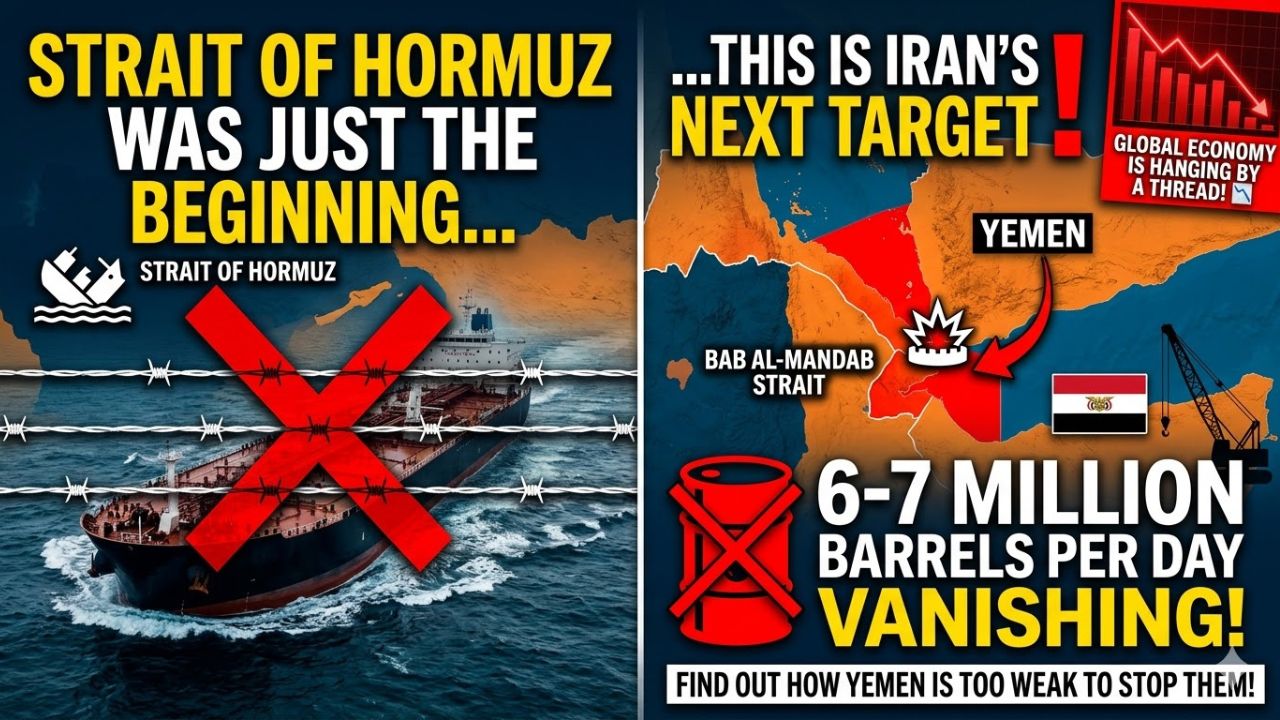
The global economy is currently facing what could become the largest supply blockade of the 21st century. With the critical Strait of Hormuz already closed, Iran has escalated geopolitical tensions by threatening to block a second vital maritime route: the Bab el-Mandeb Strait.
The Trigger for a Blockade The warning stems from an anonymous source linked to the Iranian Revolutionary Guard, which was reported by the Iranian news agency Tasnim and echoed by CNN International. According to this source, Iran is prepared to open “surprise fronts” and block the Bab el-Mandeb Strait if the United States or Israel attempts a land invasion of Iran, attacks Iranian islands, or conducts hostile naval movements in the Persian Gulf and the Sea of Oman. The US has allegedly considered targeting Kharg Island, prompting Iran to heavily reinforce its military defenses in the area and vow retaliation if attacked.
The Strategic Importance of Bab el-Mandeb Located between the Horn of Africa and the Arabian Peninsula, the Bab el-Mandeb Strait serves as a crucial connection between the Red Sea and the Gulf of Aden, bordering Yemen and Eritrea. It is a massive artery for global energy, with 6 to 7 million barrels of oil per day and significant quantities of liquefied natural gas (LNG) passing through it.
A blockade here would severely disrupt the Suez Canal route, which is essential for supplying Europe. Furthermore, it would cripple the distribution of oil and gas to major economies in Asia, severely impacting countries like Japan, South Korea, Taiwan, and India, which rely heavily on resources traversing the Red Sea.
A 32% Chokehold on Global Oil The mathematical reality of this threat is staggering. Approximately 12% of the world’s total oil supply passes through the Bab el-Mandeb Strait. When combined with the 20% of global oil that traditionally flows through the Strait of Hormuz, a simultaneous closure of both straits would effectively choke off 32% of the global oil supply. Such a scenario would virtually nullify passage to the Middle East for energy resources, aggravating an already severe global economic and oil crisis.
How Iran Plans to Execute the Blockade Given the geographical distance between Iran and the Bab el-Mandeb Strait, a direct blockade by Iranian naval forces would be complex. However, Iran does not need to act directly. Instead, it relies on the Houthi rebels in Yemen.
While the internationally recognized Yemeni government is allied with Saudi Arabia, it is comparatively weak. The Iran-backed Houthis, on the other hand, wield significant power and maintain precise control over the region surrounding the strait. The Houthis have already demonstrated their capabilities and allegiance to Iran’s broader network by launching their own attacks against Israel in support of Gaza. Through this powerful proxy, Iran has both the will and the credible capability to turn its threat into a reality.
If the US and its allies push forward with military action against Iranian territory, they risk triggering an unprecedented logistical and energy nightmare.