Published 01/08/2026 13:35 | Edited 01/09/2026 13:39
The death of Renee Nicole Good by an ICE agent, the immigration police, sparked protests in Minneapolis and other cities in the United States this Wednesday (7).
The reaction comes amid the intensification of the offensive against immigrants by the Donald Trump administration, which increased the presence of federal agents in cities governed by Democrats.
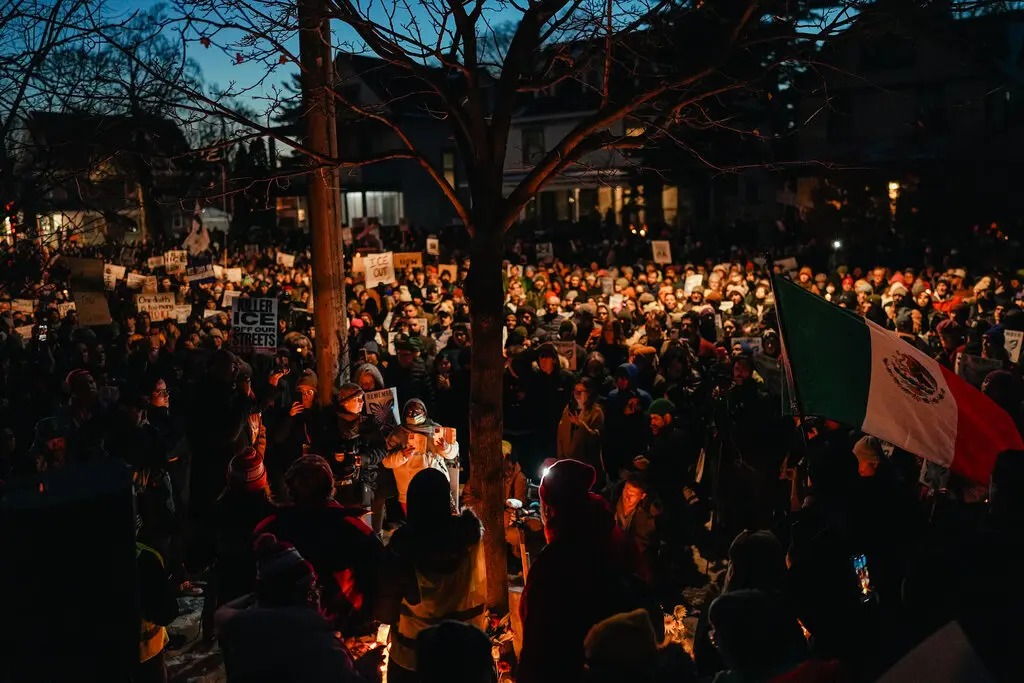
In Minneapolis, protests began on Wednesday night, just hours after the death of Renee Nicole Good was confirmed.
Initially, thousands of people gathered near the scene of the shooting, in the south of the city, for vigils and demonstrations against ICE’s actions. Protesters occupied nearby streets, chanted slogans against the immigration police and displayed signs demanding an end to federal operations.
Amid the concentration, agents from ICE and federal forces were harassed and ended up repelled by the population, with records of protesters throwing snowballs towards the police.
In response, security forces used pepper spray and tear gas to disperse part of the protest.
As the night progressed, the mobilization decreased from thousands to a few hundred people, concentrated at improvised memorials with candles, flowers and messages in honor of the victim.
The escalation of tension led state and municipal authorities to repeatedly ask that the demonstrations remain peaceful, given the risk of escalating the confrontation.
Minneapolis Mayor Jacob Frey stated that one of the city hall’s first decisions was to demand the immediate removal of federal agents from the scene.
“The priority was to remove ICE from the scene. There were dozens, if not hundreds, of ICE agents and federal forces on the scene at the time. Their presence was only causing more chaos. Being there only made a difficult situation even more problematic — a situation that, yes, was of their own making,” he stated.
Governor Tim Walz warned that the federal government could exploit any escalation of clashes as a pretext to expand repression and military presence in the city, evoking the precedent of the 2020 protests after the murder of George Floyd, which occurred less than two kilometers from the location of the new episode.
Walz said he issued an “alert order” to prepare the Minnesota National Guard, explaining that there are soldiers in training and ready to be mobilized “if necessary,” while also defending the right to demonstrate.
“I want Minnesotans to hear this directly from me: the desire to take to the streets to protest and tell this administration how wrong it is is, at this time, a patriotic duty, but it needs to be done safely,” he said.
“I feel their anger, I’m angry too. They want a show, we can’t give them that,” Walz added.
Protests spread to other cities and increase national pressure against ICE
The reaction to ICE’s actions went beyond the borders of Minnesota and led to demonstrations in different cities across the United States throughout Wednesday, increasing the political weariness of the Trump administration in the face of the ongoing anti-immigration offensive.
In New York, hundreds of people gathered outside an ICE office in Lower Manhattan, where they protested the operations and denounced the use of lethal force by federal agents.
The event was attended by community leaders and local politicians, who warned of the increase in immigration raids.
There were also demonstrations in Chicago, especially in the Little Village neighborhood, where protesters demanded an end to ICE actions in residential areas and associated immigration repression with the rhetoric of criminalization promoted by the White House.
In California, demonstrations and vigils took place in cities like Altadena, with residents displaying signs against the actions of the immigration police and demanding accountability from the agents involved. Records of similar protests circulated on social media in other urban centers, indicating a coordinated response from civil society.
Civil rights organizations and local authorities began to treat the protests as part of a national reaction to the escalation of ICE operations, pointing to the episode in Minneapolis as a symbol of the risks posed by the tough policy adopted by the Trump administration.
Source: vermelho.org.br