Published 12/19/2025 19:16 | Edited 12/19/2025 19:59
In 1823, James Monroe announced to the world the idea of “America for Americans.” It sounded like protection against European empires, but it carried, between the lines, a silent warning to the neighbors to the south: someone would start watching their backyard. Time revealed that “Americans”, in that phrase, had a very specific meaning.
Decades later, the promise of continental sovereignty was transformed into a doctrine of guardianship. What began as a diplomatic speech became a recurrent practice of intervention, direct or indirect, whenever a Latin American government dared to step outside the path accepted by Washington.
Read also: US surrounds Venezuela with greatest military power ever seen in Latin America
The smile of good neighborliness
In the 20th century, Franklin Roosevelt updated the old principle with the so-called good neighbor policy. Fewer rifles in sight, more cinema, music, loans and cultural influence. It was the time of soft power: convincing before imposing. But the diplomatic smile did not erase the central logic — that of containing political projects that challenged North American hegemony.
When persuasion failed, other methods came into play.
The invisible hand
Founded in 1947, the CIA became the preferred instrument of this mechanism. Often far from the spotlight, the agency operated behind the scenes in Latin America, mixing espionage, propaganda, political financing and military support.
In Brazil, this invisible hand gained clear contours in 1964. Operation Brother Sam, which even mobilized an aircraft carrier, was the external life insurance of the coup that established the dictatorship. The message was clear: when democracy threatened to contradict strategic interests, it became disposable.
Scam labs
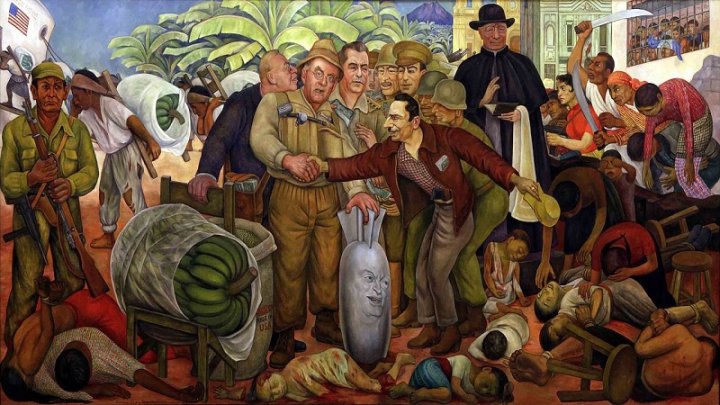
Guatemala was one of the first successful trials. In 1954, the progressive government of Jacobo Árbenz fell after an operation that combined military bribery, disinformation campaigns and diplomatic pressure. According to William Blum, author of ‘The Cia: A Forgotten History’, the method became a manual for future interventions.
In what was then British Guiana, the recipe was repeated: financing of opponents, political instability and the weakening of Cheddi Jagan, elected on a popular platform. It wasn’t yet the Cold War at its height, but the script was already being rehearsed.
Cuba, or permanent trauma
With the Cuban Revolution, interventionism gained obsession. Embargos, sabotage, assassination attempts and the failed Bay of Pigs invasion made up a chapter that historian Michael Grow, professor at Ohio University, in his book US Presidents and Latin American Interventions, would define as “a perfect failure”. Still, the episode consolidated the US’s willingness to go to the limit to prevent a socialist project from prospering on the continent.
Tailor-made dictatorships
In the 1960s and 1970s, logic spread. In Ecuador, Peru, Chile, Uruguay, Argentina, the CIA was present — training security forces, financing campaigns, legitimizing coups. In Chile, millions of dollars helped pave the way for the fall of Salvador Allende and the rise of the bloodthirsty Pinochet. In Argentina, Kissinger’s “green light” was echoed in thousands of forced disappearances.
The rhetoric was always the same: fighting communism, defending order, protecting the free world. The result too: interrupted democracies, traumatized societies, generations marked by fear.
A story that insists on returning
In the Dominican Republic, troops remained until 1966 to ensure that political change did not get out of control. Episodes like this make up a mosaic that crosses decades and borders, linking coups, dictatorships and interventions under the same common thread.
Today, when new tensions arise on the continent, historical memory imposes itself. Latin America learned, the hard way, that the discourse of protection was almost always accompanied by the practice of domination. The shadow of interventionism is long — and continues to be cast over the present.
Source: vermelho.org.br