Published 04/12/2025 11:37
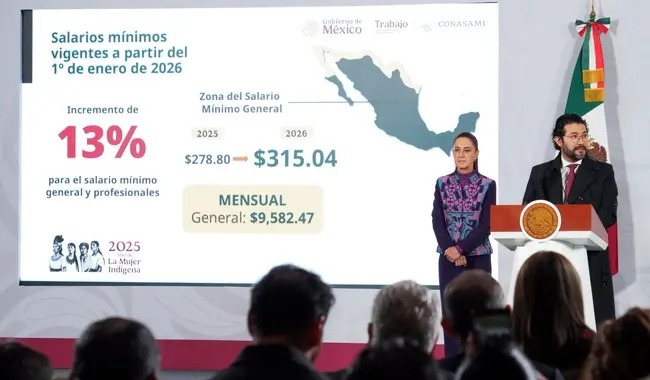
The Mexican government announced this Wednesday (3) a 13% increase in the minimum wage from January 2026, increasing the value from 278.80 pesos per day (R$80.90) to 315 pesos per day (R$91.45), the equivalent of 9,582 pesos per month (R$2,785).
The agreement was concluded at the National Minimum Wage Commission (Conasami) with the participation of the government, the employer sector and trade unions. This is the highest real level of minimum wage since 1980, according to data from the Labor Department.
In the North Border Free Zone, the adjustment will be 5%, with the floor going from 419.88 daily pesos (R$122.00) to 440 daily pesos (R$128.00). The measure meets the goal established by the government of guaranteeing the equivalent of two basic food baskets in the region.
The Ministry of Labor reported that, also on the northern border, the value exceeds the historical record recorded in 1976.
President Claudia Sheinbaum stated that the agreement between the government, workers and business community “is very good news for all Mexicans” and rejected any inflationary impact of the measure.
According to her, the nominal increase does not affect domestic prices and occurs in a context of inflation within the central bank’s target of 3% with a margin of one percentage point. Sheinbaum also refuted criticism that the adjustments could drive away investment.
“Contrary to what was said, there is more foreign investment,” he declared.
Labor Secretary Marath Bolaños classified the new floor as the greatest recovery in purchasing power in more than four decades.
In real terms, the new minimum wage overcomes the process of income erosion accumulated throughout the neoliberal period, a cycle that lasted from 1982 to 2018 and encompassed the governments of Miguel de la Madrid, Carlos Salinas de Gortari, Ernesto Zedillo, Vicente Fox, Felipe Calderón and Enrique Peña Nieto, marked by privatizations, accelerated commercial opening and income stagnation.
Bolaños explained that the general minimum has accumulated a recovery of 154.2% since 2018. The ministry estimates that 8.5 million workers will directly benefit.
The economic team reported that the new value increases the ability to purchase essential foods.
With the readjusted floor, a worker will be able to purchase 7.1 kilos of beans, 6.5 kilos of eggs and 14.8 kilos of tortillas, according to Mexico City accounts. The government maintains that this policy, combined with the anti-inflation package and the agreement to limit the price of gasoline, has contributed to lifting 13.5 million people out of poverty since the beginning of the political transformation cycle in 2018.
Authorities point out that, since 2018, lower-income workers have had accumulated increases of 204% on the northern border and 115% in the rest of the country. These numbers are often cited by the government as evidence of a change in the labor and distribution model.
The announcement was attended by business and union leaders, such as the Labor Congress, Coparmex, Conasami and the Confederation of Industrial Chambers.
Francisco Cervantes, president of the Business Coordinating Council, emphasized that the negotiation took place in an institutional manner.
For him, the dialogue took place “within the channels of the rule of law and respect for the pillars of the Mexican economy”, among which he cited formal employment, workers’ rights and legal security for companies and investments.
The government interprets this position as a sign of accommodation between capital and labor in a period of economic slowdown.
Mexico recorded a 0.3% drop in GDP in the third quarter, influenced by the adverse global environment and the Donald Trump administration’s tariff threats in the United States.
Sheinbaum’s economic team maintains that the readjustment policy strengthens domestic demand and offsets the effect of external shocks, especially in a country that still leads the OECD ranking in hours worked per person per year.
In the same announcement, Sheinbaum confirmed the sending to Congress of a project to gradually reduce working hours, which will go from 48 to 40 hours per week by 2030.
The proposal foresees reductions of two hours per year from 2027 and depends on approval in 2026, when the Legislature will have a government majority. The decision was presented as a continuation of recent labor reforms, which extended vacations from six to 12 days and extended rights to digital platform workers.
According to the government, the change aims to bring Mexico closer to international standards. Sheinbaum mentioned Nordic experiences that reduced working hours to up to 36 hours, associating the practice with productivity gains.
Bolaños reinforced that the Mexican transition will be gradual to avoid abrupt costs for companies and allow adaptations in the services sector. The official estimate is that 13.4 million workers will benefit from the reduction.
Source: vermelho.org.br