Published 11/19/2025 10:58 | Edited 11/19/2025 12:22
China expanded its diplomatic offensive against the government of Prime Minister Sanae Takaichi after the Japanese leader’s statements about Taiwan, triggering a crisis that began to involve formal protests, public warnings, pressure at the UN and travel guidelines that affect economic sectors in both countries.
The crisis between the South Asian powers reached a new level after Beijing accused Sanae Takaichi’s government of violating 1972 commitments and threatening Chinese sovereignty.
The offensive began after Takaichi declared, in the Diet plenary, that a possible Chinese action against Taiwan could constitute a “situation threatening to survival” and authorize the activation of Japan’s right to collective self-defense.
The expression, used by the Japanese military in the 1930s and 1940s to justify external aggression, was taken up by the conservative leader as a hypothesis for possible Japanese involvement in the event of a maritime blockade imposed by Beijing.
Chinese Foreign Ministry spokesperson Mao Ning classified the statements on Wednesday (19) as “erroneous statements” that undermined “fundamentally the political basis of China-Japan relations” and warned that, if Tokyo does not back down, Beijing will adopt “strict and resolute countermeasures”.
According to her, all consequences “will be borne by the Japanese side”.
In Tokyo, Ambassador Wu Jianghao presented a formal protest to Vice Minister Takehiro Funakoshi last Friday (14).
The diplomat claimed that Takaichi “threatened force, called for war and crossed China’s red line”, refusing to retract even after official protests. For Wu, the stance represents a violation of international law, the one-China principle and the commitments signed in the bilateral documents of 1972, 1978, 1998 and 2008.
China activates Security Council and invokes post-war order to isolate Tokyo
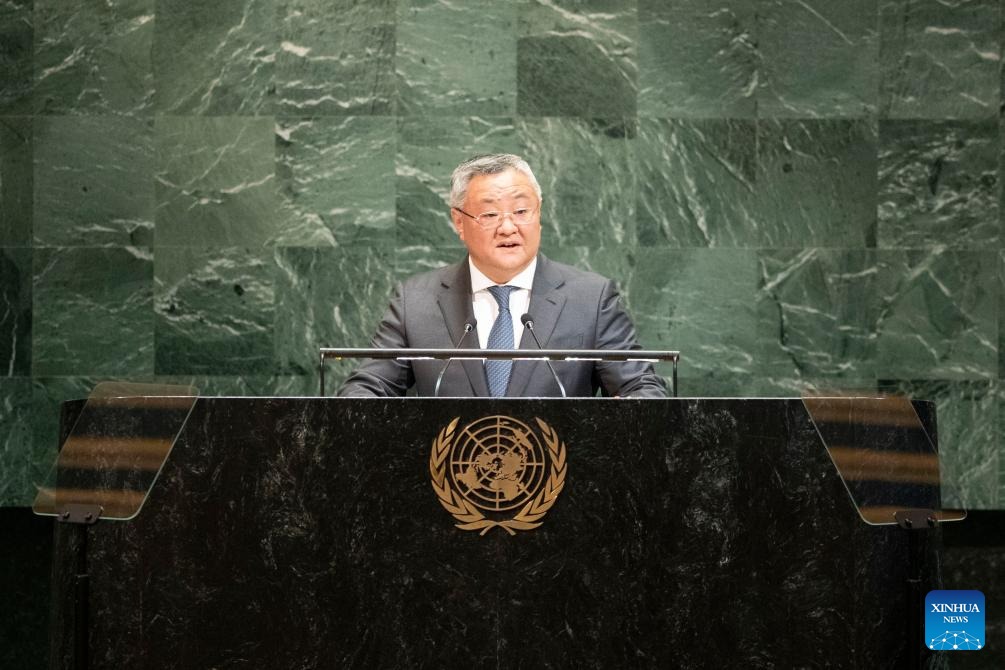
The crisis gained a multilateral dimension this Tuesday (18) when the Chinese ambassador to the UN, Fu Cong, stated that Japan is “totally unqualified” to seek a permanent seat on the Security Council.
In a speech to the General Assembly, he accused Takaichi of “defying international justice”, “damaging the post-war order” and “treading the path of militarism again”.
Fu recalled that the four political documents that govern bilateral relations — the 1972 Joint Declaration, the 1978 Peace and Friendship Treaty, the 1998 Declaration of Cooperation and the 2008 strategic agreement — form a set of binding obligations that Japan would be breaking by considering military intervention in Taiwan.
For Beijing, security on the island is a domestic issue and the core of Chinese core interests.
The People’s Daily newspaper, the official organ of the Communist Party of China, reinforced this historical framework this Wednesday by stating that Tokyo must “face the consequences” of its actions.
The text commemorated the 80th anniversary of the defeat of Japanese militarism in World War II and returned to the theme of atrocities committed during colonial rule in Taiwan.
According to the editorial, reviving militaristic rhetoric violates Japan’s commitment to normalizing relations with Beijing.
In parallel, state media began to present Takaichi as a leader who “invokes militaristic demons”, in a direct reference to symbols from the Japanese imperial period.
Travel warnings, economic impact and military movements raise immediate tension between countries
Political deterioration quickly translated into economic and security effects. China has advised its citizens against traveling to Japan, leading more than ten Chinese airlines — including Sichuan Airlines — to offer full refunds until the end of the year and suspend routes.
In Japan, shares of companies dependent on Chinese tourism fell, and sectors are already calculating the losses linked to the interruption of the flow of visitors.
In the cultural sector, China suspended the premieres of Japanese films, a measure that CCTV classified as “prudent” due to the adverse diplomatic environment. Tokyo, in turn, advised citizens residing in China to exercise caution, avoiding crowds and interactions outside known environments.
On the military front, the dispute gained a new layer after Japan mobilized F-15 fighters to monitor Chinese J-11 aircraft and announced the presence of a TB-001 drone near the island of Yonaguni.
The Chinese coast guard has stepped up patrols off the Diaoyu/Senkaku islands, while Tokyo has reported a Chinese Navy missile vessel passing near its waters.
The combination of warnings, naval movements and exchange of accusations raised the perception of risk of an unplanned incident — especially in areas where Japan and the United States carry out joint exercises.
Internal criticism grows in Japan and exposes Takaichi’s isolation
The Japanese prime minister’s rhetorical toughening did not go unchallenged within the country itself. In an interview with Xinhua, researcher Yuki Izumikawa, from the University of Okinawa, classified the statements as “extremely harmful” and “seriously dangerous”.
For him, the speech broke a historical consensus. “No previous government has officially stated that the Taiwan Strait could trigger the right of collective self-defense, it said
Izumikawa stressed that Okinawa and nearby islands would be “battlefields” if Japan became militarily involved in the region. “It wouldn’t be Japan being drawn into the war — it would be Japan actively entering it,” he said.
The position echoes criticism published in Tokyo Shimbunwho classified Takaichi’s speech as “reckless and careless”. Civil society groups organized protests and Japanese internet users began to question the prime minister’s “diplomatic competence”.
The Japanese colonial history in Taiwan — beginning with the Treaty of Shimonoseki in 1895 — is mentioned as a factor that intensifies the sensitivity of the Chinese population to any Japanese declaration on the island.
For Japanese progressive sectors, Takaichi’s stance deteriorates the country’s international position and increases vulnerabilities, especially in regions such as Okinawa, home to American bases and a likely target in the event of conflict.
Japanese attempt to ease crisis meets firm resistance from Beijing
Seeking to contain the damage, Japan sent Masaaki Kanai, director-general of the Department of Asian and Oceanic Affairs, to a meeting with Chinese diplomat Liu Jinsong in Beijing. The conversation, however, produced no progress. “The atmosphere was solemn,” said Liu, who reiterated his demand that Japan “retract erroneous statements and stop creating incidents.”
Beijing also ruled out any possibility of a meeting between Li Qiang and Takaichi at the G20 summit.
The decision deepens Japanese diplomatic isolation at a time when China seeks to expand its geopolitical influence and reiterate the principle that the Taiwan issue is an “exclusive issue for the Chinese people”.
On the Washington-Tokyo axis, the United States government reaffirmed that it will defend Japan in the event of an attack on the Senkaku Islands, which Beijing classified as a “political spectacle with ulterior motives”.
Historical memory, strategic dispute and risk of military incident define new stage of crisis
The set of declarations, diplomatic protests, explicit threats and economic pressures reveals that the dispute is no longer a one-off. China frames it as a direct violation of the post-war order and as a Japanese breach of legal commitments made half a century ago.
For Beijing, Tokyo broke a pact that had sustained bilateral stability since 1972: recognizing that Taiwan is part of China and refraining from any action that could be interpreted as interference. For Takaichi, on the contrary, the “crisis of survival” places Japan on the side of the United States in a hypothetical conflict across the Straits.
At the center of the dispute is a strategic dilemma: how far can Japan go in relaxing its pacifist Constitution without being accused of reviving 20th century militarism — and how far China is willing to go to prevent this movement.
With simultaneously diplomatic, military, historical and economic tensions, the conflict enters a stage of increased risk. One message stands out in each of Beijing’s statements: “The China of today is not the China of the past.”
Source: vermelho.org.br