Published 11/18/2025 09:24 | Edited 11/18/2025 11:40
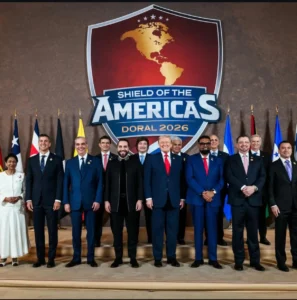
Brazil has become “the strongest test” of Donald Trump’s strategy to expand United States control over the Western Hemisphere. The assessment is from the New York Times, which this Monday (17) described the actions of the US president’s government as a new stage of the so-called Donroe Doctrine.
For journalist Jack Nicas, who wrote the report, this doctrine operates as “a set of punishments and rewards” aimed at framing Latin American governments, favoring allies and isolating countries that resist Washington’s agenda — and it was precisely during the Lula government that the strategy found its greatest limit.
According to the NYT, the difference in relation to previous phases of US foreign policy is the abandonment of ideological justifications, such as anti-communism or defense of democracy.
The current logic would be “purely pragmatic”, aimed at maximizing North American influence, guaranteeing privileged access to strategic resources and expanding the range of economic action of US companies.
In this context, Trump has applied tariffs, pressured elected governments, expanded military operations and resumed coercion mechanisms that directly affect Latin American sovereignty.
The article mentions that the actions function as an update of the old Monroe Doctrine, formulated in 1823, which sought to block European presence on the continent. In 2025, the declared target is China, increasingly present in the region through investments, infrastructure and trade agreements.
For the Trump administration, containing Chinese influence requires reconfiguring alliances, defining zones of influence and using economic and military instruments to force accession.
At the same time, the newspaper points out that politics is not just rhetoric. It materializes in concrete measures, such as sanctions, 100% tariffs against specific governments, direct pressure on internal processes in other countries and military interventions in the Caribbean and the South American coast.
In this redesign, Brazil occupies the most sensitive position — and, according to the NYT, the most strategic — to measure the limits of the North American offensive.
50% tariff was used to try to interfere in the process against Bolsonaro
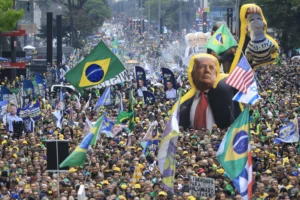
The central point of the article is the explicit accusation that Trump used 50% tariffs and new sanctions as a way of interfering in the progress of the legal process against Jair Bolsonaro.
“But Brazil represents the strongest test of Trump’s approach. In July, he hit the country with 50% tariffs and sanctions in an effort to stop the Brazilian government’s criminal prosecution of former President Jair Bolsonaro, a Trump ally,” the text reads.
The pressure came directly from Trump, who treated Bolsonaro’s conviction as an attack on a political ally. The offensive included public statements, hostile diplomatic communication and the sudden imposition of tariffs, which affected strategic sectors of the Brazilian economy. According to the newspaper, the objective was “not to let the process move forward”.
The Lula government’s response was the opposite of what Washington expected. Instead of giving in, the president publicly criticized the interference and reinforced that the Brazilian justice system acted independently.
The article highlights that, after the episode, Lula rose in the opinion polls, while the US government saw its initial pressure lose support in the US Congress itself.
The immediate outcome was unfavorable to Trump. The attempt to protect Bolsonaro failed and, weeks later, the former Brazilian president was definitively convicted.
According to the NYT, the White House found itself isolated in the offensive and the political cost of the pressure ended up being greater than the eventual benefit, revealing the limits of the Donroe Doctrine when applied to a country of great regional weight with strong leadership.
After failure, Trump retreats and seeks rapprochement with Lula
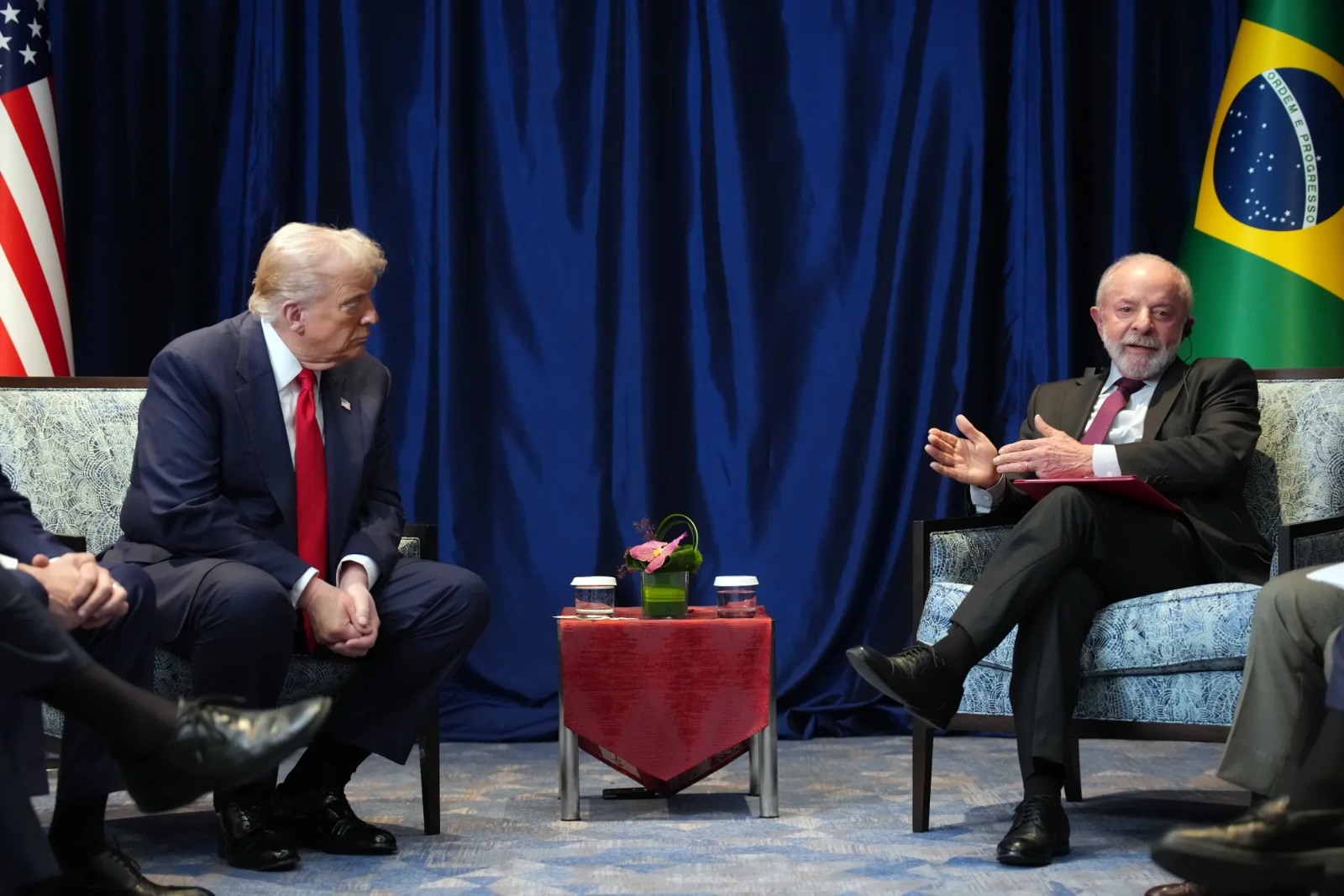
Faced with failure, the Trump administration abruptly changed its stance. According to the NYT, the Republican met with Lula a few weeks after Bolsonaro’s conviction and declared that he “liked” the Brazilian president — a gesture that marked an immediate end to the escalation of hostility.
It is at this point that the newspaper identifies Brazil as the “strongest test”: the country resisted, did not give in and the North American government was forced to change course.
The article also states that the US and Brazil have begun negotiations to suspend the tariffs, although sectors close to Trump still defend some form of pressure as a bargaining mechanism.
The NYT emphasizes that the sudden approach does not necessarily mean a change in strategy, but rather recognition that a policy of direct coercion did not produce the expected result.
For analysts interviewed by the newspaper, Trump’s attempt to interfere in the internal processes of other countries is a central feature of the Donroe Doctrine.
In the Brazilian case, however, diplomatic wear and tear and the firmness of the Lula government created a turning point: the use of tariffs as a punishment tool found concrete limits.
The episode reinforced the view that Brazil is not a secondary actor, but a country capable of influencing the entire regional dynamics. For Washington, reversing the conflict became a strategic necessity — including to prevent the crisis from being interpreted by neighbors as a defeat of the new US hemispheric policy.
Source: vermelho.org.br