Published 11/18/2025 11:46 | Edited 11/18/2025 11:56
The UN Security Council approved this Monday (17) the resolution presented by the United States on Gaza, in a vote that, in practice, consolidates a model of international guardianship over the Palestinian territory and redesigns its future under direct control of Washington and Tel Aviv.
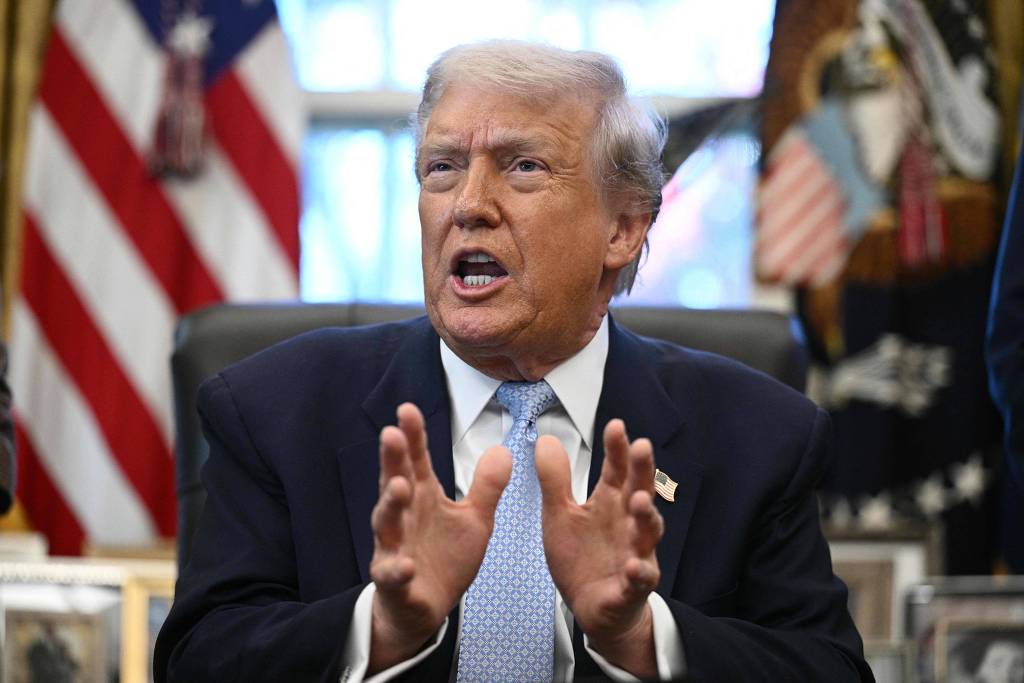
The text endorses President Donald Trump’s 20-point plan, creates a transitional administration presided over by the American president himself until 2027 and authorizes an international force with the power to “use all necessary measures” to demilitarize Gaza.
Although mentioned in a vague and conditional way, the promise of a “credible path” to the Palestinian state functions as diplomatic currency to legitimize an arrangement that removes control over their destiny from the Palestinians and reinstalls, in the 21st century, a model similar to the colonial mandate system.
The resolution was approved by 13 votes to zero, with abstentions from Russia and China, and formalizes the ceasefire signed on October 10, after two years of war that left more than 71,000 Palestinians dead.
At the heart of the device is the International Stabilization Force (ISF), which will replace the Israeli military presence and assume direct power over security, weapons and the movement of people.
The Israeli withdrawal is no longer linked to transparent frameworks and is conditioned on the moment in which the international force believes it has imposed “control and stability”, reinforcing the model of tutelage that removes the Palestinians from command over their own territory.
A “technocratic” committee — still undefined — will be in charge of basic services, while the Peace Council, led by Trump, will not be subordinate to the UN or the Palestinian Authority.
Despite the appearance of diplomatic progress, the approved text reflects concessions made by Arab and Islamic countries, which only agreed to support the resolution after the late inclusion of references to Palestinian self-determination.
The final wording, however, maintains vague language and conditions any step towards a Palestinian State on the internal reform of the Palestinian Authority and progress in the reconstruction of Gaza — two processes whose conduct and supervision will be controlled by the same Peace Council.
Arab delegations admitted, in their speeches, that they accepted the commitment to preserve the truce and guarantee the entry of humanitarian aid, but the result crystallizes the historical asymmetry between the Palestinian popular sectors and an international system marked by pressure from Washington.
The Israeli reaction made clear the real scope of the agreement. Prime Minister Benjamin Netanyahu celebrated the resolution by saying that Trump’s plan “will lead to peace” and “prosperity”, by envisaging “complete disarmament”, the “dismantling of military structures” and the elimination of “extremism” in Gaza.
At the same time, he reaffirmed that “opposition to a Palestinian state in any territory has not changed”, initially dismantling any expectation of real sovereignty for the Palestinians.
Security Minister Itamar Ben-Gvir was even more explicit in publicly defending the assassination of Palestinian Authority officials if the UN moves forward in recognizing the Palestinian State.
Among Palestinians, the contrast was evident. Hamas rejected the resolution entirely, denouncing that it imposes “international guardianship” over Gaza and stating that it will not accept disarmament.
For the movement, assigning the task of confiscating weapons to the ISF “removes its neutrality” and places it at the service of the Israeli occupation.
Fatah, internationally pressured and politically weakened, supported the text and stated that it opens “a new political horizon” after months of aggression — a position that, in practice, strengthens the arrangement designed by the US and limits the Palestinian capacity to autonomously define the direction of the reconstruction process.
Algeria, speaking on behalf of the Arab bloc, defended the inclusion of clauses such as “no annexation, no occupation, no forced displacement”.
Even so, the Algerian speech itself revealed the contradictions of the agreement, stating that it voted in favor to “maintain the ceasefire” and admitting that the compromise was only possible within the limits imposed by the negotiation format.
European delegations also accepted the minimalist wording, underlining that transitional measures need to respect international law — something that is not guaranteed in practice, given the autonomy attributed to the international force and the Peace Council.
Russia called the day “sad” for the Security Council and said the US “twisted the arms” of countries to approve the resolution. Even though it abstained, Moscow denounced the lack of guarantees on self-determination and criticized the endorsement of an initiative dependent on “Washington’s promises”.
With several undefined points — from the composition of the Peace Council to the choice of countries that will send troops — and with Israel itself maintaining attacks against Gaza despite the truce, the arrangement approved by the UN combines the emptying of Palestinian representation, the direct intervention of Western powers and the reluctant adhesion of weakened Arab governments.
Source: vermelho.org.br