Published 11/18/2025 14:55 | Edited 11/18/2025 15:08
The President of the United States, Donald Trump, stated this Monday (17) that he would be “OK” to authorize military attacks on Mexican territory to contain drug trafficking, in a statement that deepens diplomatic tension with the government of Claudia Sheinbaum and occurs in parallel with the largest North American military mobilization in the Caribbean in more than half a century.
The Republican said the US will do “whatever it takes to stop drugs”, in yet another demonstration of psychological terror in the region.
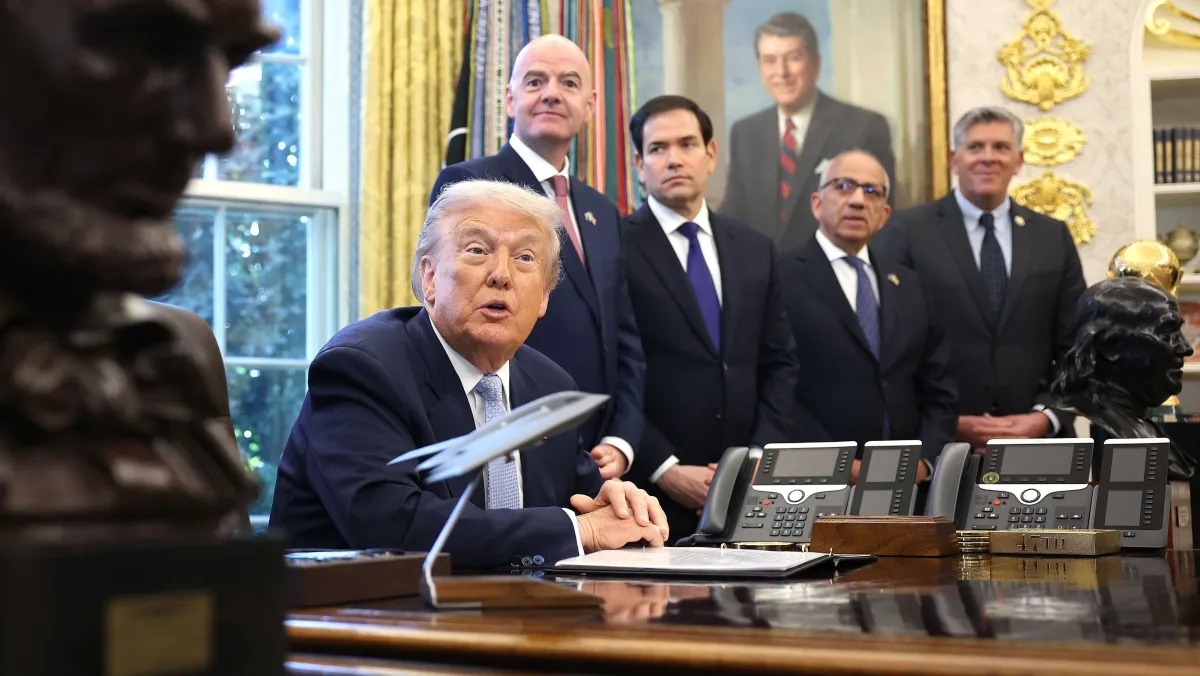
Speaking to reporters in the Oval Office, Trump opened up the possibility of direct intervention when asked whether he was considering attacks on Mexican soil or sending troops to the country.
“Launch attacks in Mexico to stop drugs? OK with me, whatever we have to do to stop drugs. I looked at Mexico City over the weekend, there are some big problems there,” he said.
The president also refused to answer whether he would only attack with the approval of the Mexican government, saying that he “will not answer that question” and that he has already been talking to the country, which “knows what its position is”.
Trump also said that the US knows “all the routes” and “the addresses of every drug kingpin”, calling the situation “a war”.
At another point, he expanded the scope of the threat by mentioning that he would be “proud” to dismantle cocaine laboratories in Colombia. “Colombia has cocaine factories. Would I take down these factories? I would be proud to do it personally,” he said. The Colombian embassy in Washington did not comment on the statements.
The speeches represent a new stage in the military campaign that Washington has intensified in recent months.
Data published by the US press indicates that the US Armed Forces have already carried out 22 missile attacks against vessels that, according to the Pentagon, would be used to transport drugs from Venezuela, resulting in more than 80 deaths — including Colombian citizens.
Since last Thursday (13), operation “Lança do Sul” has deployed between 12,000 and 15,000 military personnel to the Caribbean and put into action the aircraft carrier Gerald Ford, the largest and most modern in the fleet.
This is the largest US military presence in the region in 35 to 60 years, depending on the survey considered.
The offensive reignited speculation about the real objectives of the operation, especially after the State Department designated the Venezuelan Soles cartel — which Washington claims is commanded by Nicolás Maduro — as a foreign terrorist organization, which opens a legal path for attacks on Venezuelan soil.
In response, the president of Venezuela stated that he seeks “peace” and even sang excerpts from Imagine, by John Lennon, during a speech this Sunday (16).
In Mexico, Trump’s statements increased discomfort with the new US security policy. President Claudia Sheinbaum reiterated last week that she will not allow US troops to operate on her territory.
“We will never put our sovereignty at risk, we will never put Mexico’s independence at risk. We will never allow the US Army to set foot on Mexican territory,” he said.
The Mexican government had also already rejected reports from NBC News that pointed to the beginning of Washington’s planning to send troops and intelligence agents to the country with the aim of attacking cartels.
Regional tension, however, took an unexpected turn. On Sunday, Trump said he was considering opening negotiations with Nicolás Maduro, even after months of military escalation and new attacks in the Caribbean.
“We can have some discussions with Maduro and we will see how this ends,” the president told reporters, before returning to Washington. Asked what this willingness to talk would mean, Trump said he didn’t know, but added that “I’ll talk to anyone.”
Despite the rhetorical openness, the Republican reaffirmed that he does not rule out any option regarding possible military intervention in Venezuela. “I don’t rule out anything. We just need to take care of Venezuela,” he said.
With the concentration of naval forces in the Caribbean and the simultaneous threats to Mexico, Colombia and Venezuela, fear among Latin American governments is growing that Washington will open a new phase of unilateral interventions in the region under the pretext of combating drug trafficking.
For Mexico, the debate has particular weight, because in addition to its geographic proximity, the country carries the memory of North American invasions and maintains a diplomatic tradition based on defending sovereignty and non-intervention — principles reiterated by Sheinbaum in the face of pressure from Washington.
Source: vermelho.org.br