Published 11/17/2025 11:41 | Edited 11/17/2025 11:49
Communist candidate Jeannette Jara won the first round of the presidential election in Chile, this Sunday (16), and placed the Communist Party back at the center of national politics after more than two decades away from the front line.
With 26.8% of the votes, according to the Chilean Electoral Service, she will face on December 14th the ultra-rightist José Antonio Kast, who reached 23.9% and is trying to consolidate a turnaround supported by the entire conservative camp.
The vote, which mobilized more than 15 million qualified voters, recorded a participation rate of over 66% — the first presidential contest since the return of mandatory voting. In addition to the presidential choice, Chile renewed the Chamber of Deputies and half of the Senate.
The right advanced in Congress, but the Communist Party celebrated significant growth. The party went from 10 to 11 deputies and doubled its presence in the Senate, from two to four seats, consolidating itself as the second force of the government bloc.
The bench now includes names with strong national projection, such as Gustavo Gatica, Karol Cariola, Elisa Loncón, Irací Hassler and Marcos Barraza. The result indicates that Jara’s performance is part of a broader movement to recover the presence of the socialist and popular left.
Election night, marked by long queues and delays in voting, also reveals a mobilized, polarized country facing two clearly antagonistic political projects.
Jara speaks to the “majority” and claims breadth
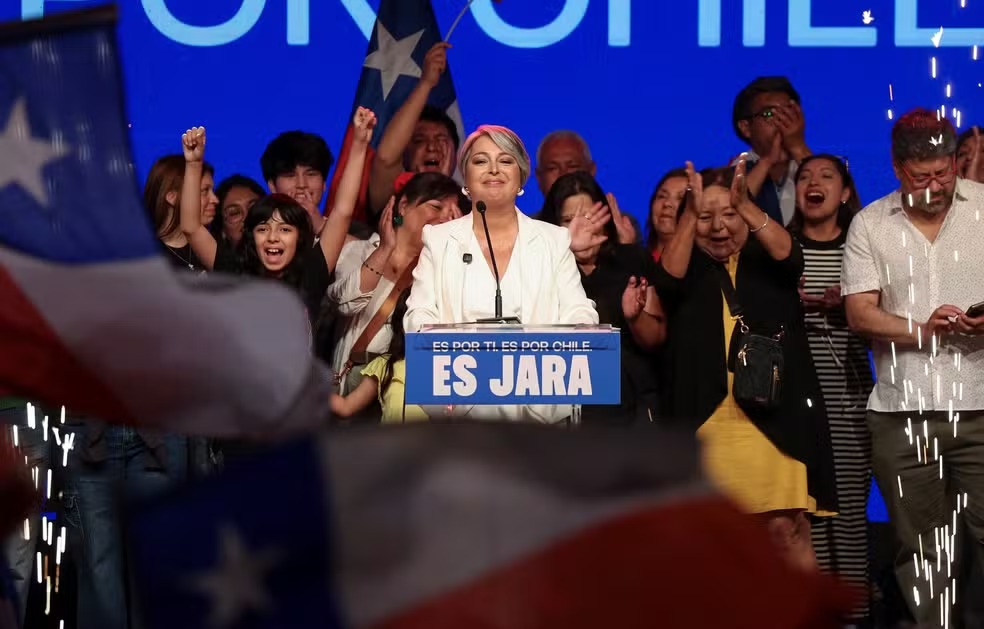
The communist candidate spoke this Sunday in Santiago in front of supporters and framed her victory as a call to rebuild national bridges.
“The majority of Chilean men and women did not vote for me or Kast. Whoever wants to govern Chile will have to know how to represent the majority. Whoever wants to govern Chile has to listen to all Chileans, everyone deserves to be listened to”, he stated.
The tone sought to break traditional left-wing boundaries and situate his candidacy as an alternative for a country facing an environment of political tension, institutional wear and tear and successive electoral consultations since 2019.
In the same vein, he called on his activists to intensify the political hand-to-hand on the streets of the country. “From tomorrow we have to go to the streets, talk to people and listen carefully,” he said.
The strategy is clear and seeks to transform Sunday’s victory into political capital capable of expanding support, especially among the independent and middle class sectors that migrated to Franco Parisi.
Jara also directly addressed the liberal economist, who came in third place with around 19.5%.
“I want to congratulate the surprise of the night, Franco Parisi, because he knew how to interpret with radical and innovative measures a great citizen feeling. It is our obligation to listen to the people”, he stated, in a calculated gesture towards an urban, young and often refractory to traditional parties electorate.
Dispute over security and economy marks second round
When speaking, Jara reaffirmed a program centered on development driven by internal demand, “decent neighborhoods” with community services and full citizenship.
She recalled measures that she carried out as Labor Minister under Gabriel Boric, including the reduction of the weekly working day from 45 to 40 hours, and moved the issue of security from the repressive rhetoric of the right to everyday life.
“I hope that in Chile the security of reaching the end of the month becomes a reality, as well as the security of living in a quieter neighborhood,” he said.
The candidate also linked her project to the defense of democracy and historical memory. “We know that many new generations did not know this history, but it was a very difficult period, in which anyone who thought differently was persecuted. Nobody wants this fate to happen again in our homeland”, he stated, referring to the dictatorship of Augusto Pinochet.
In a critical tone towards Kast’s rhetoric, he stated that “hatred, criticism of others and the exaltation of fear do not mean governing a country; it is necessary to have the capacity for dialogue and empathy with the population”.
Kast calls for unity on the right and aims turned
On the other side, José Antonio Kast tried to convert the conservative fragmentation of the first round into a demonstration of strength in the second. With immediate support from Evelyn Matthei (12.5%) and Johannes Kaiser (13.9%), he argued that Chile is experiencing an “economic and social” crisis that requires cohesion between the traditional and radical sectors of the right.
“The unity of our sector is essential, not only to win at the polls but also to later make the significant changes that our people desire”, he declared.
The far-right candidate has focused his campaign on accelerated deportations, police strengthening and a discourse that associates irregular immigration with the growth of violence — even though Chilean rates remain below the Latin American average.
His narrative targets part of the voters who migrated to Parisi and a conservative part of the middle class who distanced themselves from the Boric government.
Parisi becomes the pivot of the dispute and puts pressure on Jara and Kast
With almost 20% of the votes, Franco Parisi became a key player in the final stretch. He attacked the polls — “poll terrorists” — and said he would only announce his position in the coming days. He also sent a message to the two finalists.
“Chile needs a project that is not tied to the icons of the past. No more Allende, no more Pinochet”, said the exempt.
The speech reveals the symbolic content of the dispute. While Kast symbolically refers to the authoritarian order, and Jara demands social reconstruction and rights, Parisi tries to preserve a pragmatic outsider space and compete for the middle class vote.
Source: vermelho.org.br