Published 14/11/2025 18:55 | Edited 14/11/2025 19:14
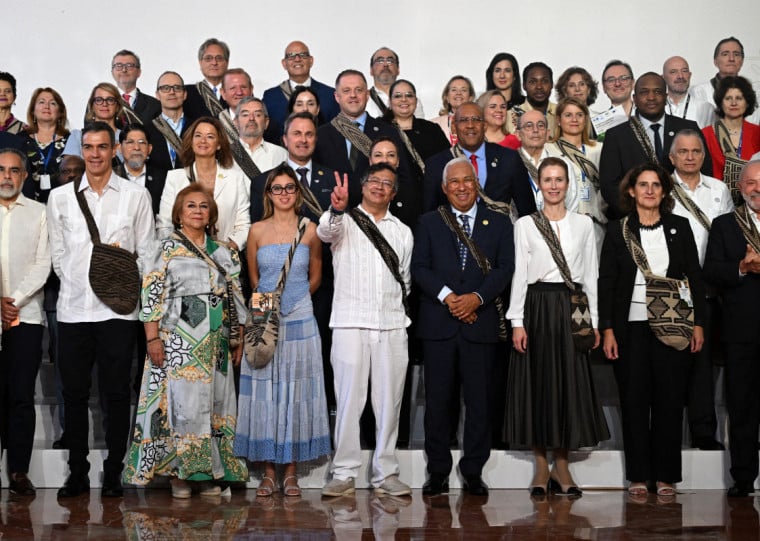
The Celac–EU Summit (Community of Latin American and Caribbean States and the European Union) approved, this week, a joint declaration by 58 countries that rejects the use of force in the Southern Hemisphere and reaffirms Latin America and the Caribbean as a Zone of Peace — a direct message to the United States’ military escalation in the Caribbean Sea.
The operation also generated protests from the UN High Commissioner for Human Rights, Volker Türk, and G7 governments.
The North American movement, marked by the sending of destroyers, submarines and the aircraft carrier USS Gerald R. Ford, reactivates the aggressive logic of US imperialism that has historically guided Washington’s foreign policy towards the region.
Read more: Brazil and Cuba stand against the US at the CELAC summit against the return of the Monroe Doctrine
Governments and multilateral organizations classified the actions as violations of regional sovereignty and warned that Washington is once again acting under an imperial and interventionist logic that breaks the diplomatic balance built in recent decades.
Among those who reacted are Colombia, Russia, the United Kingdom, Canada and Mexico, in addition to the United Nations High Commissioner for Human Rights, who described the actions as “extrajudicial executions”.
The statements came after the entry of the aircraft carrier USS Gerald R. Ford into the Southern Command’s area of responsibility, marking the largest US military presence in Latin America since the invasion of Panama in 1989.
Latin American convictions and defense of sovereignty
The Colombian government was the first to adopt a concrete measure. President Gustavo Petro ordered the immediate suspension of intelligence cooperation with the United States, in protest against the bombings of small vessels in the Caribbean and the Pacific.
In a public statement, Petro stated that “the fight against drugs must be subordinated to the human rights of the Caribbean people” and accused Washington of violating sovereignty and international humanitarian law.
According to data confirmed by the UN, the attacks have already left at least 80 people dead.
In Caracas, Foreign Minister Yván Gil thanked the Duma, Russia’s parliament, for the unanimous resolution that condemns the increase in the US military presence in the Caribbean. The Russian text, presented by Leonid Slutsky, calls on parliaments around the world to repudiate US operations and reaffirms Latin America and the Caribbean as a Zone of Peace.
Gil stated that “Venezuela deeply values Russia’s firm solidarity in defending our sovereignty”, and classified the accusations of drug trafficking made by Washington as “false and absurd”, arguing that the objective is to justify aggression with the aim of appropriating Venezuelan energy resources.
Europe reacts and imposes limits on military cooperation
Criticism extended to historic allies of the United States. The United Kingdom announced the suspension of sharing intelligence information after finding that British data had been used in lethal attacks against civilian vessels.
Diplomatic sources interviewed by CNN stated that London considers the actions “contrary to international law” and “incompatible with the principles of the proportional use of force”.
Canada adopted a similar measure: the Ministry of Defense declared that Canadian activities in the Caribbean are “separate and distinct” from operations conducted by Washington and demanded formal guarantees that its intelligence will not be used for lethal attacks.
The joint reaction of the two countries, central members of the Atlantic alliance, represents an unprecedented condemnation of the unilateral use of force by the United States in Latin American territory.
UN classifies actions as illegal and without legal support
The United Nations High Commissioner for Human Rights, Volker Türk, declared that the US attacks “violate international law and amount to extrajudicial executions”.
According to UN experts, the affected vessels were not participating in armed hostilities nor did they pose an immediate threat, which makes the use of missiles against civilian targets incompatible with International Humanitarian Law.
The UN analysis reinforces the assessment that Trump’s decision to reclassify drug cartels as “foreign terrorist organizations” does not provide a legal basis for the use of lethal force. For jurists interviewed by the international press, the justification constitutes an abuse of authority and a violation of the United Nations Charter.
Mexico reaffirms independence and rejects interference
In Mexico, President Claudia Sheinbaum repudiated in a public statement any proposal for foreign military intervention under the pretext of combating drug trafficking.
“We are not anyone’s colony, we are a sovereign and independent country”, he stated, remembering that “the last intervention by the United States caused us to lose half of our territory”.
Sheinbaum defended the security policy centered on social programs and the National Guard, opposing it to the “war on drug trafficking” promoted by previous governments, marked by militarization without a legal basis and increased violence.
The president’s speech follows the same tone as other Latin American reactions: defending sovereignty, denouncing interventionist practices and demanding political solutions instead of military coercion.
Region reaffirms Latin America and the Caribbean as a Zone of Peace
During the Celac Summit, held in Bogotá, 58 of the 60 member countries approved a joint declaration that rejects “the use or threat of use of force and any action contrary to international law”.
Although the text does not directly mention the United States, diplomats confirm that the resolution expresses collective repudiation of the militarization of the Caribbean and reiterates the commitment to the Zone of Peace, a principle established in Havana in 2014.
Source: vermelho.org.br