Published 13/11/2025 11:04 | Edited 11/13/2025 16:06
Venezuela announced this Tuesday (11) a national military mobilization and the promulgation of a new defense law in response to the approach of the aircraft carrier USS Gerald R. Ford, the largest warship in the United States, which entered Latin American waters this week.
The North American operation, presented as part of the “war on drugs”, has already resulted in the deaths of civilians in waters in the region and is considered a demonstration of imperialist force against the government of Nicolás Maduro and South America.
Caracas’ move comes less than 48 hours after confirming the Ford’s presence in the Caribbean and marks a broader reaction by Venezuela in the face of a North American military escalation since 2019.
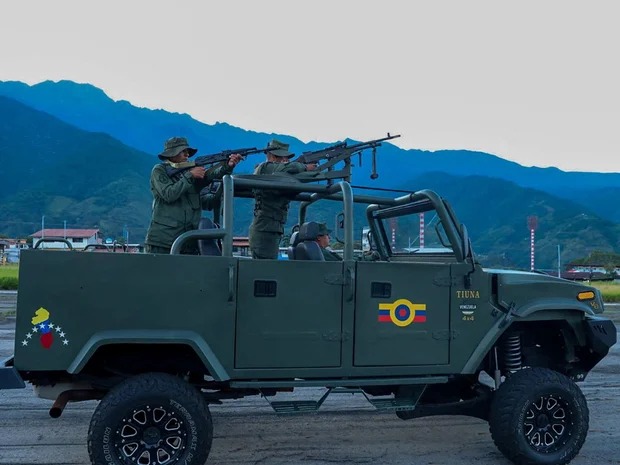
Defense Minister Vladimir Padrino López announced the maximum level of military alert and reported that the country will place its entire arsenal in operational readiness, with the mobilization of almost 200,000 soldiers, civilian militias and security forces throughout the territory.
“The objective is to place the country’s entire military arsenal in full operational readiness,” declared Padrino, in a statement broadcast on state television this Tuesday.
The plan, called “massive deployment of forces”, includes land, naval, air, river and missile troops. According to the Ministry of Defense, the measure responds to the presence of North American “hostile forces” in the Caribbean and aims to reinforce the ability to react quickly in the face of any violation of sovereignty.
President Nicolás Maduro classified the US move as “the greatest threat the continent has faced in a hundred years” and reaffirmed his commitment to the country’s defense.
“If Bolívar was prepared for victory, so are we. We defend the most sacred cause that has ever been defended. We are in our law, in our land, and nothing and no one should disturb the peace and tranquility.”
Command Law and integral defense doctrine
Caracas’ reaction was accompanied by the promulgation of the Command Law for the Integral Defense of the Nation, approved by the National Assembly and sanctioned by Maduro on Tuesday night (11).
The new standard reorganizes the structure of national defense and reinforces integration between the Armed Forces and the civilian population in the face of external threats.
The norm establishes that the defense of the homeland is the co-responsibility of the State and all citizens, consolidating the doctrine of “army-people” and “people-army” formulated by Hugo Chávez.
With three titles and 35 articles, the law defines the structure of the nation’s comprehensive defense, giving the President of the Republic the power to create and supervise defense management bodies at all territorial levels. The standard also creates five specialized committees:
- Bolivarian Patriotic Committee;
- Economic, Productive and Services Committee;
- Popular Social Committee;
- Internal Order Committee;
- Mobilization and Requisition Committee.
The President of Parliament, Jorge Rodríguez, stated that the new legislation “legitimizes a new operation between the Bolivarian National Armed Forces and the Venezuelan people”, guaranteeing a defense that transcends the military field and also covers social, economic and internal order dimensions.
“This is a structure that strengthens democracy and ensures the integrity of the nation,” stated Rodríguez during the approval session.
Exercise “Independence 200” and territorial integration
Parallel to the promulgation of the law, the government activated the military and police exercise Deployment of Independence Forces 200, which began at 4 am local time this Wednesday (12).
The operation involves all Integral Defense Operational Zones (ZODI) — territorial divisions created by Bolivarian doctrine to coordinate joint actions between the Armed Forces, militias and civil authorities.
The exercise seeks to test, in real time, the mobilization, communication and deployment capabilities of systems and weapons across the country.
Described as the first simultaneous military exercise across the entire national territory, the plan includes direct participation by popular militias and coordination between civil and military committees.
According to a statement from the Ministry of Defense, the objective is to “reinforce the right to peace, the republic and national sovereignty in the face of external threats”.
International support and regional reactions
During the session of the National Assembly, a statement from the State Duma of the Russian Federation was read, which condemned the threats of use of force against Venezuela and reaffirmed the principle of non-interference in Latin American internal affairs.
The document defends the preservation of Latin America and the Caribbean as a Zone of Peace, in line with the historic resolutions of the Community of Latin American and Caribbean States (CELAC).
In response, the Venezuelan Assembly expressed gratitude and solidarity with the people and government of Russia.
“Russian support in complex and difficult moments proves that Russia is a true friend of the people of Venezuela,” said Jorge Rodríguez, at the end of the session.
The escalation also provoked diplomatic reactions in the region. Colombian President Gustavo Petro announced the suspension of intelligence cooperation with the United States, in protest against attacks on civilian vessels in Caribbean waters.
At the CELAC Summit, held in Colombia, 58 of the 60 member countries approved a declaration rejecting the use of force, although without directly mentioning Washington.
Venezuela and Nicaragua refused to sign the text as they considered it lenient given the seriousness of the military escalation.
President Luiz Inácio Lula da Silva also avoided direct mention of the United States, but defended the diplomatic route and the political solution. “We are a zone of peace. We don’t need war here. The problem in Venezuela is political and must be resolved through politics,” said Lula.
Sovereignty and self-determination
Caracas’ response combines popular mobilization, legal support and support from strategic allies. The combination of these factors has supported the Venezuelan government’s position in the face of the largest US military operation in the Caribbean in more than three decades.
Under the argument of combating drug trafficking, Washington has carried out attacks on civilian vessels in the Caribbean and the Pacific, which experts in international law classify as illegal actions with no legal basis. Legal experts claim that the affected vessels were carrying civilians, did not represent armed hostility and, therefore, could not be military targets.
Latin American analysts see the offensive as a new expression of the Monroe Doctrine, through which the United States reaffirms political and military dominance over the hemisphere. The assessment is that, behind the security discourse, there is a movement of geopolitical expansion in Latin America.
Venezuela, on the other hand, reacts based on its Constitution and the Bolivarian doctrine of integral defense — which preaches unity between the people, government and Armed Forces in protecting the territory. This mobilization places the limits of sovereignty and the right to self-determination of peoples at the center of the regional debate amid the resumption of North American militarization on the continent.
Source: vermelho.org.br