Published 12/11/2025 14:30 | Edited 11/13/2025 16:08
The French National Assembly approved this Wednesday (12) the freezing of pension reform, an unpopular measure that increased the minimum retirement age from 62 to 64 years.
With 255 votes in favor and 146 against, the decision postpones the full implementation of the reform until after the 2027 presidential elections.
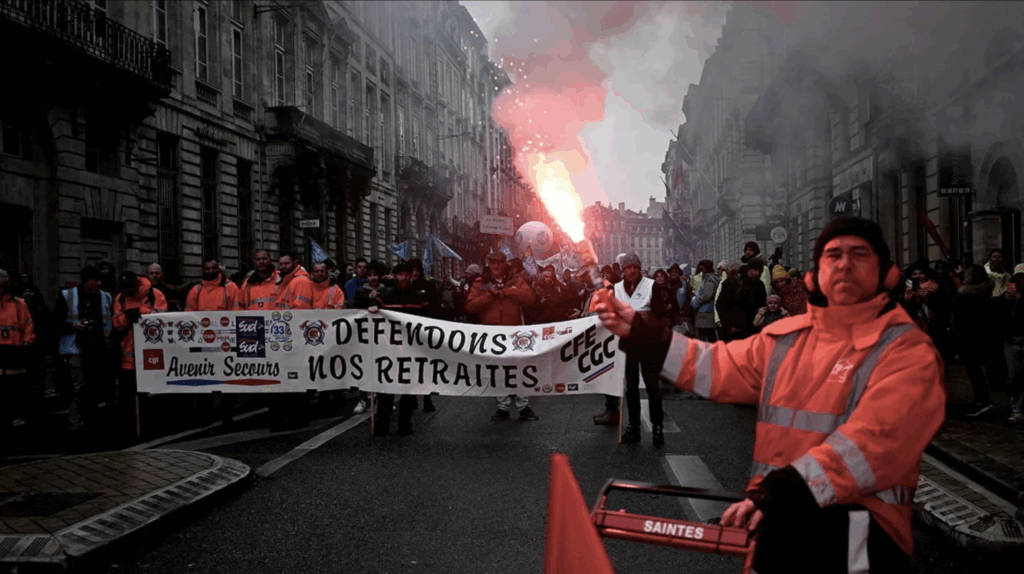
In practice, the minimum age will remain at 62 years and 9 months until the end of the current term, signaling a partial victory for unions and social movements that, since 2023, have been promoting one of the largest waves of strikes and protests in recent French history.
Read also: Macron loses fifth prime minister and political crisis in France worsens
Unions mobilize 800,000 in France on strike against Macron’s austerity
New Social Security is validated in France and political-social crisis increases
Protests in France highlight the failure of neoliberalism
Macron backs down after treating issue as “non-negotiable”
The suspension of the reform represents a political shift by President Emmanuel Macron, who until a few months ago stated that the change was essential to “save the pension system”.
Now, cornered by a fragmented Parliament and a weakened coalition, the president has delegated to Prime Minister Sébastien Lecornu the task of negotiating concessions and avoiding new legislative blockages.
The retreat exposes the decline of Macron’s political authority, whose liberal project faced resistance from both the union left and the nationalist right, united in their criticism of the social cost of the reforms.
Reform imposed without vote and with massive protests
In 2023, then Prime Minister Élisabeth Borne imposed the reform without a vote, using the controversial article 49.3 of the French Constitution, which allows laws to be approved without the approval of the Assembly.
The decision sparked nationwide protests, transport stoppages, refinery blockades and clashes between protesters and police.
For the majority of French people, the reform symbolized the government’s disconnection from social reality, penalizing the poorest workers and those who started working early.
“It was a law made for the market, not for the people”, summarized Sophie Binet, general secretary of the CGT, the main French trade union federation.
“Fatal error”, say businesspeople; “victory for the street”, say unions
The president of the French Business Movement (Medef), Patrick Martin, called the suspension a “fatal error” and “economic heresy”, reflecting the discontent of the business sector.
The unions celebrated it as a “victory of the street over the elitism of the Élysée Palace”, promising to maintain the mobilization until the reform is definitively repealed.
The CGT called for a new national day of protests on December 2, denouncing the 2026 budget as “full of social horrors”, with cuts to education, health and family assistance.
The French impasse and the political cost of austerity
For Macron, pension reform was a pillar of his austerity policy and a test of credibility in international markets.
But in practice, it revealed the limits of the neoliberal consensus in a country that still strongly values the welfare state and intergenerational solidarity.
Even after the retreat, France remains divided: while the government talks about “fiscal responsibility”, workers see an attack on their won rights.
The freeze, therefore, does not end the conflict — it only postponed the confrontation until 2027, when the presidential succession will return the issue to the center of the debate.
A reform rejected by the streets
More than an accounting dispute, the French impasse highlights a clash of societal models.
On the one hand, a government that insists on market solutions to a social problem; on the other, a people who refuse to work harder to support a system that excludes them.
The reform freeze is, therefore, a symptom of Macron’s political crisis — and a reminder that, in France, the streets still have the power to rewrite the laws.
Source: vermelho.org.br