Published 12/11/2025 12:27 | Edited 12/11/2025 12:43
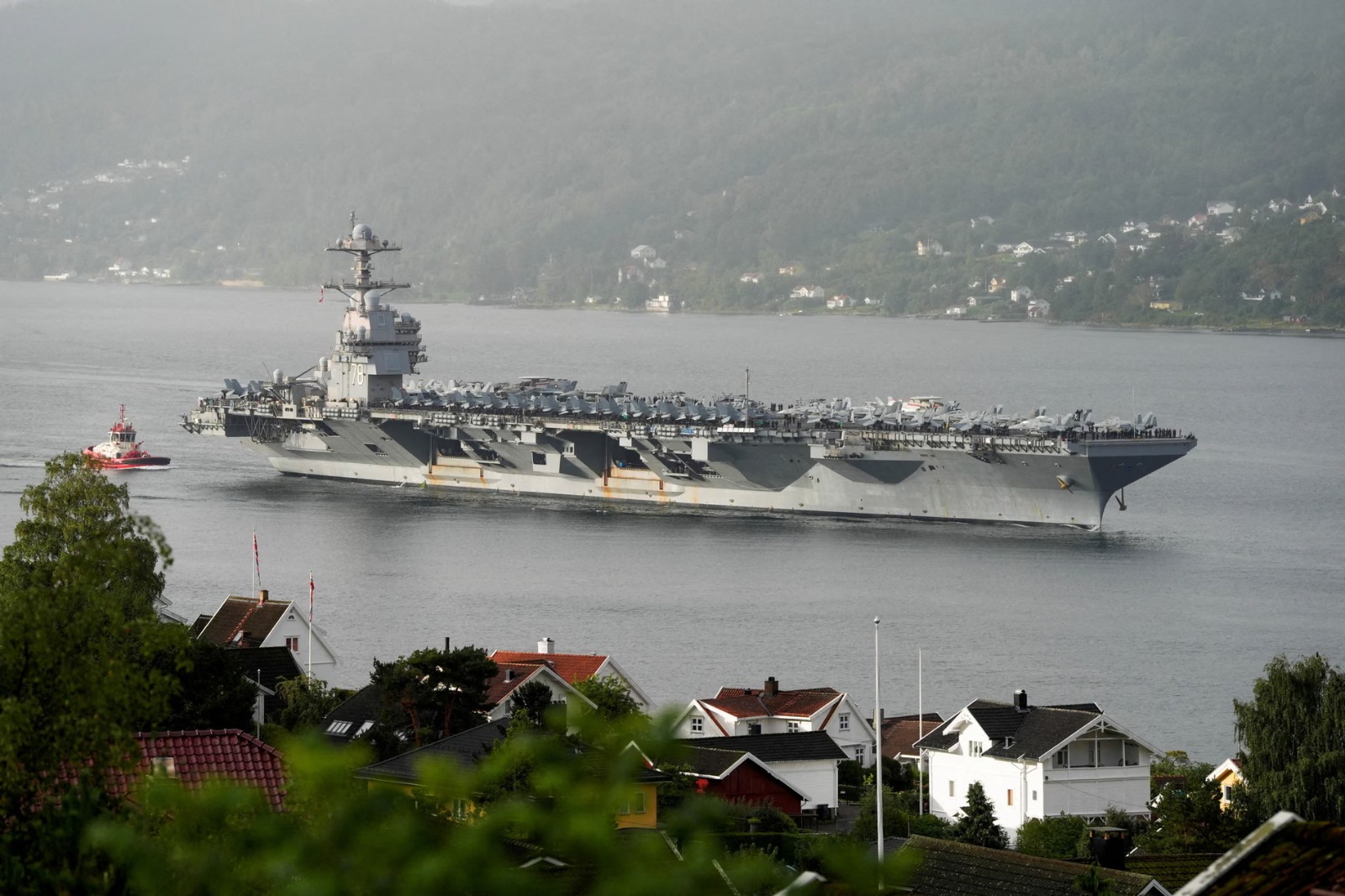
The aircraft carrier USS Gerald R. Ford, the largest warship in the world, entered the area of responsibility of the United States Southern Command, which covers Latin America and the Caribbean.
The arrival of the vessel, confirmed this Tuesday (11), marks the largest US military presence in the region since the invasion of Panama in 1989, and deepens tensions with Venezuela, which reacts with a broad military deployment.
The shipment was personally ordered by President Donald Trump and confirmed by the Pentagon, under the argument of reinforcing the fight against drug trafficking. The US government claims that the mission is part of the “war on drugs”, aimed against alleged groups operating on the Caribbean and Pacific routes.
The operation, however, represents a demonstration of strength by North American imperialism in Latin America and paves the way for a possible intervention in Venezuela, under the pretext of combating drug trafficking.
The Gerald R. Ford leads a strike group made up of eight destroyers, a nuclear submarine and dozens of tactical aircraft, some based in Puerto Rico.
With more than 5 thousand sailors, the aircraft carrier is powered by a nuclear reactor and has capacity for 75 aircraft, including F-18 Super Hornet fighters and E-2 Hawkeye early warning planes.
The use of a nuclear aircraft carrier is unusual in operations outside war zones and, according to experts interviewed by Reuters and the Guardian, represents a change in doctrine.
“These aircraft carriers are strategic assets of limited use, used only in missions considered a priority by the Pentagon, with high power projection. Sending one of them to the Caribbean is a political decision”, assessed a former officer interviewed by Reuters.
Since September, Trump’s “anti-drug campaign” has resulted in air strikes against vessels, which have killed at least 76 people in Latin American waters. Washington did not provide details about the victims or prove a direct link to drug trafficking.
O Washington Post describes US actions as a radical change in military doctrine. Under Trump, the United States has abandoned seizure and arrest operations to adopt lethal attacks on suspected crews, a practice that international law experts classify as illegal.
Jurists interviewed by the newspaper claim that the vessels affected were civilian, operated by fishermen and traders accused of involvement in trafficking, without any armed hostility against the United States.
For analysts, the new pattern of attacks expands the zone of impunity in North American foreign policy and reinforces the perception that the “war on drugs” serves as a facade to justify actions of force and intimidation in Latin America.
Venezuelan reaction
In response to the North American movement, President Nicolás Maduro announced a “massive deployment” of land, naval, air, river and missile forces, in addition to the activation of civilian militias. The government classified the arrival of the Ford as an “imperialist threat” and began a new phase of military exercises throughout the territory.
In a statement broadcast on state television, Maduro declared that the North American displacement represents “the greatest threat that our continent has faced in the last 100 years”. He further stated that, in the event of an invasion, “millions of men and women with rifles would march across the entire national territory.”
Sources cited by Reuters indicate that Venezuela is preparing guerrilla-style resistance plans, using old Russian weapons and territorial sabotage strategies in the event of an air or land attack.
Diplomacy and isolation
The military escalation by the United States provokes diplomatic reactions throughout Latin America and exposed differences between countries in the region regarding the North American presence in the Caribbean.
At the closing of the Summit of the Community of Latin American and Caribbean States (Celac), held in Colombia, 58 of the 60 countries present signed a joint declaration rejecting “the use or threat of use of force and any action contrary to international law and the Charter of the United Nations”.
Although the text did not directly mention the United States, it is a veiled criticism of the naval operation. Venezuela and Nicaragua refused to sign the declaration, claiming it downplayed the seriousness of the military escalation.
President Luiz Inácio Lula da Silva, who is negotiating an agreement with Trump to reduce tariffs on Brazilian products by more than 50%, also avoided mentioning Washington directly.
“We are a zone of peace. We don’t need war here. The problem in Venezuela is political and must be resolved through politics,” said Lula.
Strategic interests
The reactivation of a former US naval base in the Caribbean, revealed by satellite images analyzed by Reuters, may suggest, according to the agency, preparation for sustained operations in the region.
Analysts assess that the gesture is part of the strategy of containment and pressure on Caracas, but could have broader repercussions.
Amid the escalation, the Trump administration also imposed sanctions on Colombian President Gustavo Petro, whom it called an “illegal drug trafficking leader.” Petro responded by accusing Washington of “assassination” for the air strikes on the South American coast.
For defense experts consulted by Guardianthe operation marks “a return to the logic of the Monroe Doctrine”, by which the United States reaffirms political and military dominance over the Western Hemisphere.
Sovereignty at risk
The arrival of Gerald R. Ford in the Caribbean rekindles memories of previous military interventions and calls into question the sovereignty of Latin American countries. At the same time that Trump seeks to project power, the articulation of regional governments that defend non-intervention and political dialogue is growing.
The episode consolidates a new stage of militarization in the Caribbean and reveals the contrast between the discourse of combating crime and the practice of military expansion by the United States in Latin American territory.
Source: vermelho.org.br