Published 10/11/2025 12:22
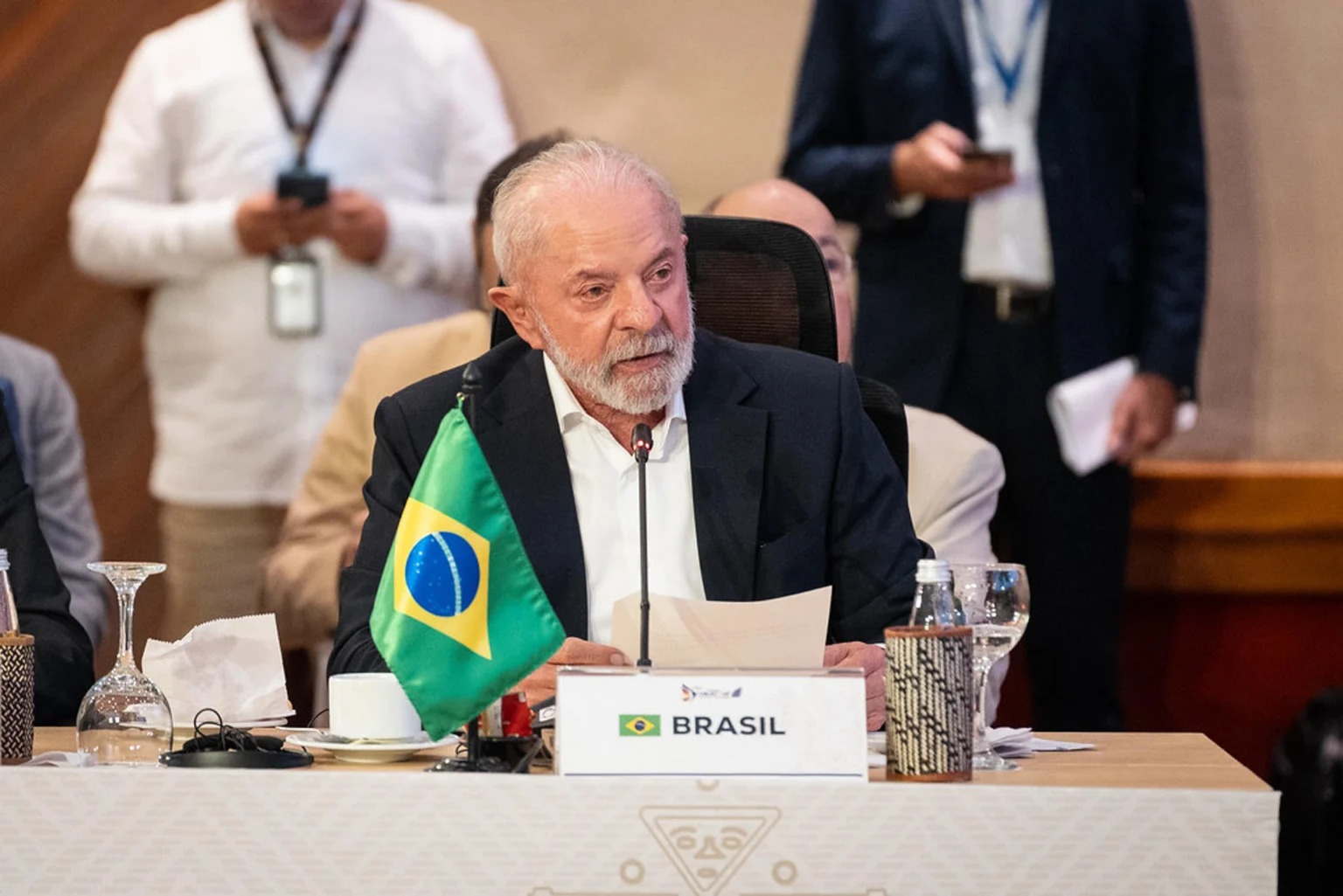
President Luiz Inácio Lula da Silva stated this Sunday (9) that “the threat of the use of military force has once again become part of everyday life in Latin America and the Caribbean” and warned about the “recycling of old rhetorical maneuvers to justify illegal interventions”.
The declaration was made during the IV Summit of the Community of Latin American and Caribbean States (Celac) and the European Union (EU), which ended in Santa Marta, Colombia, with a joint declaration that reaffirms the region as a zone of peace.
Lula’s speech took place amid the United States’ military escalation against the Venezuelan government of Nicolás Maduro.
Since August, the imperialist threat has mobilized aircraft carriers, destroyers and patrol planes in the Caribbean Sea, under the argument of combating international drug trafficking networks. The operations have already left dozens of people dead and caused the destruction of vessels in the region.
Lula criticized the foreign military presence in the hemisphere and warned that “democracies do not fight crime in violation of international law”.
The president defended that security should be treated as “a duty of the State and a fundamental human right” and that no nation is capable of facing transnational crime alone.
“No country can face this challenge in isolation; we must act in cooperation,” he said.
The IV Celac-EU Summit brought together 32 Latin American and Caribbean countries and 27 European nations at a time of strong diplomatic tension with the United States. The meeting was held in the city of Santa Marta, in Colombia, which celebrates 500 years of founding and became, for two days, the political epicenter of the hemisphere.
Colombian President Gustavo Petro, host of the summit and president pro tempore of Celac, presented the final text of the joint declaration and highlighted the need for “common solutions” instead of “unilateral impositions”.
“We insist, persist and deepen the criterion that it is multilateralism that allows different nations to come together to solve common problems”, he stated.
The 52-point declaration reaffirms the commitment to multilateralism and condemns the use of force as an instrument of international policy. The text does not mention the United States, but makes reference to the need to maintain the Caribbean as a zone of peace.
“We reiterate our opposition to the use or threat of use of force and to any action that does not comply with international law and the Charter of the United Nations”, says the document, signed by 32 of the 33 members of CELAC and the 27 of the EU.
Argentina, governed by Javier Milei, was the only CELAC country not to sign the final document, breaking with the Latin American majority position. According to Chancellor Diana Mondino, Buenos Aires preferred to “maintain constructive relations with all countries” and avoid “interpretations that sounded like indirect criticism of the United States”.
Recently, the North American president announced a US$20 billion financial aid package for Argentina, aimed at strengthening the country’s reserves and easing exchange rate pressure on the peso.
The gesture is interpreted as a political counterpart to Milei’s alignment with Washington, at a time of increasing diplomatic isolation of the Argentine government in Latin America. Abstention isolates Argentina within the bloc and is read by diplomats as a gesture of complete alignment with the White House amid Trump’s military buildup in the Caribbean.
Brazil and Cuba react to the Monroe Doctrine
Lula’s statement was accompanied by the vice-president of Cuba, Salvador Valdés Mesa, who denounced attempts to “reactivate the Monroe Doctrine” and urged Latin American countries to “act to stop aggression and military infiltration”.
The Cuban expressed solidarity with the Colombian government, the target of sanctions imposed by Trump following Petro’s criticism of military operations in the Caribbean, and condemned “the military genocide perpetrated by Israel in Gaza”, classifying the offensive as an unprecedented humanitarian crisis.
For Lula and Valdés Mesa, the reactivation of interventionist strategies represents a threat to regional sovereignty. Both advocated strengthening cooperation between Latin American countries and combating organized crime without violating international law.
“Democracy succumbs when organized crime corrupts institutions, invades public spaces and destroys families”, stated the Brazilian president, when defending the tracking of crime financing and the fight against arms trafficking.
Petro talks about global democracy and Costa reinforces biregional dialogue
Colombian Gustavo Petro defended the construction of a “global democracy based on diversity”, arguing that “a unanimous humanity is a dead humanity”. According to him, the dialogue between Celac and the European Union should serve as a model for a new type of cooperation between civilizations.
On the European side, the president of the European Council, António Costa, described the summit as “a clear message to the world” and stated that the meeting “reaffirms the commitment to dialogue over division, and cooperation over confrontation”.
Costa highlighted that bi-regional dialogue strengthens a shared world vision based on democracy, human rights and social justice.
In addition to the political declaration, the European Union announced a new boost to the Global Gateway program, with 31 billion euros in investments in more than 100 projects in Latin America and the Caribbean.
Among the initiatives are the expansion of digital connectivity via satellite, the integration of regional electrical networks and the creation of a network of supercomputers that will connect the two continents.
Two specific pacts were also signed: an Alliance for Citizen Security, aimed at combating organized crime, and a pact on the care economy, aimed at exchanging social policies.
Source: vermelho.org.br