Published 11/05/2025 15:50 | Edited 05/11/2025 18:14
North American sources point out that the Donald Trump administration has prepared a series of scenarios to act against the Nicolás Maduro regime. According to a report from New York Timesthe White House is already working on options that go beyond simple sanctions: attacks on Venezuelan military units, control of oil fields, seizure of airports and possibly the capture — or even assassination — of the president of Venezuela. This set of measures constitutes an attempt at regime change with a real focus that encompasses strategic and energy interests, even though officially the government insists that the target is drug trafficking.
The combination of interests — military, energy and political — turns Venezuela into a board where the US can test the limits of its hegemony. If the plan moves forward, it could mark a new era of American intervention in Latin America — but if it fails, it will leave a legacy of diplomatic and military crisis with military, legal and geopolitical risks — and Venezuelan history shows that similar events have failed in the past. The risk, therefore, can be as high as what is at stake.
Legally controversial and politically risky
In addition to evaluating military incursions, the government requested opinions from the United States Department of Justice to legitimize the action without the need for Congressional approval, which breaks with precedents. Officially, the central argument is that Venezuela is linked to drug trafficking, via organizations such as Tren de Aragua, and that this justifies military operations without the need for a formal declaration of war. If carried out, the operation would put American troops, US credibility and international sovereignty agreements at risk.
The strategic value of Venezuela, home to the largest oil reserves in the world, transforms the crisis into an energy dispute. Analysts say that control of these fields could be the biggest motivator for Washington’s maneuvers, which have already mobilized the coup to overthrow Bashar Al-Assad in Syria, to control its wells, which are a tiny fraction of Venezuela, a country neighboring the USA. Similar situations occurred with Saddam Hussein’s Iraq and Muammar Gaddafi’s Libya.
However, without a clear post-Maduro governance plan, an eventual intervention could lead to instability or hand the country over to another non-aligned government. Some experts warn that the country could descend into Libya-like chaos if the armed forces fragment into rival factions.
Strategies under discussion and weaknesses
North American plans are divided into several fronts:
- Air strikes and ground installations — targeting military units and transport runways linked to the regime.
- Special operations — use of elite forces to capture or eliminate Maduro.
- Control of strategic infrastructure — airports, oil fields and transportation systems.
This last option raises questions because it requires significant force on the ground, occupation and subsequent administration — which has historically failed or generated immense costs.
Then there’s the fact that it’s unclear whether Trump wants to take on the political and military risk of a direct invasion. He demands “what do we get in return?” before authorizing larger operations.
Why this plan might not work
- Venezuelan resistance capacity: the Maduro regime has internal military and paramilitary support, factors that make a quick operation difficult.
- Post-intervention void: even if Maduro were deposed, who would guarantee stability and popular support? The US does not have a robust plan to govern or rebuild Venezuela.
- Legality and supervision: any direct attack on a foreign head of state or invasion violates international rights and requires support from Congress — a point that the White House tries to avoid.
- Global political cost: military escalation would place the US under criticism of imperialism, invasion and could intensify opposing alliances (such as Russia and China supporting Caracas).
Although there is a mobilization of naval and US forces in the Caribbean and the coast of Venezuela, experts suggest that the government is more likely to opt for limited interventions — bombings, covert operations, economic pressure — rather than a large-scale invasion.
Venezuelan resistance
According to another report from New York TimesVenezuela appears to have solid defenses that could test the military might of the United States. Iranian cruise missiles designed to sink ships at sea. Russian surface-to-air missiles to attack aircraft flying at low altitude. Chinese armored vehicles to suppress protests. Even some obsolete American F-16 fighters.
The country’s unusual arsenal, largely acquired from U.S. adversaries and combined with years of arming civilians to bolster its defenses, underscores the challenges the United States could face in concentrating its forces in the Caribbean. However, unlike the armed forces of neighboring Colombia, the Venezuelan armed forces lack real combat experience.
Prohibited from acquiring US weapons, Venezuela turned to suppliers such as Iran, which provided the technology to manufacture drones capable of carrying missiles. But by far Venezuela’s biggest arms supplier is Russia, which has supplied everything from tanks and helicopters to Dragunov sniper rifles and Igla-S portable missile launchers.
Russia contributes to the maintenance of some of Venezuela’s weapons systems. As a sign of this close relationship, a Russian Ilyushin Il-76 plane, capable of carrying 50 tons of military cargo, landed in Caracas in October. Maduro has requested assistance from Russia and China to strengthen Venezuela’s military capabilities, according to The Washington Post.
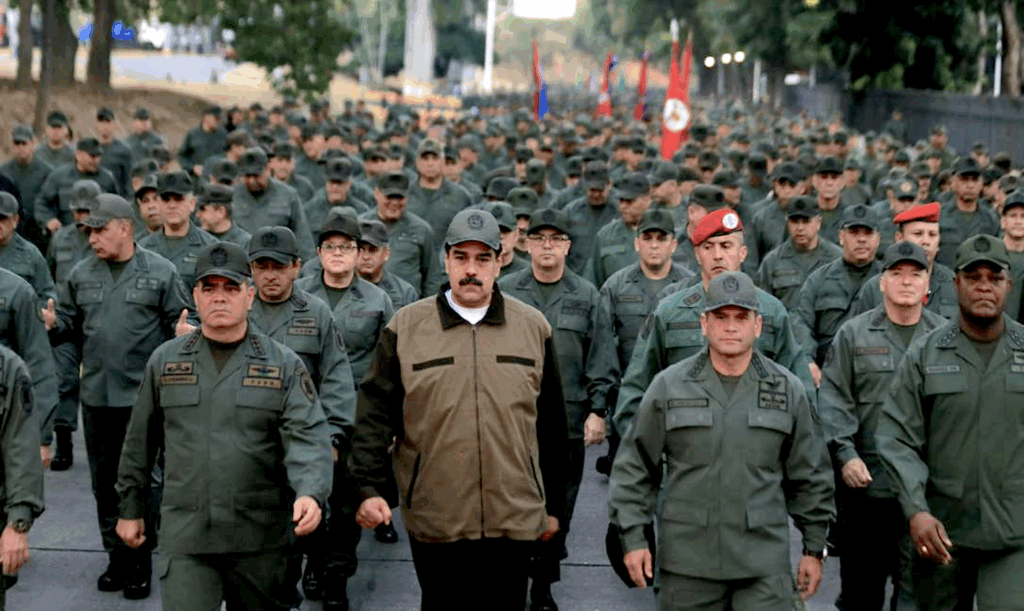
Estimates vary considerably, but Venezuela is believed to have more than 30 operational fighter jets, more than 40 warships and up to 200 tanks. Venezuela also maintains one of the largest standing armies in Latin America. Across all branches, the Venezuelan military has approximately 150,000 members, according to John Polga-Hecimovich, a Venezuela expert at the U.S. Naval Academy.
For years, Venezuelan leaders have been preparing for what they call asymmetric warfare, drawing up insurgency plans against a much more powerful rival and arming the civilian population to resist a U.S. invasion. According to security experts, paramilitary street cells, known as colectivos, could, for example, transform Caracas into a lethal scenario of urban guerrilla warfare, where fighters take refuge in the city’s mountainous topography and abandoned high-rise buildings.
Maduro has proven adept at fending off serious challenges to his rule. When Venezuela was wracked by social unrest between 2017 and 2020, fueled in part by an economic crisis and food shortages, its government thwarted at least nine military mutinies, mostly led by mid-ranking officers, according to Polga-Hecimovich. A sign of stability is the long tenure of Maduro’s Defense Minister, Vladimir Padrino López, who has held the position for 11 years.
Historical trend: coups, invasions and CIA
The international press draws parallels between the current situation and the Cold War coups and interventions in Latin America. The use of the CIA in covert operations and the sending of military force to border areas evoke a memory that many considered outdated. Critics warn that this type of poorly planned strategy has a high risk of failure — as previous attempts to change the Venezuelan regime have demonstrated.
For Venezuela, the escalation means a real risk to national sovereignty, an increase in internal repression and a worsening of the humanitarian crisis. For the region, a dangerous precedent of direct military intervention in the Western Hemisphere is being set.
Despite internal pressure to proceed, Trump is cautious. In an interview, he stated that he “doesn’t think” he will go to war, although he agreed that Maduro’s days would be numbered. The fear of a strategic fiasco — and of losing political control of the operation — still holds back the decision. With little planning for Venezuelan reconstruction, the possible costs exceed the gains.
Source: vermelho.org.br