Published 04/11/2025 11:12 | Edited 11/04/2025 12:29
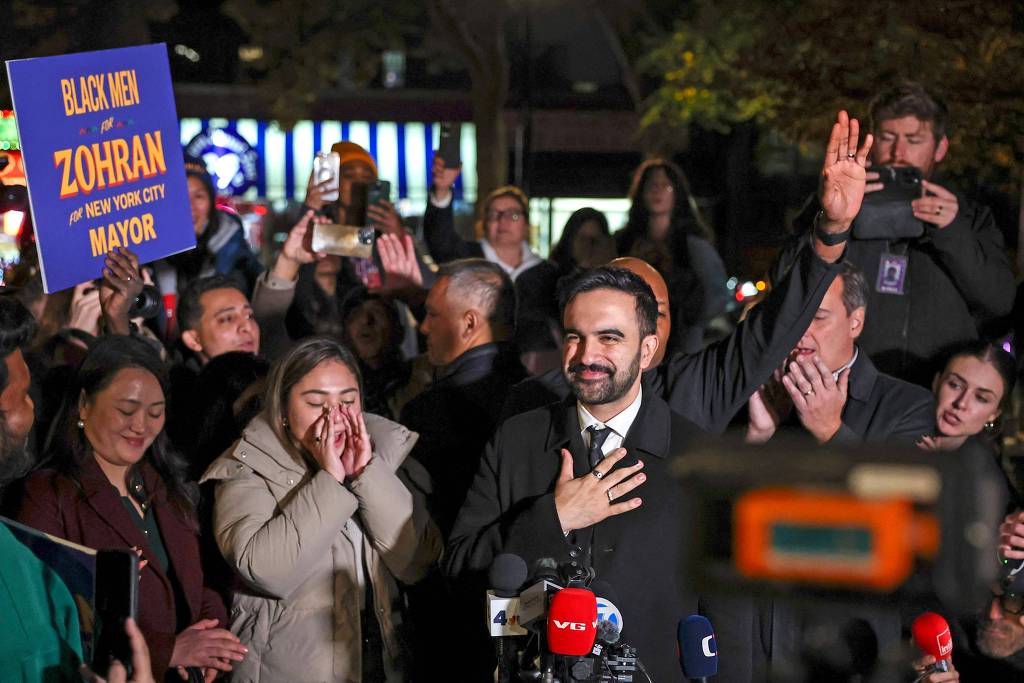
In the midst of the Trump era, the richest city in the United States can choose a self-proclaimed socialist to govern it. This Tuesday’s election (4) in New York pits Zohran Mamdani, 34, supported by Bernie Sanders and Alexandria Ocasio-Cortez, against former governor Andrew Cuomo, an independent candidate who received endorsement from President Donald Trump.
The dispute became a symbol of the clash between financial power and the new urban left.
Voting takes place until 9pm (local time), with early and postal votes already registered since last week. According to the city’s Electoral Board, 735,000 votes were cast in advance — more than four times the 2021 total.
In addition to the New York dispute, North American voters choose governors in New Jersey and Virginia and vote on a redistricting proposal in California.
The elections as a whole are treated by the country’s press as the first major political test of Donald Trump’s second term, which began nine months ago and was marked by institutional conflicts and economic slowdown.
In New York, the campaign exposed America’s ideological divisions. Mamdani faces former governor Andrew Cuomo, who is trying to return to politics as an independent after losing the Democratic primary, and Republican Curtis Sliwa, founder of the civil patrol group Guardian Angels.
The dispute was intensified by direct threats from Trump, who endorsed Cuomo and declared that he will cut federal funding if the city “falls into the hands of the extreme left”.
Who is Zohran Mamdani and what does he propose
The son of Indian immigrants, born in Uganda and raised in Queens, Zohran Mamdani became one of the most expressive voices of the new American left.
At 34 years old, the state deputy represents the socialist wing of the Democratic Party and defends structural reforms inspired by the agenda of Bernie Sanders and Alexandria Ocasio-Cortez — both among his main supporters in this election.
Elected to the New York Assembly in 2020, Mamdani gained prominence for denouncing the impact of financial capital on urban life. His program for city hall has as its axis the redistribution of space and wealth in the city, proposing measures that directly address the real estate market.
Among them, freezing rents for five years, progressive taxation on idle properties and large fortunes, free public transport and expansion of public housing under state control of urban land.
The campaign’s motto — “New York is Not For Sale” — expresses criticism of the dominance of developers and investment funds over local politics. In his speeches, Mamdani states that the electoral dispute is “between the right to live in the city and the power of money”.
He associates the housing crisis with the “inheritance of financial capitalism”, which, according to him, turned New York into a “showcase of global speculation”.
With direct language and strong popular appeal, the candidate mobilized young people, workers and immigrants, especially in the peripheral neighborhoods of Astoria, Jackson Heights and Corona, where he maintains community support networks and grassroots activism.
The most recent polls indicate Mamdani with 46.1% of voting intentions, an advantage of 14 points over Andrew Cuomo and almost 30 points over Curtis Sliwa.
As New York adopts the simple majority system, the candidate with the most votes wins, even without exceeding 50% of the valid votes. Still, a victory with an absolute majority would be seen as a clear political mandate for the Democrat’s agenda, consolidating Mamdani as the new national leader of the progressive field.
The strength of Mamdami’s campaign surprised even traditional observers of the Democratic party. Analysts point out that the socialist managed to expand the progressive electorate by incorporating issues of security and quality of life into an economic platform of redistribution.
His speech combines social criticism and administrative pragmatism, presenting the city as a space that should “produce well-being, not profits for the few”.
Trump’s adversaries and direct interference
Andrew Cuomo’s comeback attempt became one of the most controversial points of the election. Former governor between 2011 and 2021, he resigned after allegations of sexual harassment and is now trying to reposition himself as a pragmatic manager and “alternative to radicalism”.
His campaign, however, took on another shape when Donald Trump announced public support.
The president asked Cuomo for votes, called Mamdani a “threat to national security” and threatened to withdraw federal resources from the city if the socialist wins. The statement was criticized by Democratic mayors and parliamentarians, who classified it as authoritarian interference in a local electoral process.
Republican Curtis Sliwa, 71, is also in the race, although he appears far behind in the polls. A well-known figure on the New York right, he promises to “restore order” and evokes the climate of insecurity of the 1980s, when he founded the Guardian Angels.
In the final stretch, Mamdani reacted to Trump’s threats by stating that “democracy cannot be negotiated with federal blackmail” and that New York “does not bow to presidents who govern through fear”.
Democratic split and return of national figures
The New York dispute exposed the fragmentation of the Democratic party, divided between the progressive wing and the traditional establishment. Cuomo, although running as an independent, still attracts part of the party’s union and business base, while Mamdani represents the field of political renewal.
To avoid an internal collapse, national leaders returned to the campaign. Former President Barack Obama toured New Jersey and Virginia asking for votes for Democrats and criticizing “the illegality of Trumpism”.
Bernie Sanders and Alexandria Ocasio-Cortez participated in rallies in Queens, reaffirming Mamdani as a symbol of progressive resistance.
“The Democratic party is fragmented. It needs local victories to prove it still has direction,” Larry Sabato of the University of Virginia told New York Times.
In the Republican field, Trump’s speech dominates the national agenda. The president tries to remain a political reference even outside the polls, acting as an electoral leader and informal commander of the party.
The election results will serve as a measure of the real strength of your political movement.
Other votes and the national political climate
While the spotlight is focused on the electoral dispute in New York, other votes reinforce the national nature of this Tuesday’s election.
In the state of Virginia, Democrat Abigail Spanberger leads over Republican Winsome Earle-Sears, in an election marked by the effects of the federal shutdown and budget cuts promoted by Trump.
In New Jersey, Democrat Mikie Sherrill and Republican Jack Ciattarelli are technically tied, in a state where the dominant issue is the cost of living.
In California, the so-called Proposition 50 must be approved by voters and authorize the redrawing of the state’s electoral map, changing the borders of five districts that currently elect Republican deputies to the House of Representatives.
The measure, proposed by Governor Gavin Newsom and local Democrats, seeks to correct the political imbalance created after the redesign carried out in Texas, ordered by Donald Trump at the beginning of his second term.
In 2025, the Texas Republican government modified the voting map in order to transfer five seats from the Democratic opposition to the Republican Party, reinforcing conservative dominance in Congress.
Proposition 50, therefore, is the response of California, the most populous and most Democratic state in the country, to reverse the impact of the Texas redesign and open a new front in the national dispute for a legislative majority.
Currently, the House of Representatives is divided between 219 Republicans and 213 Democrats, making each seat decisive for political control in Washington.
If the measure is approved, California could hand over five new seats to Democrats in the 2026 legislative elections, temporarily balancing the correlation of forces in Congress.
Analysts describe the elections as a whole as a rehearsal for the 2026 legislative elections, when the Chamber of Representatives will be renewed.
With 57% disapproval, Trump keeps the country divided and faces growing opposition in big cities, but the Democratic Party has not yet consolidated a national alternative.
Source: vermelho.org.br