Published 10/20/2025 1:48 pm
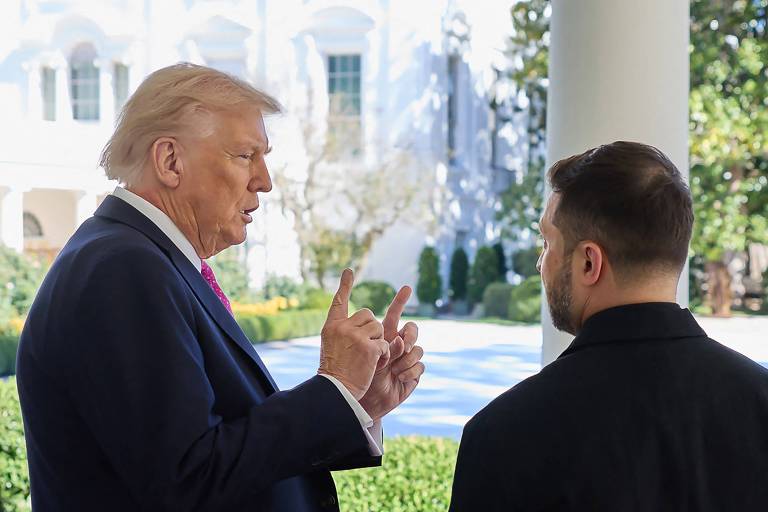
The President of the United States, Donald Trump, last Friday (17) pressured his Ukrainian counterpart, Volodymyr Zelensky, in a meeting at the White House, to accept Vladimir Putin’s conditions to end the war in Ukraine.
According to diplomatic sources Reutersthe Republican defended an immediate ceasefire on the current front lines and suggested that Kiev hand over the entire Donbas region to Russia, a day after having a long telephone conversation with the Kremlin leader.
The meeting was described by interlocutors as “tense” and “disappointing”. Trump reportedly tossed aside the frontline maps presented by Zelensky and insisted that “Putin will destroy you if you don’t agree now.”
The Ukrainian traveled to Washington to discuss sending Tomahawk missiles and new defense packages, but left empty-handed. The American president refused the request and declared that “both sides must stop at the battle line, go home, stop fighting and stop killing people”.
The meeting marked a turning point in the United States’ stance. In September, Trump said he believed Ukraine could “recover all lost territory and even advance further.”
The day before last Friday’s meeting, however, Trump held a call of around two and a half hours with Vladimir Putin, in which they discussed a possible territorial exchange and agreed on a new summit in Budapest.
According to European diplomats, the republican seemed “persuaded” that the Kremlin would be willing to negotiate peace in exchange for formal recognition of the occupations in Donetsk and Luhansk.
During the meeting, Trump was reportedly unreceptive to Zelensky’s explanations about the risks of handing over Donbas.
“There’s nothing we can do to save them. Try to give diplomacy one more chance,” the North American was quoted as saying, according to a European official interviewed by the Washington Post.
Another diplomat described the meeting as “a mess,” saying the US president “talked endlessly about not having received the Nobel Peace Prize.”
In response, Zelensky began a diplomatic offensive with European partners. Over the weekend, he stated that it is “very important that Europe maintains a unified position with Kiev” and called for a new meeting of the so-called “coalition of the willing” to coordinate the reaction to the American plan.
Polish Prime Minister Donald Tusk declared that “none of us should pressure Zelensky regarding territorial concessions,” and that “Europe’s solidarity with Ukraine is more important today than ever.”
Behind the scenes, European Union leaders are preparing a summit to discuss financial and military alternatives, including the use of frozen Russian assets as a form of compensation to Ukraine.
The issue gained momentum after the failure of the Ukrainian mission in Washington, which ended without agreements on defense, energy or financing.
The change of course in Washington worries allies and favors Moscow. By proposing to freeze the conflict, Trump reinforces the Russian discourse that “the war can end quickly if Kiev accepts the new territorial reality”.
For the Kremlin, the American position amounts to tacit recognition of Russian military advances.
Spokesman Dmitry Peskov stated that “the idea of stopping on current lines has been raised repeatedly” in talks with the US and that “Russia’s position remains unchanged”.
Analysts assess that Trump is trying to project himself as a “global peacemaker” after brokering the ceasefire in Gaza, but the initiative is seen in Kiev as capitulation.
The episode highlights Kiev’s diplomatic isolation and the weakening of Western cohesion in the face of war.
For Europe, the North American impasse reopens the debate on strategic autonomy and puts pressure on the bloc to maintain military and financial support for the Ukrainian resistance alone. The result, so far, is that Trump appears closer to Putin than to his NATO allies — and Zelensky, more isolated than at any other time since the start of the invasion.
Source: vermelho.org.br