Published 10/17/2025 10:10
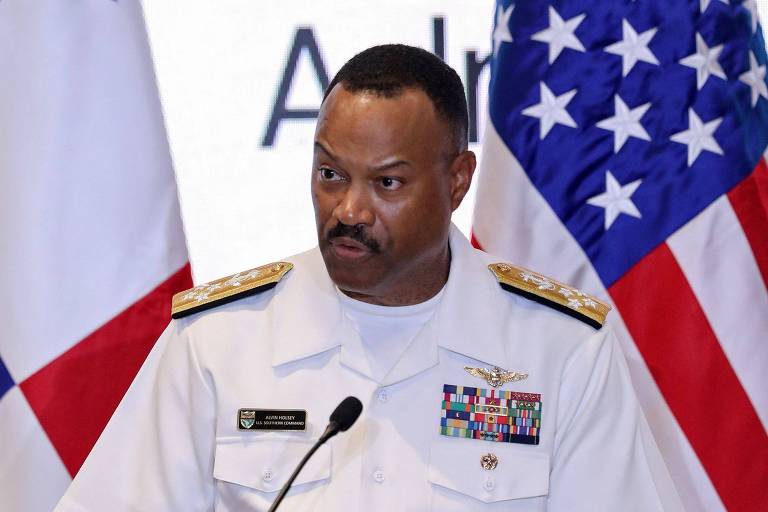
Admiral Alvin Holsey, commander of the Southern Command of the United States Armed Forces, announced this Thursday (16) that he will leave his position at the end of the year, two years ahead of schedule.
The decision, considered unexpected, comes amid escalating tensions between the Donald Trump government and Venezuela, and reignites the debate about the growing politicization of US military forces.
According to sources cited by the New York Times, Holsey expressed concern about operations in the Caribbean Sea, especially attacks against vessels allegedly involved in drug trafficking.
Since September, at least five boats have been hit by US special forces, leaving 27 people dead.
Other sources reported that laudatory statements from Holsey and Defense Secretary Pete Hegseth masked strong political tensions over the US role in the region and the degree of direct involvement in the actions.
The resignation came less than a week after the Pentagon announced that anti-drug operations in Latin America would no longer be coordinated by the Southern Command — based in Miami and traditionally responsible for diplomatic dialogue with countries in the region — and would be controlled by the II Marine Expeditionary Force, based in North Carolina and specialized in rapid attacks abroad.
The change was interpreted by analysts as an institutional emptying of the Southern Command and an attempt to centralize military decisions in the White House.
Democratic lawmakers reacted with concern. Representative Adam Smith, member of the House Armed Services Committee, recalled that “before Trump, I don’t remember any combat commander who left his post before the end of his term”.
Senator Jack Reed, top Democrat on the Senate Armed Services Committee, said that “at a time when U.S. forces are concentrated in the Caribbean and tensions with Venezuela reach a boiling point, the departure of our top commander in the region sends an alarming signal of instability in the chain of command.”
Holsey’s early resignation adds to a series of forced departures and retirements promoted by Hegseth since he took over the Pentagon, imposing an ideological and disciplinary turn in the Armed Forces.
Among the most notorious cases are that of General Charles Q. Brown Jr., the first black person to head the Joint Chiefs of Staff, and that of Admiral Lisa Franchetti, the first woman to command the Navy — both removed without detailed explanations.
Hegseth, a former Fox News host and close Trump ally, renamed the Defense Department the “War Department” and began advocating a “cultural purification” at the top.
The differences between the admiral and the government occur in the context of an unprecedented military mobilization in the Caribbean since 1994, when the US intervened in Haiti.
Today, around 10,000 soldiers, including 2,200 marines, as well as eight warships, a nuclear submarine and F-35 fighter jets, are deployed in the region. The White House claims that the objective is to combat drug trafficking and prevent the advance of what it calls “Venezuelan narco-terrorist groups”, but critics claim that it is a political destabilization operation against the government of Nicolás Maduro.
On Wednesday (15), Trump himself confirmed that he had authorized the CIA to conduct secret operations inside Venezuela, reinforcing the perception that Washington has returned to employing typical Cold War methods to intervene in internal Latin American affairs.
The initiative provoked an immediate reaction from the Brazilian government, which questioned the legality of the measure and the violation of Venezuelan sovereignty.
Holsey’s departure also highlights the clash between the so-called professional tradition of the Armed Forces — shaped by codes of institutional command and balance — and the personalist political logic of the current administration.
The New York Times described the episode as the clearest sign of an internal dispute between Trump’s political core and the top military leadership, at a time when the Pentagon seeks to redefine its doctrine of international engagement.
Throughout his 37-year career, Admiral Holsey was considered a discreet officer, with a technical profile, and one of the few four-star black officers on active duty.
He assumed Southern Command in November 2024, after having headed aircraft carrier strike groups and naval air units.
In a message published on social media, he simply stated that “it was an honor to serve the nation, the American people and defend the Constitution for more than 37 years”.
For observers in South America, the change in US military command should be read as a symptom of instability at the center of Washington’s power and a warning for the resumption of interventionist practices in the region.
The use of the war on drugs as a justification for unilateral military actions and the replacement of Southern Command with expeditionary forces signal a dangerous shift in North American foreign policy towards the logic of permanent war.
Source: vermelho.org.br