Published 10/15/2025 17:37 | Edited 10/15/2025 18:25
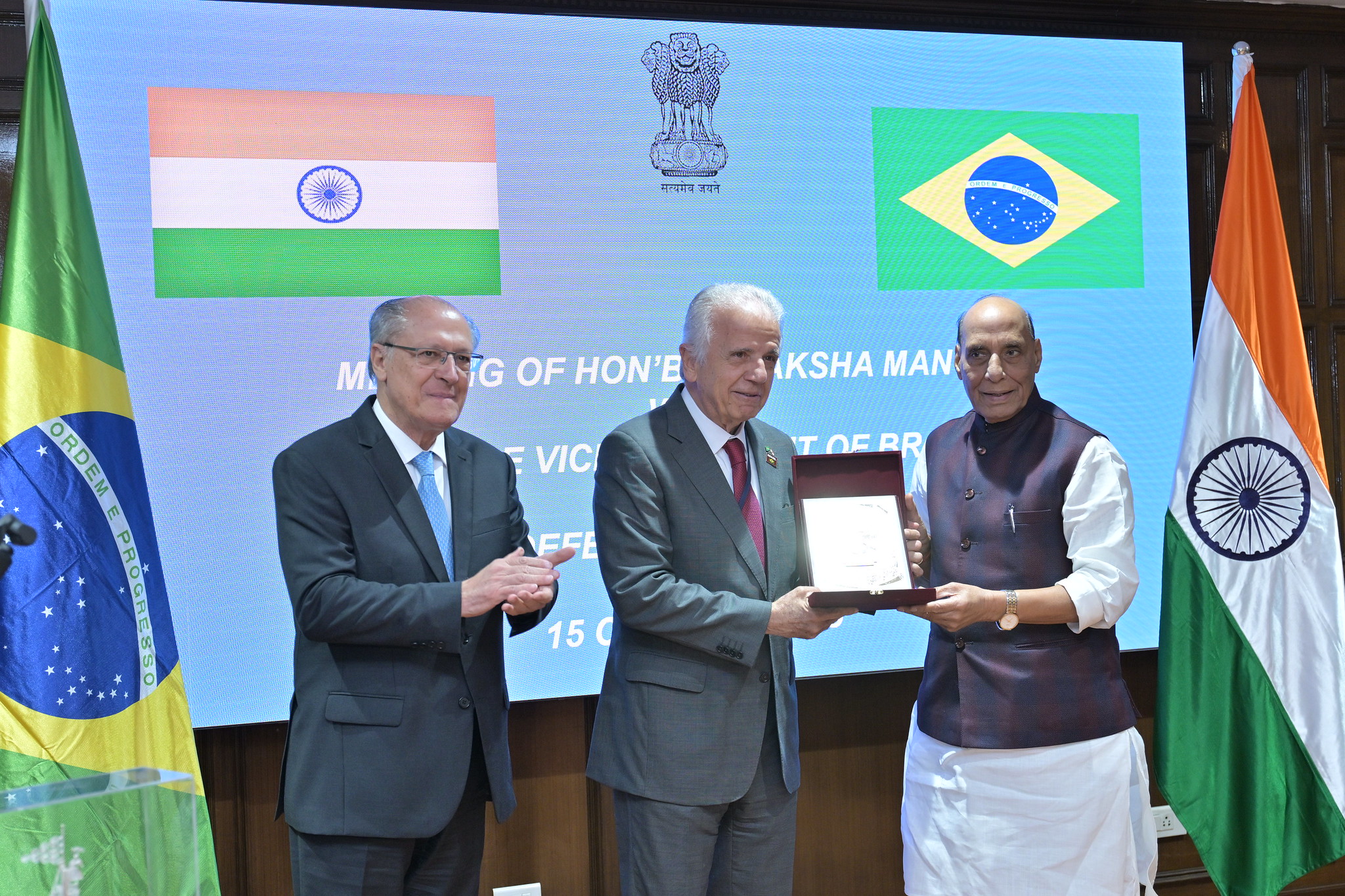
The meeting held this Wednesday (15), in New Delhi, between the vice-president and minister of Development, Industry and Commerce, Geraldo Alckmin, the Minister of Defense, José Múcio Monteiro, and the Minister of Defense of India, Rajnath Singh, marked a new level in strategic cooperation between Brazil and India.
The meeting is part of the official Brazilian mission to India, which seeks to consolidate partnerships in trade, defense, energy, technology and investments, continuing the commitments signed between President Luiz Inácio Lula da Silva and Prime Minister Narendra Modi in July.
“It is a great pleasure to reinforce the dialogue between Brazil and India in the area of defense, a sector in which we share a vision of strategic autonomy, technological cooperation and global balance”, stated Alckmin.
In the context of geopolitical tensions and attacks on multilateralism, the advancement of the partnership between two members of the BRICS is interpreted as a sign of the reconfiguration of global alliances. The agenda reinforces the role of Brazil and India as voices from the Global South, which seek greater weight in international governance.
Defense: cooperation between navies, aircraft and military technology
Minister José Múcio highlighted that the defense area is one of the most promising in the bilateral relationship. According to him, the two countries already have dialogue between the commands of the Armed Forces and are studying joint operations and forms of technological cooperation.
One of the central themes is the maintenance of the Scorpène submarines, a French model used by both the Brazilian Navy and the Indian Navy.
“We are discussing joint operations. They are acquiring radar planes that we are bringing from Brazil for adaptation here. We are also studying cooperation in the maintenance of submarines, since our models are similar”, explained Múcio.
Another highlight is the advancement of negotiations on the sale of six Embraer E-145 aircraft, which would be converted into advanced warning and air control platforms for India. The Brazilian company is also negotiating the sale of the C-390 Millennium multi-mission military freighter, with the possibility of local co-production with Mahindra Systems.
During the mission, Embraer inaugurates its regional office in New Delhi, a milestone in the consolidation of its presence in the Indian market.
Strategic opportunity: Tejas Mk1A and FAB modernization
A sensitive technical point of the visit is the possible exchange of interests between Brazil and India: if India selects the KC-390 for its medium transport fleet, Brazil will be able to acquire the Indian HAL Tejas Mk1A light fighters, as replacements for the aging AMXs of the Brazilian Air Force (FAB).
The Tejas, with performance and combat radius similar to the AMX, offers superior speed and maneuverability and can fill the FAB’s urgent operational gaps.
Currently, Brazil has only 17 fully operational combat aircraft, a number considered critical for a country of continental dimensions. The recommended minimum would be around 100 aircraft for a defense appropriate to its geopolitical position.
The eventual partnership with India would diversify suppliers and reduce the risk of dependence on NATO countries, such as Sweden, manufacturer of the Gripen E, whose delivery is delayed.
Industrial cooperation and technology transfer
In addition to defense, the Brazilian mission focuses on co-production and technology transfer in strategic sectors such as armored vehicles, ammunition, radars and aerial systems.
“The time is ripe to deepen the relationship in light of the expansion of the Indian defense industry and its supplier diversification strategy. Brazil and India share the ambition of developing an autonomous defense capability, anchored in mutual trust and the search for their own technological solutions”, declared Alckmin.
Cooperation reflects a new model of South-South partnership, in which local production, innovation and industrial autonomy replace the old paradigm of technological dependence.
Expansion of trade and new integration fronts
Trade and investment are also at the heart of the mission. From January to May 2025, Brazilian exports to India grew 14.8%, reaching US$ 2.39 billion, while imports increased 31.8%, consolidating the Asian country as the 11th export destination and 6th largest supplier to Brazil.
The plan is to expand the Mercosur–India tariff preference agreement, currently restricted to 450 products, opening space for new diversification of the trade agenda.
“We will expand markets and reciprocal investments. Brazil and India have technology, scale and inclusion — we can grow together in a sustainable way”, declared Alckmin.
Biofuels, health and digital technology
The mission also includes five strategic axes of cooperation:
- Health industrial complex — expansion of cooperation in generics and pharmaceutical inputs, strengthening the SUS;
- Biofuels and energy transition — policy integration for ethanol and sustainable aviation fuel (SAF);
- Defense and aeronautical industry — opening of the Embraer office and partnerships in military co-production;
- Agroindustry and food security — increase in Brazilian exports of proteins and processed foods;
- Digital transformation — partnerships in digital public infrastructures and data centers, inspired by Indian solutions.
Alliance of the Global South: a counterpoint to unilateralism
The strengthening of the Brazil-India relationship occurs in a scenario of rearrangement of the international order. Both countries defend a balanced multipolarity, resisting pressure from great powers and reinforcing cooperation between nations in the Global South.
The mission led by Alckmin and Múcio symbolizes the resumption of Brazil’s international protagonism, no longer as a mere exporter of commodities, but as a strategic actor in defense, innovation and technological diplomacy.
“India is the fifth economy in the world, Brazil is the eighth. Our countries are regional leaders and share the same world vision: sovereign development with social inclusion”, summarized Alckmin.
With information from Sputnik News
Source: vermelho.org.br