Published 10/14/2025 14:23
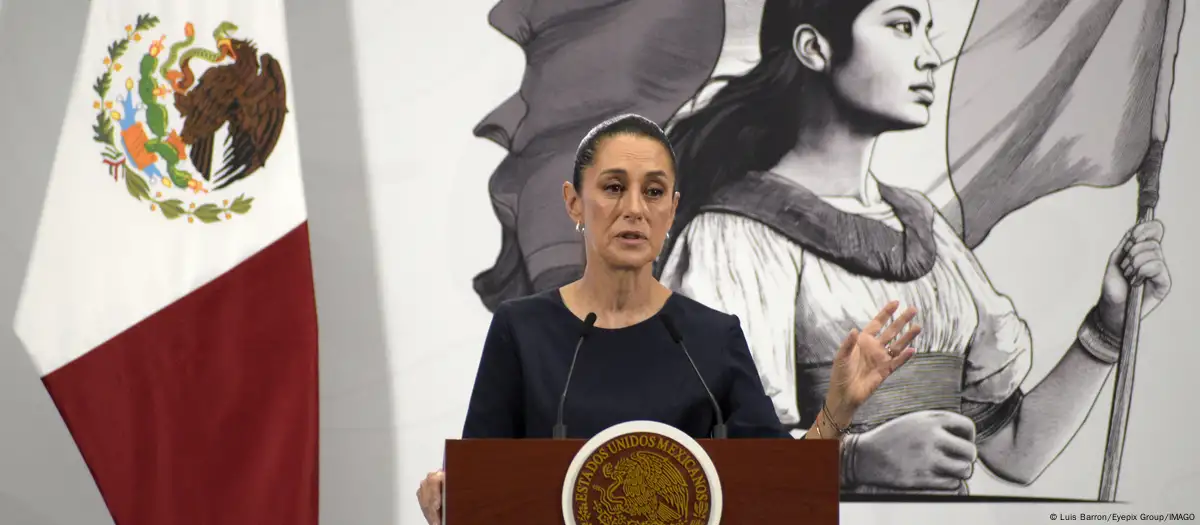
The president of Mexico, Claudia Sheinbaum, announced this Monday (13) that she will not participate in the 10th Summit of the Americas, scheduled for December 4th and 5th, in Punta Cana, Dominican Republic.
During his daily press conference — known as La Mañanera del Pueblo — Sheinbaum was blunt: “No, I will not participate.”
The decision comes in protest against the exclusion of Cuba, Nicaragua and Venezuela from the hemispheric meeting, determined by the Dominican government under the justification of “avoiding political polarization”. The president stated that her government is considering sending a representative from the Secretariat of Foreign Affairs, but reinforced that “Mexico will never agree to the exclusion of any country”.
Sheinbaum’s position reaffirms the tradition of independent foreign policy that Mexico has maintained since the governments of Lázaro Cárdenas and was strengthened under Andrés Manuel López Obrador, whose political successor she is.
Exclusion repeats Washington policy
The controversy was caused by the decision of ultra-right President Luis Abinader, aligned with the White House, not to invite Cuba, Venezuela and Nicaragua to the summit. The Dominican government justified the measure as necessary to guarantee “the greatest possible adhesion” from other countries, echoing the speech used by the United States when, in 2022, then-president Joe Biden also prevented the participation of these same nations in the Los Angeles Summit.
The argument, however, contradicts the promise made by Abinader when assuming the pro tempore presidency of the forum: to organize an “inclusive summit”. In practice, the Caribbean country broke with its diplomatic tradition — in previous editions of multilateral forums based in the Dominican Republic, such as the 2023 Ibero-American Summit and the 2017 CELAC, Cuba and Venezuela participated normally.
In response, the Cuban government classified the decision as a “surrender to unilateral pressure from the United States” and warned that the exclusion of Latin American countries “revives the Monroe Doctrine and the gunboat policy”, historical symbols of North American interventionism.
Sheinbaum: “We need to take care of the country”
In addition to the diplomatic issue, Sheinbaum highlighted that the internal situation requires priority, referring to the heavy rains that caused flooding in several regions of Mexico, with 64 confirmed deaths. “Given the current circumstances, it is necessary to take care of the country,” he stated.
Since assuming the presidency, in October 2024, Sheinbaum has made only four international trips, all of a multilateral nature: to the G20 in Brazil, to Celac in Honduras, to the G7 in Canada and to a trilateral meeting in Guatemala. The caution reflects a diplomacy with low international exposure, but with a strong symbolic charge, guided by sovereignty and regional solidarity.
Latin American reaction and Peoples’ Summit
Sheinbaum’s absence adds to a broad wave of diplomatic protests. Delegates from 35 countries in Latin America, the Caribbean and other regions met on October 12 in Mexico City and decided to convene a “Peoples’ Summit”, to be held on the same dates as the official meeting, in Santo Domingo.
The objective is to give a voice to excluded nations and reaffirm the principle of self-determination of peoples.
Diplomatic continuity and coherence
Sheinbaum’s decision continues the stance adopted by Andrés Manuel López Obrador, who also boycotted the 2022 summit for the same reasons. At the time, then-chancellor Marcelo Ebrard represented Mexico at the event.
By refusing the invitation, Sheinbaum reinforces the historical line of Mexican diplomacy, which rejects external interventions and defends dialogue between equals. His decision resonates with political force: a gesture of autonomy in a hemispheric scenario marked by dependence on Washington.
More than an act of solidarity with Cuba, Venezuela and Nicaragua, the boycott symbolizes a critique of political selectivity in regional forums — and reaffirms Mexico’s role as one of the few voices in the region willing to confront North American hegemony in defense of a sovereign and plural Latin America.
Source: vermelho.org.br