Published 10/10/2025 13:53
1 – Preparing the flight
A change will come
I usually study, read or simply “spend time” listening to blues, a musical genre that I incorporated into my daily life in the early 2000s, regretting that I did so late.
The habit allows my mind to relax, embarking on imaginary journeys through different parts of the world, traveling different paths and unexpected destinations. I seek to get closer to places that can help us understand, even if in a limited way, this blue planet floating in space, known by geography as Earth.
On one of those occasions I heard, for the “trillionth time”, “A change is gonna come”, released in 1964, during the height of the struggle for the civil rights movement in the USA, composed by Sam Cooke, a black American, and inspired by his own experiences of racism, exclusion and hope for justice. Beth Hart’s interpretation of this song, in fact, is one of my favorites.
The “river” — “I was born near the river, in a little tent. Oh, and just like the river, I’ve been running ever since…” —, right at the beginning, represents both the humble beginnings and the idea of life’s constant flow and struggle.
The crisis of the Western world, which I deal with in my last article — “The twilight of the West – anatomy of an announced crisis” — is not just a decline of hegemonies, but the synthesis of a profound historical paradox.
Faced with geopolitical fragmentation, the rise of the global South and the frenetic pace of transformation, it is possible to find in Sam Cooke’s blues a guiding thread to think about the new cycle of history.
2 – Taking off
“I was born near the river, in a small tent…”
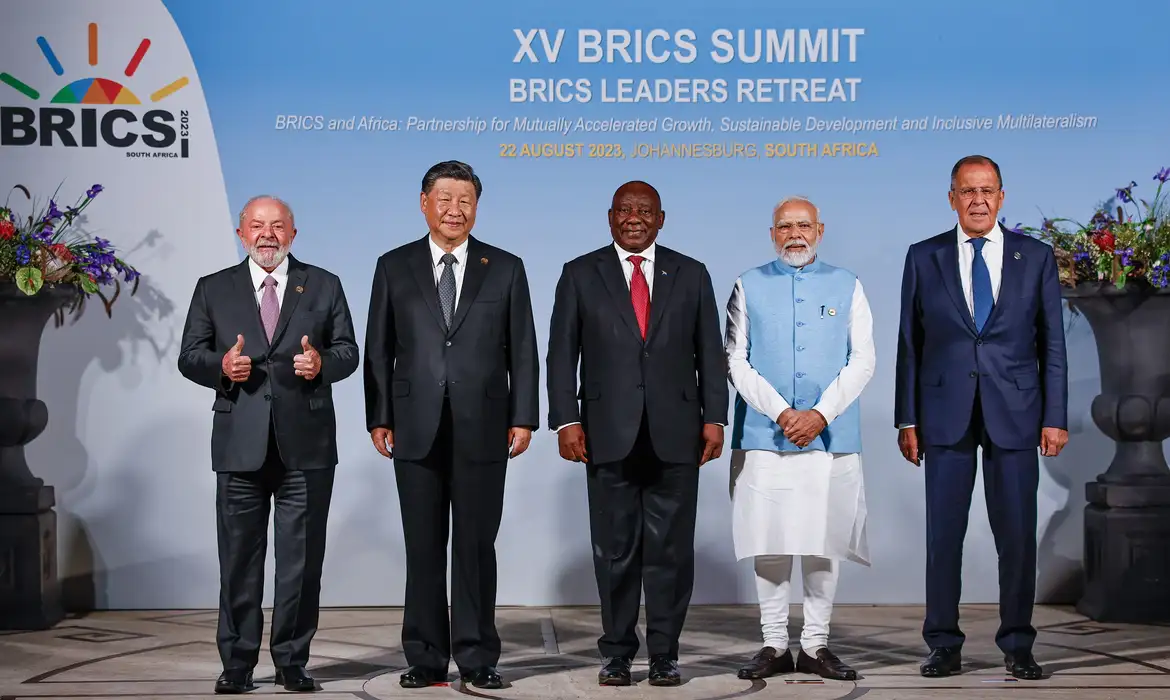
Like emerging civilizations, the BRICS and partners from the global South began on the margins of the great flows. The 17th BRICS Summit, held in July 2025 in Rio de Janeiro, consecrated this crossing — the bloc now has ten full members: Brazil, Russia, India, China, South Africa, Egypt, United Arab Emirates, Ethiopia, Iran and Indonesia, announced in January this year.
Furthermore, the grouping incorporated ten partner countries: Belarus, Bolivia, Kazakhstan, Cuba, Malaysia, Nigeria, Thailand, Uganda, Uzbekistan and Vietnam. Together, the BRICS represent close to 50% of the world’s population and account for approximately 40% of global GDP at purchasing power parity.
While full members lead initiatives and make decisions by consensus, partner countries participate in specific projects and signal the group’s expansive influence. Brazil’s leading role in the 2025 “pro tempore” presidency reinforces that the new is born from the meeting of people and experiences previously silenced, who seek autonomy and their own voice in the international system.
“It’s been hard to live, but I’m afraid of dying…”
Traditional blocs resist change, fearing losing their privileges. The United States and Europe face economic slowdown, migration crises and political fragmentation, hesitating in the face of the need for structural reforms. The fear of breaking up with the old is the central obstacle.
Xi Jinping, in this context, calls, through his proposal for a new global governance (GGI, in English), a “new era” of international relations, where sustainable development and cultural diversity are priorities to democratize global power and build a truly multipolar world. It offers us a “community with a shared future”, also discussed by me on a previous occasion.
“…Someone keeps telling me ‘don’t hang around’…”
Emerging powers still face barriers, whether sanctions, institutional limitations or exclusion from decisive forums. Brics, however, is moving forward with new initiatives: 1. economic partnership strategy for 2030; 2. strengthening public-private partnerships; 3. climate resilient infrastructure; 4. sustainable financing and 5. agreements on artificial intelligence and the elimination of socially determined diseases, actions that seek to break down access barriers and modernize the rules of the international game.
3 – Turbulence
“I’m looking for my brother… but he ends up knocking me down…”
Flight turbulence is inevitable. Even with the route set towards multipolarity, the BRICS face headwinds that test the solidity of the formation.
The contradictions do not only emerge from external resistance: a) Western sanctions on Russia that affect the bloc’s entire production chain; b) diplomatic pressure from the USA and Europe to isolate “dissident” countries and c) attempts to block reforms of the multilateral system, but they also arise from internal dynamics themselves.
The energy paradox
Externally, sanctions aimed at penalizing Moscow ended up benefiting importers such as India and China, which increased their purchases of Russian oil from 2% to around 20% of the total. The war in Ukraine, initially polarizing, led to distinct diplomatic initiatives, including a peace proposal presented jointly by Brazil and China in 2023.
When brothers face each other
Domestically, Sino-Indian tensions in the Himalayas, with clashes that left 20 Indian and four Chinese soldiers dead in 2020, continue to cast shadows on cooperation. The economic asymmetry remains striking, with China and India concentrating most of the group’s productive and commercial capacity.
Systems in conflict
The coexistence of “models” of democracies makes it difficult to reach consensus on sensitive issues such as human rights and freedom of the press. The disagreements on energy transition illustrate another critical issue: oil producers (Russia, Iran, United Arab Emirates) and large importers (China, India) have often antagonistic interests in defining climate goals.
Sailing the storm
Even so, these turbulences are not insurmountable obstacles, but a natural part of the historical crossing. The ability to transform contradictions into complementarities will determine whether the bloc will be able to land in the new multipolar world that it so desires.
5 – Landing
“I know a change will come, yes, it will”
In the blues, the chorus is hope and announcement. On the geopolitical board, the reform of global institutions is a central theme, defended by Lula, Xi Jinping, Cyril Ramaphosa, Modi, Putin and other leaders, to guarantee a voice for the Global South, make the Security Council responsive to current challenges and practice true multilateralism.
Concrete proposals are already on the table: reviewing mandates, increasing efficiency, including new member states and adapting to climate, financial and digital challenges.
The creation of financing mechanisms for sustainable development and alternative international payment systems demonstrate that ambition goes beyond rhetoric.
The strength of resilience
The data confirm the growth of influence: rising human development rates, economic growth projections for 2025 higher than the world average in the case of India (6.2%), Indonesia (4.7%), Ethiopia (6.6%), and the consolidation of strategic partnerships that redraw the geography of global power.
The new can only be consolidated if it learns from the pain of the journey, overcomes rivalries and invests in common projects. The twilight of the West is more than a decline — it is the historic chance to reinvent the bases of global power, to open plural paths and to dialogue with the hope that transformation is the result of the collective action of those who dare to challenge the old.
Just as Sam Cooke sang, “it was a long wait”, but everything indicates that, now, the change is here to stay. The music continues, the river follows its course, and the Brics learn that true strength does not come from the absence of turbulence, but from the ability to fly through it.
Maybe now I deserve a glass with a generous dose of whiskey…
Source: vermelho.org.br