Published 10/07/2025 11:10 | Edited 10/07/2025 11:24
The massacre in Gaza completes two years this Tuesday (7) with a result that summarizes the Palestinian tragedy: more than 67 thousand dead, 170 thousand injured, famine officially recognized by the UN and a territory reduced to rubble.
The conflict has already been formally classified as genocide by two international courts. The International Court of Justice accepted South Africa’s complaint against Israel for violating the 1948 Convention and issued precautionary orders demanding an immediate end to military operations and the guarantee of humanitarian aid.
The International Criminal Court has now opened proceedings against Prime Minister Benjamin Netanyahu and Defense Minister Yoav Gallant, accusing them of genocide, war crimes and crimes against humanity.
Since the start of the Israeli offensive, on October 7, 2023, after Hamas’ attack on southern Israel, the siege imposed by Tel Aviv has transformed the Strip into an open-air prison, where survivors fight for water, food and space in improvised shelters.
Reports from the UN, the World Health Organization and Brown University classify the conflict as one of the greatest humanitarian disasters of the century, worsened by military and financial support from the United States and the inaction of Western powers in the face of evidence of genocide.
The total blockade, which has lasted 24 months, has decimated the enclave’s civil and health infrastructure.
According to the United Nations’ UNOSAT satellite program, 193,000 buildings were destroyed or severely damaged, which corresponds to almost 80% of the buildings in Gaza.
The World Bank estimates the direct losses caused by the offensive at US$55 billion.
Almost the entire water and sewage network has been rendered unusable: 89% of sanitation facilities are out of operation, and 96% of families do not have regular access to drinking water.
According to the United Nations Office for Humanitarian Coordination, half of the population currently lives on less than six liters of water per day, an amount insufficient even for basic survival.
In hospitals, the collapse is total. Of the 38 medical units that existed before the war, 25 were closed and 13 operate precariously, without anesthetics, energy or basic supplies.
The World Health Organization counts 790 attacks on hospitals and ambulances, which the International Criminal Court classifies as war crimes.
At least 1,722 health professionals were killed, and 28 doctors remain imprisoned in Israel, including specialists in surgery, pediatrics and intensive care. Two died under torture.
The deliberate destruction of medical units and the detention of their staff turned Gaza’s healthcare system into an extension of the battlefield.
Hunger has become the new form of extermination Since August, the UN has officially recognized a situation of widespread hunger in the enclave, the first declared in the Middle East. The IPC (Integrated Food Security Classification) system indicates that 641,000 Palestinians live in catastrophic conditions, and 459 died from starvation, including 154 children.
With the entry of the Gaza Humanitarian Foundation (GHF) — created with support from Israel and the United States — in control of food distribution, what was seen was a worsening of the tragedy.
Reports from Al Jazeera and the Israeli newspaper Haaretz reveal that 2,600 Palestinians were killed and 19,000 were injured while trying to collect food from distribution areas surrounded by the Israeli military.
Soldiers reported receiving orders to “open fire” on hungry crowds.
The war also destroyed the right to education and childhood. According to the UN, 658 thousand children and 87 thousand university students are without access to classes. More than 2,300 schools and universities were destroyed, and the few that remain operate as shelters. In two years, 40,000 children were orphaned, 13,000 women were murdered and another 700 remained missing.
The birth rate fell 41% in the first half of 2025 compared to the same period the previous year, and the number of miscarriages grew 300%. Palestinian doctors report that pregnant women give birth in rubble and that one in five women has premature or underweight children.
Israeli prisons currently house 10,800 Palestinians, including 450 children and 87 women, detained under the “administrative detention” regime, which allows for indefinite imprisonment without formal charges.
Human rights organizations denounce torture, disappearances and extrajudicial executions. More than 3,600 prisoners have been detained for more than a year without trial, which constitutes a direct violation of international humanitarian law.
Despite the scale of the destruction, the Israeli government remains supported by Washington.
Two reports published by Brown University and the Quincy Institute for Responsible Statecraft reveal that, since the start of the war, the United States has allocated more than US$21 billion in direct military aid to Israel, a figure that exceeds US$33 billion when combined with joint operations in the region.
The financing guaranteed the supply of weapons, ammunition and technology used in attacks on Gaza, Lebanon, Syria and Iran.
“Israel needs American weapons to do what it’s doing. It produces certain technologies, but it doesn’t make the bombs — without the US, it wouldn’t be able to launch them,” said researcher Omar H. Rahman of the Middle East Council on Global Affairs.
Lead study author William D. Hartung concludes that the Israeli army “could not have caused such destruction in Gaza nor expanded its war without Washington’s funding, weapons and political backing.”
The bipartisan alliance that supports the supply of weapons is old: both Joe Biden and Donald Trump signed new billion-dollar sales and military assistance packages.
For analyst Matt Duss, from the Center for International Policy, “even with the most fragile social protection network in the developed world, the US always finds billions to finance Israel’s wars”.
Meanwhile, the perception of Tel Aviv’s political isolation is growing. A UN commission of inquiry concluded that Israel committed “acts of genocide” in the Gaza Strip, and the International Court of Justice opened formal proceedings against the Netanyahu government.
European countries such as France, the United Kingdom and Canada recognized the Palestinian state, and the Israeli prime minister’s speech at the United Nations in September was met with the abandonment of entire delegations. Domestically, Netanyahu faces daily protests, divisions in his coalition and the collapse of his international image.
Even with the almost total destruction of the territory, Palestinian factions claim that the resistance has not been defeated.
In a joint statement, the groups stated that “Israel failed to eliminate Hamas and release hostages by force” and declared that “no one is allowed to renounce the weapons of the Palestinian people.”
The offensive, they say, represents “a war of extermination waged under the complicit silence of the international community.”
Gaza has also become the deadliest territory on the planet for journalists. Since 2023, almost 300 press professionals have been killed, including ten from Al Jazeera.
UN special rapporteur Irene Khan claims that Israel conducts “a policy of extermination of information”, combining censorship and murder of reporters.
“Israel first delegitimizes and discredits the journalist, accuses him of supporting terrorism — and then kills him. It’s not just about killing journalists, it’s about killing history,” he said.
According to Brown University’s Costs of War project, more journalists were killed in Gaza than in the wars in Korea, Vietnam, Yugoslavia, Afghanistan and the two World Wars combined.
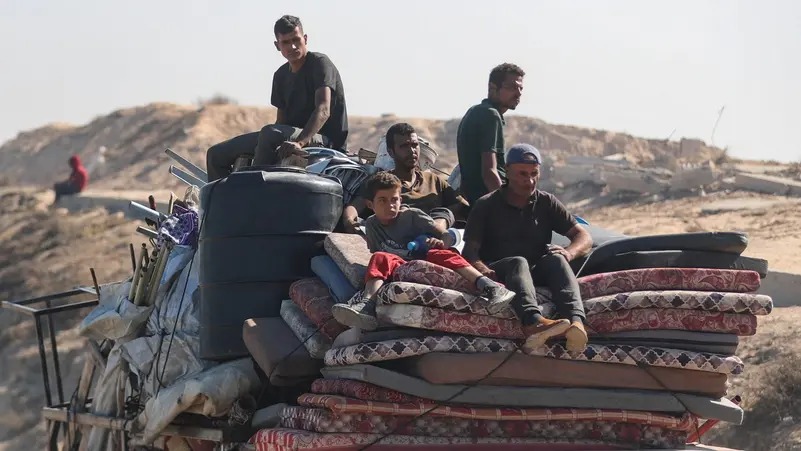
Two years later, the territory remains under bombardment, famine and mass displacement.
Negotiations mediated by Egypt, Qatar and the United States remain without agreement. The Qatari government stated that there is “an American commitment that the ceasefire will not be temporary”, but acknowledged deep differences over the total withdrawal of Israeli troops and the exchange of prisoners.
Netanyahu declared that “the war is approaching an end”, but the Israeli army threatens to resume attacks if talks fail.
The war that began in response to an attack has become a machine of permanent destruction. Gaza is today a mutilated territory, without hospitals, without schools and without electricity.
What remains, according to Palestinian diplomats, is an exhausted people, surrounded by ruins and global indifference.
“What they did in 1948 with ethnic cleansing,” said a representative in Geneva, “they are now doing with genocide. Gaza is the mirror of the world — a cracked mirror that everyone prefers not to face,” said the Al Jazera.
Source: vermelho.org.br