Published 29/09/2025 12:27 | Edited 29/09/2025 12:43
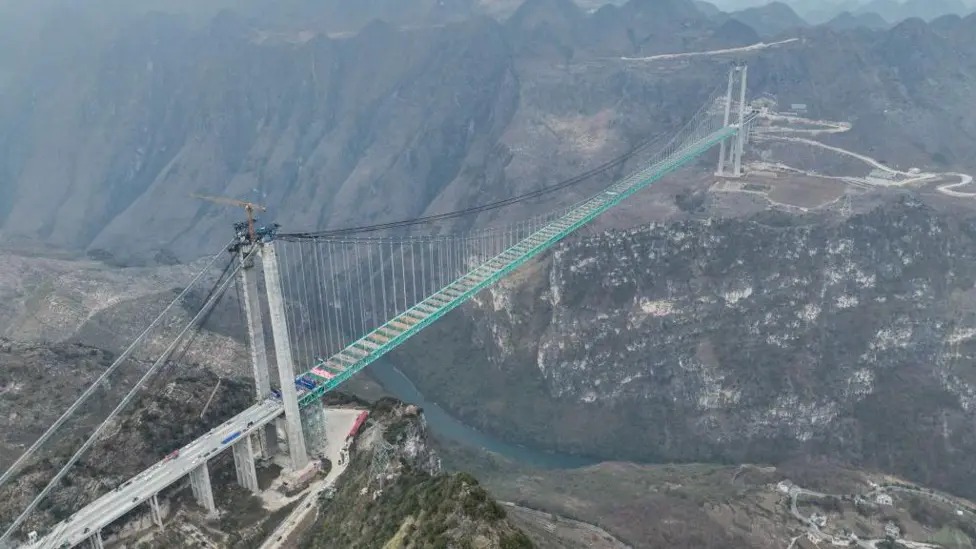
China inaugurated this Sunday (28) the Huajiang Great Canyon Bridge in Guizhou, in the country’s southwestern western, consolidating the largest world record ever reached by a type structure.
Raised 625 meters above the Beipan River, the bridge is almost nine times the height of Golden Gate, in San Francisco, and establishes another milestone: the largest main span in the mountainous region, with 1,420 meters.
With 2,890 meters long, the work reduced the two -hour canyon crossing time to just two minutes after three years of construction.
The project, which began in 2022, attracted international attention and was presented by the authorities as an example of the Chinese approach to overcoming rugged terrain through cutting -edge engineering.
The province of Guizhou, the only one in the country without plains and marked by deep ravines and steep mountains, historically depends on tunnels and bridges to overcome the charsic landscape.
Since 2012, the local government has accelerated investments and has added more than 32,000 bridges built or under construction – ten times more than in the 1980s.
Guizhou houses almost half of the world’s top 100 bridges, including the first three, which earned him the title of “Museum of Bridges of the World”. The former world record holder was also located in the region, over the same Beipan River, about 100 kilometers, with a height of 565.4 meters.
The new structure, in addition to overcoming the previous record, should relieve pressure on the expressway Shanghai-Kunming, one of China’s main road axles, and integrate the province to the Western land corridor, considered strategic for regional development.
The magnitude of the project involved unpublished challenges. According to Yuan Quan, president of the investment group responsible for the work, the difficulties included complex geological conditions, strong winds in the canyon and extreme demands of precision at altitude.
To overcome them, engineers have used new technologies such as drones, intelligent monitoring systems, satellite navigation and ultra-high resistance materials.
The work achieved millimeter accuracy at full altitude and resulted in 21 technical innovations.
Yang Jian, chief engineer of the project, explained that the height of the bridge was not determined by the search for records, but by the technical need to avoid long and expensive tunnels. “Only when we concluded the project we realized, stunned, that the bridge would be more than 600 meters high,” he said.
For Zhang Yin, head of the province’s Transport Department, it is an emblematic project that displays Chinese innovation and proves the country’s world leadership in Bridge Engineering in Charsic Regions.
Epens Ge Yaojun said the DIARY OF THE PEOPLE that “Guizhou demonstrates that the complex terrain is not a restriction, but a catalyst for innovation.”
Wu Chaoming, project manager, recalled that in his childhood the trip to the provincial capital depended on a single crowded bus, in contrast to the current connectivity. He himself traveled 15 kilometers of inspection on foot for the work, more than a third of a marathon, to ensure execution.
In addition to the logistics function, the Huajiang Great Canyon Bridge was conceived as a tourist destination.
The Guizhou government plans to transform the 50 square kilometers around into an integrated leisure, science and extreme sports.
Attractions such as a panoramic coffee 800 meters high, observation platforms, paragliding, bungee jump without rope, altitude runway and water screen light shows are foreseen.
The potential was recently demonstrated in the first international triathlon challenge of the highest bridge in the world, with almost 200 athletes from 20 countries.
“For me, the hardest part of this race was not to distract me with the impressive view,” said Australian Joshua Pedlow, 19.
Authorities predict that more than one million tourists visit the structure annually, boosting local sectors such as lodging, food, selling agricultural products and handicrafts.
Source: vermelho.org.br