Published 09/22/2025 19:24
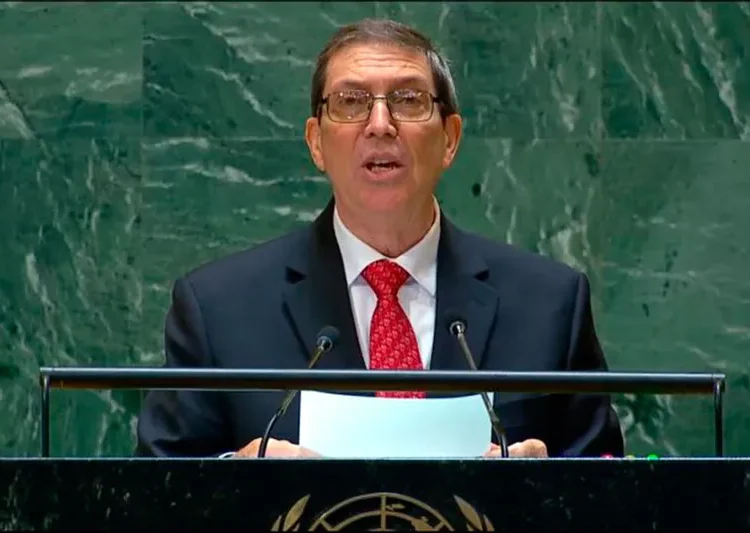
The economic blockade imposed by the United States to Cuba more than six decades returned to the center of the international debate. In a current report presented last Wednesday (17) by Chancellor Bruno Rodríguez Parrilla, the Ministry of Foreign Affairs (Minrex) details the devastating impacts of this imperialist policy, which not only strangle the Cuban economy, but deepens the human suffering of a people who were born under arbitrary restrictions.
According to the document, losses between March 2024 and February 2025 reached US $ 7.556 billion – a 49% jump compared to the previous period. Prepared for the UN General Assembly debate on the resolution “Need to End Blocking” on October 28 and 29, the report has revealed total damages since 1962 of US $ 170.677 billion, or $ 2.103 trillion adjusted to gold enhancement. “It is impossible to translate in figures the pain and deprivation that this policy imposes on Cuban families,” said Rodríguez Parrilla before the diplomatic corps in Havana. “This has been happening for several generations; more than 80% of Cubans were born after the start of the blockade,” he said.
The human cost of an obsolete policy
The numbers are eloquent: without blocking, the Cuban gross domestic product would have grown 9.2% – one of the highest rates in the hemisphere. Strategic sectors such as exports, foreign trade, telecommunications and health suffer billionaire losses. The report shows that two months of loss would be enough to ensure fuel or the annual basket of the entire population; In just 14 hours, the wasted value would cover the insulin of all diabetics in the country.
In addition to depriving resource island, Washington also pursues Cuban medical cooperation actions, restricts access to cutting -edge medicines and blocks financial transactions – by 2024, 40 international banks refused to operate with Cuba, while 140 transfers were rejected. The list of obstacles has grown in recent years with the arbitrary of Cuba on the list of countries “sponsors of terrorism” and the activation of Title III of Helms-Burton Law, which intimidates foreign companies under threat of judicial sanctions.
Diplomatic setbacks and economic persecution
If the Obama era (2014-2017) signaled the possibility of approach, the following years were marked by setbacks. Donald Trump has reversed the advances, reinstating restrictions on travel, waging energy agreements and imposing new barriers on tourism and commerce. Under its “maximum pressure” policy, economic persecution has returned to centrality, a strategy now reinforced by the July 2025 presidential memo.
American and European independent studies confirm the dimension of disaster. The Columbia Law School estimates that the lock removes 1 to 2 percentage points of Cuban growth. Already the European Economic Review He exposed the extraterritorial effects that isolate the island of international trade. For the UN, it is a clear violation of the United Nations Charter and a direct obstacle to the sustainable development objectives.
The world says no to blockade
The international clamor is practically unanimous. In the latest resolutions of the UN General Assembly, until 187 countries voted for the end of hostile policy, classifying it as “immoral” and “contrary to international law”. Regional organizations such as Celac and Caricom also reaffirmed solidarity, while the European Union has publicly condemned the extraterritorial effects of the embargo.
Despite the brutality of the sanctions, Cuba goes on standing. “The block will not make us resign to our revolution or socialism,” said Rodríguez Parrilla. Resilience, expressed in thousands of popular initiatives and the support of governments and movements around the world, reinforces the conviction that the embargo is a remnant of the Cold War, with no place in the present. More than two thousand mobilizations in 2024 sent a clear message: Cuba’s sovereignty is not on sale.
Source: vermelho.org.br