Published 09/15/2025 11:57 | Edited 15/09/2025 12:18
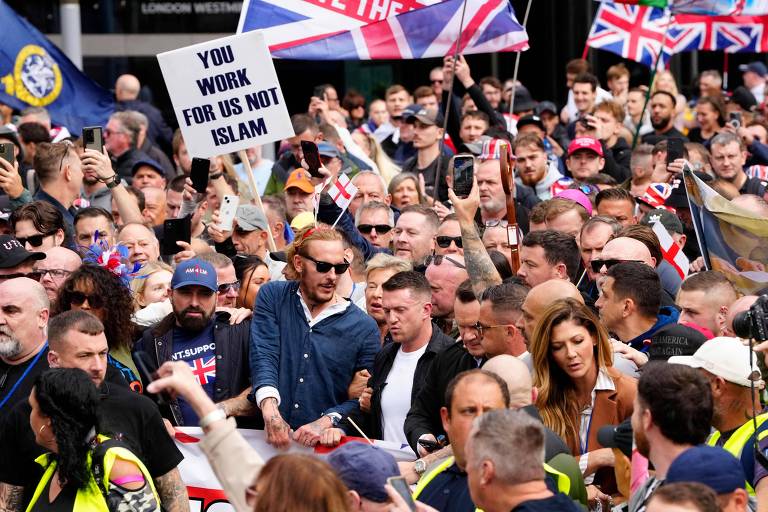
More than 100,000 people marched last Saturday (13) through the center of London in the manifestation named “Unite the Kingdom”, organized by ultra-right activist Tommy Robinson, whose real name is Stephen Yaxley-Lennon.
Police estimated about 110,000 participants, while organizers spoke in up to 150,000, characterizing the act as one of the greatest far -right mobilizations in recent UK history.
The march toured symbolic points of the British capital, crossing the Thames river and passing by Big Ben, amid a sea of UK, England and Scotland flags.
Posters demanding the deportation of asylum applicants who cross the spot canal in small boats mingled with slogans against Prime Minister Keir Stmerer.
Many protesters wore “Maga” red caps, associated with former President Donald Trump, and also carried flags from the United States and Israel.
The protest was confronted by a contracoming of the Stand Up to Racism movement, which brought together about 5,000 people.
Police set up barriers between the two groups, but there were still violent incidents. According to the corporation, 25 people were arrested and 26 police officers were injured, four of them in serious condition.
Reports account for aggressions with punches, kicks, bottles and flags launched against agents.
Videos released by the Metropolitan Police itself showed the shocks between police and protesters. Although Robinson has asked to calm down – “We are asking all of you, all who are understandably frustrated, who, please keep calm and peace. Let’s keep things safe and civilized” – the corporation has classified episodes as “unacceptable violence” and reinforced cavalry policing.
MUSK Speech Incita Cultão
The main moment of the act was the participation of Elon Musk, in a video call broadcast in screen. The American billionaire, who had already spoken at an event of the German far right, defended the immediate dissolution of the British Parliament and summoned the population to force new elections.
“There has to be a dissolution of Parliament and a new election,” he said, adding that the British “are afraid to exercise their freedom of expression.”
Musk also radicalized his rhetoric, calling the left “The Party of Murder” and asking protesters to “return.”
His appearance was pointed out by the British press as the biggest attraction of mobilization, as since 2024 he has become one of Robinson’s leading promoters on social networks. After purchase of Twitter, renamed as X, Musk restored the activist’s account, which had been banned in 2018 for violating “hatred conduct” rules.
The rally still paid tribute to Charlie Kirk, a US conservative activist murdered on the 10th on a university campus in Utah. Kirk’s death was used as a flag by Robinson, who described the demonstration as a festival of freedom of expression.
From the stage, the far right leader said: “Today is the spark of a cultural revolution in Britain, this is our moment. We show a wave of patriotism.”
The initial guest list also included the name of Steve Bannon, a former Donald Trump-structure, but he remained in the United States to present his podcast War Room.
Robinson, in turn, exhibited videos of young foreigners who traveled to London to participate in the act, including a Frenchman who declared in “tribute to Charlie Kirk.”
Robinson and the trajectory of violence
At 42, Tommy Robinson is one of the main faces of the British ultra right. Founder of the English League, Nationalist and Anti-Muçulman Group known as violent protests in the 2000s and 2010, he built his notoriety around hostility to immigrants and the Islamic population.
Its trajectory, however, is marked by a series of criminal convictions that include use of false passport, real estate fraud, harassment to journalists and disturbance of public order.
In 2024, Robinson was sentenced to 18 months in prison for breaking a court order by spreading false allegations about a Syrian teenager who had sued him for defamation.
Liberated in May 2025, after reducing the sentence to seven months, he promised to organize a festival of freedom of expression, now fulfilled with the march in London.
Despite the size of the mobilization, established parties kept distance. Reform UK, the main anti-immigration caption and leading polls, has avoided any association with Robinson.
Already on the international level, the activist maintains ties with figures such as Geert Wilders, leader of the Dutch far right, and leaders of the German AFD.
Robinson presents himself as a “journalist who exposes irregularities of the state” but accumulates passages through jail and a reputation of agitator responsible for fostering hostility against minorities. Even so, the London march consolidated its political visibility and showed that its support base goes beyond the marginal groups with which it has been associated in the past.
Official response and political context
Metropolitan police mobilized 1,600 agents, including 500 from other forces, to ensure security in London. Commander Clair Haynes stated that there would be “zero tolerance” for discriminatory behaviors or crossing “the line between protest and hate crime.”
In a statement, he acknowledged that Muslim communities had “specific concerns” in the face of the history of anti-side rhetoric in these acts.
Prime Minister Keir Strmer, in his first official reaction, defended British diversity on Sunday (14).
“Our flag represents the diversity of our country and we will never give in,” he wrote in a publication in X. The labor government had been the target of the most repeated slogans during the march, which asked for their fall and attacked migratory policy.
The mobilization occurred in a moment of high social tension in the UK. Only in 2025, more than 28,000 migrants have already crossed the Channel of the Mancha in Small Boats, a record number that reinforced immigration as a dominant theme in the political agenda, eclipsing to the economic crisis.
Even before the march, protests against hotels that house refugees were growing in several cities.
The episode also exposed the polarization on freedom of expression. A week earlier, the arrest of more than 800 people in a pro-Palestinian act rekindled criticism of anti-terrorism legislation, used by the government to ban groups such as Palestine Action.
Source: vermelho.org.br