Published 11/09/2025 21:28
If Surreal is already Surreal to see Donald Trump blackmail countries that he considers rivals, it is more serious to find that he applies the same work against strategic allies.
Last Friday (5), the British newspaper Financial Times and the Japanese press revealed a secret memo signed between the United States and Japan, which ensures the Americans the power to dictate the destination of $ 550 billion in agreed investments in tariff negotiations between the two countries.
The consequence was immediate: the renunciation of the premie Shigeru Ishiba, the wear of one of the oldest covenants in the United States in Asia and the realization that even in the China containment board, Washington prefers to impose submission to preserve confidence.
The document states that Trump will have the final word on projects to receive capital. It is up to an investment committee, chaired by the Secretary of Commerce Howard Lutnick, just compiling proposals.
To Japan, it is left to fulfill. There are 45 days to release the resources chosen by the US President, otherwise the 25% tariff was restored to its exports-now reduced to 15%.
The sharing of profits is another chapter of surrender: until the discharge of the contribution, the two countries divide the results; After that, the United States has 90% of cash flow.
An arrangement that, in the words of Masahiko Hosokawa, a former employee of the Ministry of Commerce, transforms Tokyo into a “ATM in America”. Not coincidentally, Japanese editorialism began to discuss whether it still makes sense to pay so expensive for an alliance presented in the American view as indispensable in the confrontation with Beijing.
Political crisis and diplomatic wear
The internal effect was devastating. Shigeru Ishiba, pressured by criticism of submission to Washington, announced his departure from the government and opened a dispute within the Democratic Liberal Party.
The crisis revealed unprecedented cracks in the conduct of Japanese foreign policy and produced an uncomfortable debate: To what extent is it worth to give economic sovereignty to avoid punitive tariffs?
While the White House sells the narrative that he signed “a unique agreement in American history,” Tokyo tries to deny the obvious.
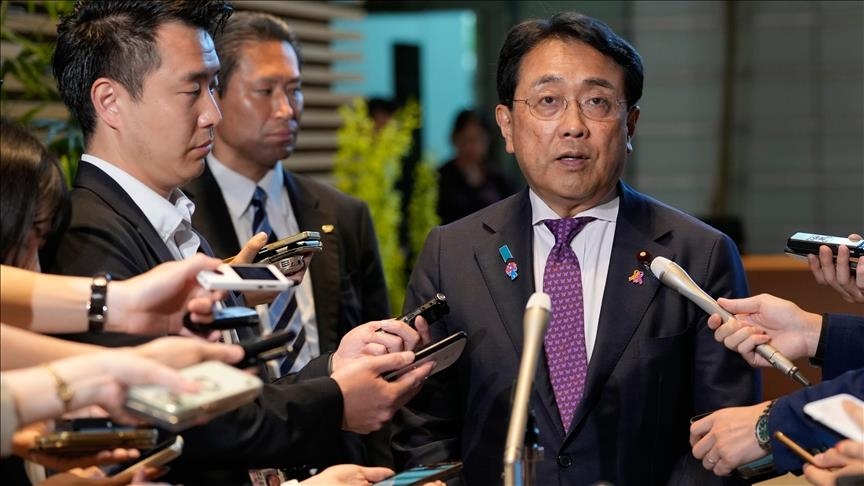
Economic Revitalization Minister Ryosi Akazawa has returned from Washington stating that Japan will participate in the project selection and that Trump will not have “total discretion.” But the defense sounded fragile at the explicit clauses of the memorandum. It is not just a semantic problem; It is the public exposure that Japan accepts dictated from outside and tries, at home, to mask the size of humiliation.
The South Korean precedent in Georgia
Japan, however powerful, is not alone on the coerced allies list. South Korea had already felt the hardness of the Trump method with the operation in Ellabell, Georgia, which arrested 475 workers from a Hyundai-LG factory-over 300 of them South Koreans.
The images of handcuffed and lined upbreaks in billionaire construction workers, erected precisely to meet Washington’s domestic production requirements, reverberated in Seoul as the greatest recent confidence violation.
The South Korean government repatrized its citizens on chartered aircraft and even saw conservative newspapers like the Chosun ilbo defend the revision of the alliance.
The episode has exposed a contradiction that now resonates in Tokyo: Trump demands billions of dollars in investments, but treats partners as criminals and workers as illegal. The implicit message is simple: they bring the money, but don’t stay for dinner.
Imperial strategy and regional risks
The junction of these episodes reveals a pattern. Trump does not distinguish enemies from allies when it comes to tariffs and investments. Logic is always the same: coercion, short deadlines, unequal profits and explicit retaliation threats.
What changes is just the target. Today is Tokyo, yesterday was Seoul, tomorrow can be any partner willing to believe that a promise of Washington is a guarantee of confidence.
In practice, this means weakening their own alliances that the US presents as indispensable to contain China. By turning Japan and Korea into blackmail objects, Trump weakens the Indo-Pacific diplomatic basis and feeds doubts about American reliability.
There is nothing accidental in this process, it is a strategy that, under the label of “America in the first place”, lowers historical partners to the condition of minority partners from projects dictated by Washington.
The result, once again, is corrosive. Japan plunged into political crisis, the warning Korea and the growing perception that the White House does not hesitate to turn their backs to those by his side. Even strategic allies, essential in the containment of China, discover that the alliance is priceed – and it is always dictated by Trump.
Source: vermelho.org.br