Published 09/09/2025 12:53 | Edited 09/09/2025 07:56
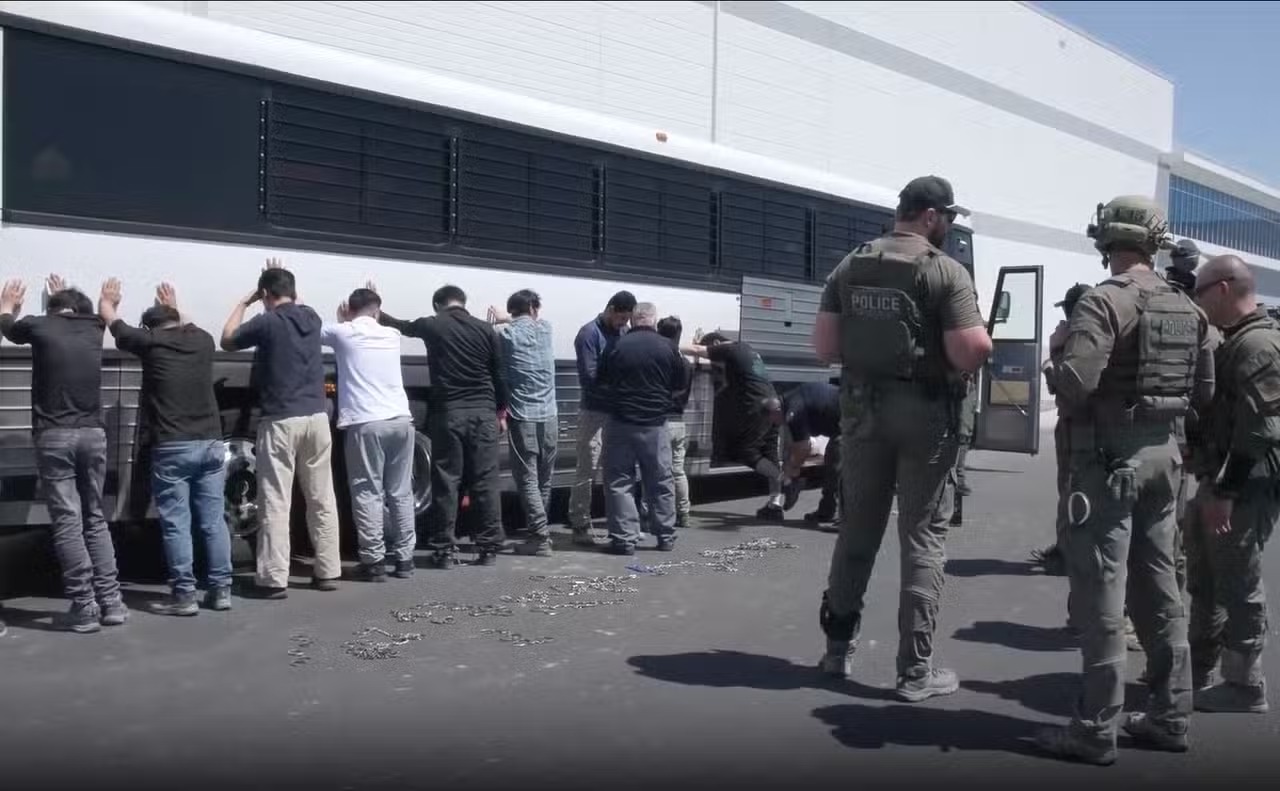
One of the largest migratory operations in US history this week reached the Hyundai and LG battery factory in Ellabell, Georgia. The complex, built with billions of South Korean dollars, was designed to meet the domestic production policy defended by Donald Trump.
On Thursday (4), federal agents detained 475 workers in the construction site. More than 300 were South Korean citizens. The Department of Internal Security (DHS) classified the action as the largest ever carried out in one place during the Trump administration.
Mass arrest caused an immediate diplomatic crisis. South Korea’s government announced on Sunday that it chartered a plane to repact the prisoners after negotiations with Washington. According to consul general cho Ki-Joong, workers should board on Wednesday (10).
Vice-chancer Park Yoon-Joo considered the US’s disclosure of images that showed handcuffed workers, ankles and waist, with vests printed with the names “Hyundai” or “LG CNS”. The video also showed helicopters and armored vehicles surrounding the flowerbed.
The action in Georgia adds to Trump’s offensive to expand beats in companies. White House “border tsar”, Tom Homan, told CNN that new operations are planned.
The justification contrasts with the reality of integer sectors of the US economy. Agriculture, hospitality, heavy construction and refrigerators report lack of workers since the White House cut migratory flows and intensified the beats.
Congress Asian American parliamentarians called the “alarming” operation. In a statement, they accused the government of pursuing immigrants in workers communities to meet mass deportation quotas in actions that “destroy families, impair the economy and undermine the confidence of global partners.”
Rhetoric against irregular immigration had been climbing. Trump and assistants suggested sending national guard troops and federal agents to Chicago. On Saturday (6), the president published in his social network socially inspired by the movie Apocalypse Now which showed the city’s horizon in flames, surrounded by helicopters. The post was criticized by local residents and authorities for suggesting the city as a military target.
The ICE reported that the operation in Ellabell was executed under a court order on suspicion of illegal labor practices. According to the agency, part of the detainees entered the country irregularly; Others exceeded the visa period or were visited by tourism and business that do not allow work.
Despite defending more domestic production, the Trump government restricts immigration to the point of creating bottlenecks for semiconductor works, electric vehicles and data centers. Analysts describe the paradox as a brake on industrial expansion that administration itself says prioritize.
Immediate reaction from South Korea
The crash occurred only ten days after the summit between Trump and South Korean President Lee Jae Myung, who had resulted in billionaire promises of investment and reinforcement of the alliance. Mass arrest was seen in Seoul as a blow to the confidence built at the meeting.
In addition to Park Yoon-Joo, Chancellor Cho Hyun confirmed that more than 300 Korean citizens were among the prisoners and indicated that he could travel to Washington if necessary. Cabinet chief Kang Hoon-Sik has promised to review the US-traveling workers system in order to avoid similar incidents.
The South Korean chancellery pointed out that “the economic activities of our companies and the rights of our citizens should not be unfairly violated during the application of US law.”
The country’s press criticized the operation and stressed the contradiction of a government that requires investments, but restricts the presence of foreign workers. Georgia parliamentarians and congressmen in Washington also claimed to be “deeply alarmed” with the action.
Alert companies
Hyundai stated that none of its direct employees was arrested, but opened internal review to verify compliance with outsourced standards. LG Energy Solution, on the other hand, recognized the arrest of 47 own employees, as well as dozens of outsourced, and announced emergency measures.
LG suspended business trips to the US, determined the return of employees in the country and sent a human resources executive to Georgia to accompany the case.
Both companies are partner in a $ 4.3 billion project to produce electric vehicle batteries, considered one of the largest industrial investments in Georgia’s history. The complex as a whole involves $ 12.6 billion, should employ 8,500 people up to 2031 and receive up to $ 2.1 billion in tax incentives.
The impact of the operation on the schedule is still uncertain. Hyundai announced in August that it would raise its US $ 21 billion investments to $ 26 billion, including a robotics unit. But continuity will depend on the resolution of migratory and tariff tensions.
Companies also face the risk of losing competitiveness with the recent US decision to reduce tariffs about Japanese cars, while South Korean vehicles are taxed by 25%. The automotive sector is one of the pillars of South Korea’s economy.
Industrial contradictions and geopolitical scenario
The episode intensified tensions between Washington and Seoul amid negotiation of a trade agreement announced in July, which provides $ 350 billion in funds to South Korean companies expanding their presence in the US market. At the time, Lee Jae Myung also promised additional $ 150 billion in investments, in a gesture of trust in the alliance.
Less than two weeks later, repression in Ellabell exposed the fragility of the relationship. While requiring resources and factories from its strategic allies, the US government fires the migratory machine against workers who make these projects viable.
“You want our money, but you don’t want us here,” summarized Tami Overby, former director of the US Business Council, about the climate in Asian business councils.
The paradox is corrosive: Trump imposes 25% tariffs on South Korean cars and presses for more production within the US, but paralyzes developments erected with foreign capital. For Seoul, the gesture sounded as a betrayal to the sealed confidence days earlier in the presidential summit.
According to CNN, Trump can visit South Korea in October during the Asia-Pacific Economic Cooperation Meeting (APEC). If confirmed, the trip will occur under the impact of the largest migratory operation ever performed against workers from one of Washington’s leading allies in Asia.
Source: vermelho.org.br