Published 09/09/2025 10:08 | Edited 02/09/2025 10:20
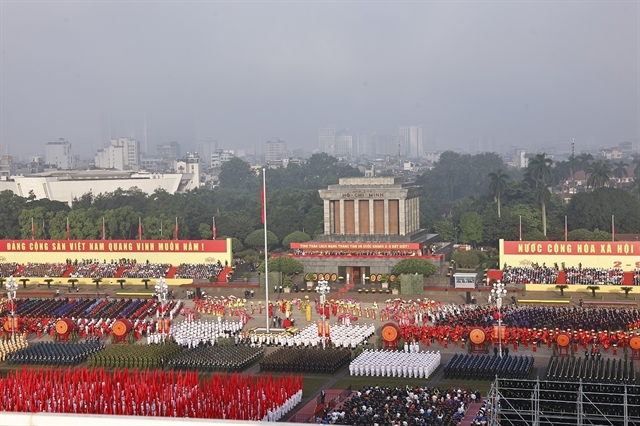
Vietnam celebrates on Tuesday (2) the 80th anniversary of the August Revolution and the Declaration of Independence with the largest military parade in decades, popular mobilization of tens of thousands of people in Hanoi and a set of measures, such as amnesty to almost 14,000 prisoners and the unprecedented distribution of resources to the population.
The event, marked by strong historical symbolism and international projection, also reinforced the country’s economic opportunities in the global scenario.
In Ba Dình Square, where Ho Chi Minh proclaimed in 1945 independence after almost a century of French colonialism and Japanese occupation, the secretary general of the Communist Party, Tô Lam, opened the celebration highlighting the historical continuity of the Vietnamese struggle.
“We are firm in our commitment to defend independence, freedom, sovereignty, and territorial integrity of our homeland, even every sacred earth,” he declared before thousands of people.
The leader evoked the legacy of Ho Chi Minh and reaffirmed that the goals set for 2045 are to turn Vietnam into a powerful, prosperous and happy nation.
In the speech, so Lam cited the achievements since the August Revolution – national liberation, reunification and economic reforms – as proof that “there are no difficulties that the Vietnamese people cannot overcome.”
The atmosphere was reinforced by popular mobilization, with residents of Hanoi crowding the streets, many dressed in red and with their face painted with the yellow star of the flag.
A resident of the capital, Hoang Thi Huyen, 42, camped two days with his family to secure place. “It was worth waiting. The troops and fighters were amazing,” he told Reuters.
Military Strength and International Solidarity
The military parade was organized into 87 divisions, including ceremonial units, infantry, police forces, popular militias and armored vehicles. The sequence began with the Air Force greeting and continued with tanks, missiles, national drones and Russian Mi-171 helicopters.
The apex occurred with the passage of the Sukhoi Su-30 fighters over the sky of Hanoi. In a parallel event at sea, Russian submarines of the Kilo class and Fragatas participated in the celebration.
In addition to displaying defense capacity, the parade has reinforced ties with historical allies. China, Russia, Laos and Cambodia troops marched in Ba đình. Moscow sent the Pre -Breeding Regiment Guard of Honor, while Laos and Cambodia contributed with 120 soldiers each.
Cuba President Miguel Díaz-Canel accompanied as a guest of honor.
National leaders and foreign delegations attended the ceremony, including Chinese and Russian parliamentarians. Representing the United States, only one embassy member was present.
In a statement, Secretary of State Marco Rubio congratulated Vietnam and described it as “a vital partner in the Indo-Pacific region and a leader in facing common global challenges.”
Closing the official program, the Ministry of Culture organized an artistic presentation with music, theater and popular demonstrations, reaffirming the cultural character of the celebration. The streets of the capital were taken by flags, choreographies and civic acts.
Expanding economy and opportunities for Brazil
The birthday served to project the image of a country that came out of the devastation of war to become one of the fastest growing economies on the planet. The Vietnamese GDP jumped from $ 8 billion in 1986 to $ 476.3 billion in 2024, multiplying almost 60 times.
The per capita GDP, which was only $ 80 in 1975, reached $ 4,700 in 2024. The average annual growth has remained close to 8% in recent decades.
According to economist Elias Jabbour, the current process “is the revolutionary legacy that materializes in accelerated development.” For him, “Vietnam’s great reference is his revolutionary process, a choice made back there, and his fight until 1976 was to ensure the conditions for this development.”
In relations with Brazil, the numbers are also expressive: the trade balance reached US $ 7.7 billion in 2024, with duplication target up to $ 15 billion in 2030. Brazilian exports are concentrated on cotton, corn and soy, but it is expected to expand to sectors such as meat, coffee, steel and fertilizers.
During a visit to Brasilia in July this year, Prime Minister Pham Minh Chinh and President Lula announced the opening of the Vietnamese market for Brazilian beef and the Brazilian market for Vietnamese tilapia.
At the time, Lula stated that “the opening of the Vietnamese market for the Brazilian beef will attract investments from Brazilian refrigerators to make this country an export platform for Southeast Asia”.
International and Future Integration
Today, Vietnam maintains diplomatic relations with 194 countries, strategic partnerships with 37 nations and actively participates in more than 70 international bodies. The country is considered a poverty reduction model – it has fallen from more than 60% in 1986 to 1.93% in 2024 – and has invested in high technology, education, health and gender equality.
In the speech in Hanoi, Tô Lam said that the “goal is that, by 2045, Vietnam will become a powerful, prosperous and happy nation. This is the aspiration of the whole nation, an oath of honor before history and the people.”
Between tanks, flags and cultural manifestations, the celebration of the 80th anniversary reaffirmed the role of Vietnam as a nation that transformed the legacy of the anti -colonial struggle into political, economic and diplomatic force. And at the same time projected concrete opportunities for integration with Brazil in a context of global market dispute and sovereignty.
Source: vermelho.org.br