Published 08/06/2025 10:44 | Edited 06/08/2025 11:03
On the day when US tariffs of 50% against Brazil exported products to the United States, China expresses its support to Brazil;
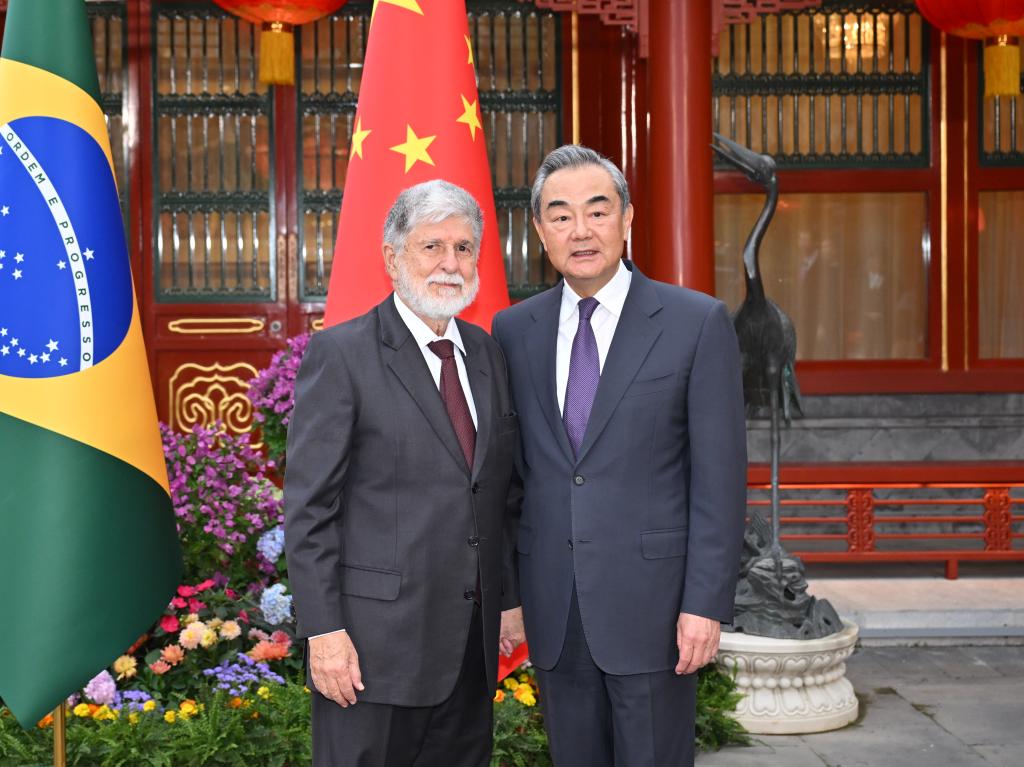
In a telephone conversation with the special presidential advisor, Celso Amorim, Chinese chancellor Wang Yi condemned the use of coercive measures as a form of political pressure and stated that Beijing opposes “unjustified external interference” in Brazilian internal affairs.
According to him, the Chinese government firmly supports the defense of sovereignty, interests and the right to development of Brazil.
Wang has classified US tariff as an intimidation behavior and reiterated that China will remain alongside Brazil in protecting its rights.
The connection between the two representatives occurs on the same day that Trump’s overcrowders officially enter into force, affecting strategic products of the Brazilian exporting agenda.
For the Chinese chancellor, “national dignity must be preserved” and discriminatory measures such as those imposed by the US “undermine international order and violate the principles of the United Nations Charter.”
In addition to reiterating support for Brazilian autonomy in the face of American tariffs, Wang Yi defended the deepening of the strategic partnership between China and Brazil. According to him, the two countries should intensify bilateral coordination in the areas of trade, finance and foreign policy, consolidating a “mutual support” relationship between the largest developing economies of their respective continents.
The chancellor stated that the governments of President Lula and President Xi Jinping together build a “community with shared future”, based on multipolarity, in defense of international justice and respect for the sovereignty of peoples.
Celso Amorim, in turn, highlighted the commitment of the Brazilian government to the strengthening of the BRICS and the articulation of the global southern countries as a strategic axis of a more balanced world.
President Lula’s advisor also reaffirmed Brazil’s willingness to broaden the cooperation ties with China in the face of the challenges imposed by unilateral measures, such as discriminatory tariffs applied by the United States.
For Amorim, the deepening of the Sino-Brazilian Alliance is essential to defend national sovereignty and promote development with social justice.
US tariff offensive and China’s solidarity
The new rates against Brazil were announced by Donald Trump in July, within a unilateral sanction package that also hit countries such as India, Mexico, Vietnam and Germany. However, Brazil was the most penalized, with rates of up to 50% on strategic products such as steel, coffee, pulp and orange juice.
The justification presented by Trump had a strong political content: he conditioned the end of the rates to the suspension of the trial of former President Jair Bolsonaro by the Supreme Court, classifying the process as a “witch hunt” that should stop “immediately.”
Since the announcement of the tariff, China has been one of the first countries to position itself in defense of Brazil. By the end of July, the spokeswoman for the Chinese Foreign Ministry, Mao Ning, had already stated that “tariffs should not be used as an instrument of coercion, intimidation or interference.”
The speech was accompanied by a note from Chancellor Wang Yi himself, warning that such measures undermine the rules -based international order and violate the principles of the UN letter.
Beijing’s posture also reflects his own tariff dispute with Washington. Since April, the two countries have been locking a trade war that has already involved successive rounds of retaliation.
While European governments sought partial agreements with the US, China adopted a firm response, raising tariffs on US products and denouncing protectionism as a threat to global stability.
In this context, the alliance with Brazil gains a new weight, projecting the two countries as advocates of multipolarity and resistance of the global south to the unilateral impositions of the Western powers.
Source: vermelho.org.br