Published 28/07/2025 11:25
The European Union accepted on Sunday (27) a trade agreement imposed by Donald Trump, current president of the United States, which triples the average fare over its products exported to the US market.
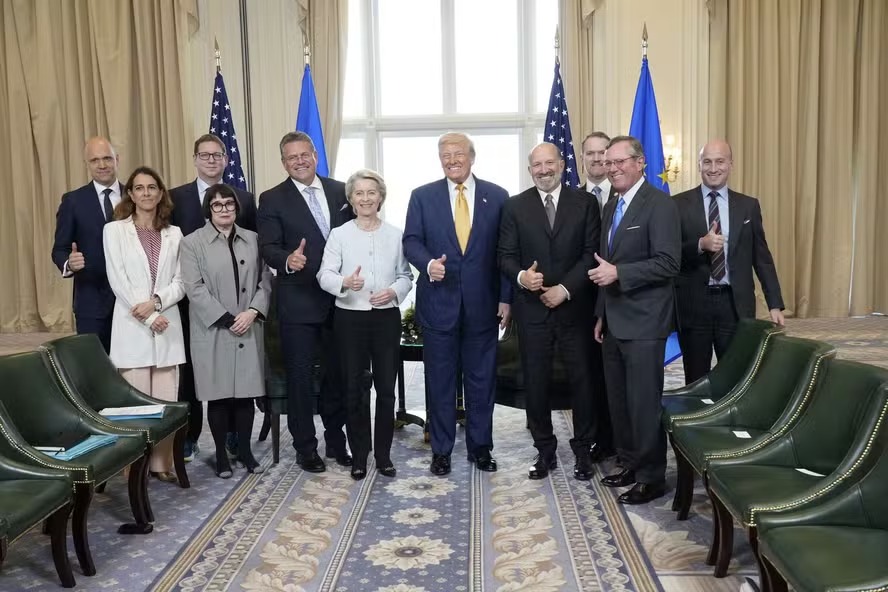
Before around 4.8%, rates now ride to 15% to about 70% of European exports, including automobiles, steel, wines and industrialized products. The decision was announced after a lightning meeting between Trump and Ursula von der Leyen at the Tryberry resort in Scotland.
The pact ends a four -month round of unilateral tariff threats from the White House, which even included the possibility of tariffs up to 30% if no agreement was reached until August 1.
In exchange for the partial truce, the European Union has pledged with billionaire counterparts: it will be US $ 750 billion in US energy purchases and semiconductors, and $ 600 billion in investments, including military equipment acquisition.
Even with relief in financial markets, analysts have classified the agreement as deeply asymmetrical and unfavorable to Europe.
In addition to the direct economic impact, the agreement exposes internal divisions in the European Commission and raises criticism of the conduct of the process by Ursula von der Leyen, chairman of the committee.
Sectors of European diplomacy, led by Sabine Weyand, advocated a firmer response to Trump’s threats, using the already authorized retaliation tools. The option for retreat, according to diplomats heard by the European press, aimed to preserve the strategic relationship with Washington amid the war in Ukraine and the risk of geopolitical destabilization.
Trump imposed the terms and left Europe in a defensive position
During negotiations, Trump repeated his tariff blackmail method. Less than an hour before the meeting with Ursula von der Leyen on Turnberry, the US president stated that the chances of 50-50 ”were still” three or four difficult points. ”
The pressure climate dominated the backstage until the time of signature. In the end, Trump greeted the diplomatic victory as “a great deal”, “an important partnership” and “a great decision” that “solves many things.”
In addition to raising tariffs, the deal included the European commitment to buy $ 750 billion in oil, liquefied natural gas, nuclear fuel and US semiconductors over three years – which he has described as “a powerful pact.”
Von der Leyen tried to convey the image that it had guaranteed predictability in the face of the worst scenario.
“The two largest economies must have a good commercial flow,” he told the press by stating that the pact would bring “stability” and “predictability.” More than a celebration, his speech indicated an effort to contain damage and defense of the agreement against European public opinion.
“You saw the tension at the beginning. We had to work hard to reach a common position,” Ursula told reporters at Glasgow airport.
The tone adopted by von der Leyen contrasts with the evaluation of diplomats who followed the negotiations in previous weeks.
Reports of Financial Times and from Guardian They point out that while the commission chairman sought a truce at any cost, other European Commission – especially Sabine Weyand – defended immediate activation of retaliatory tariffs already approved, worth € 93 billion.
The reluctance of Ursula to confront Trump, even in the face of the threat of a 30%rate, has marked an inflection in the European Union diplomatic posture since the beginning of the Republican’s second term.
Affected sectors and internal criticism expose bargaining imbalance
The agreement signed in Turnberry establishes a 15% base tariff of approximately 70% of European exports to the United States, replacing the previous average of 4.8%.
Products such as cars, steel, wines, distillates and industrial goods are among the hardest hit. In the case of steel, for example, the 50% tariff imposed by Trump will continue in force until the definition of a new quota regime.
Although the 15% rate represents a relief from the 30% threat, it normalizes permanent punitive taxation on European industry and consolidates a significant damage to exporters of the continent.
The pact also provides for a list of tariff exemptions focused on strategic sectors for the US, such as aircraft parts, certain chemicals, semiconductor equipment, generic medicines, cork and critical raw materials.
However, there is no clear reciprocity in areas sensitive to Europe, such as cars, steel or wines.
The situation of the pharmaceutical sector illustrates the lack of transparency: while von der Leyen said pharmaceutical products are subject to 15%tariff, US officials indicate that this sector is temporarily exempt until the new national security investigation – and, even with possible taxation, would be a 15%ceiling.
The absence of formal details about the pact and the fact that the text still depends on approval by the 27 European Union states increase the perception that bargain has widely favored US interests.
French Prime Minister François Bayrou classified the result as “a dark day for Europe,” stating that the block “resigned to submission.” France Minister of Commerce, Laurent Saint-Martin, was even more direct: “Donald Trump only understands strength. It would have been better to respond by showing our retaliation ability early.”
Similar criticisms came from the European financial sector. German bank Berenberg described the result as a victory for Trump:
“The agreement is asymmetrical. The US has achieved a substantial increase in EU products and have even obtained additional concessions. In its zero -sum mentality, Trump can claim it as a victory.”
In the same line, the Italian Bank Unicredit questioned the terms:
“Is this a good agreement for the EU? Probably not. The result is strongly asymmetrical and makes the US with tariffs much higher than those in the EU.”
Among the heads of government, the reception was cautious. German Chancellor Friedrich Merz admitted that he would like a greater facilitation of trade, but stated that the deal avoided a “devastating” tariff war for the strongly export -based German economy.
The Italian Prime Minister Giorgia Meloni stated that the understanding was “positive”, but stressed that Rome still needs to “study the details” of the text before issuing a definitive judgment. Both lines indicate a tone of resignation – not celebration.
Tariff agreement European retreat in the midst of geopolitical pressure
Since the beginning of Donald Trump’s second term, European authorities have been seeking to avoid the intensification of Washington disputes so as not to compromise more sensitive issues on the external agenda, especially military support to Ukraine.
EU Commissioner’s own Commissioner Marošefčovič acknowledged that the agreement signed in Scotland was not just a trade.
“It was security, Ukraine, the current geopolitical volatility,” he said, moments after the announcement.
The dominant perception between the bloc’s leaders is that a direct confrontation with Trump on the economic level could trigger more serious reprisals on other fronts, such as the sending of weapons to Ukraine, the US permanence in NATO or even Washington’s role in multilateral negotiations on Iran and Gaza.
Instead of opening a new crisis with the US government, the logic of containing damage prevailed: retreating in the tariff field to maintain some level of strategic cooperation on the international security board.
This geopolitical calculation partly explains the decision of the European Commission to seek a pact even under unfavorable conditions.
It also explains why countries such as Germany, France and Italy, despite internal criticism, avoided breaking the unit of the bloc and contemporated the signing of the agreement. But the price of this gesture is high: the European Union has accepted an asymmetrical business relationship, with lasting tariff increase and billionaire counterparts to the United States, in the name of stability that is not assured.
As they warned analysts at Pantheon Macroeconomics consultancy, there is no guarantee that the agreement be maintained in the current terms. “We strongly recommend that the agreement announced as the final word,” they wrote, remembering that Trump’s commitments – including security – are often renegotiated or abandoned.
For Europe, the agreement may have avoided an immediate crisis. But economic submission in exchange for strategic alignment charges a silent price: that of the erosion of autonomy.
Source: vermelho.org.br