Published 21/07/2025 15:59 | Edited 21/07/2025 17:37
Amid the authoritarian escalation and unilateral tariffs by the United States government, President Luiz Inacio Lula da Silva participated on Monday (21) in Santiago, the high-level “always democracy” meeting.
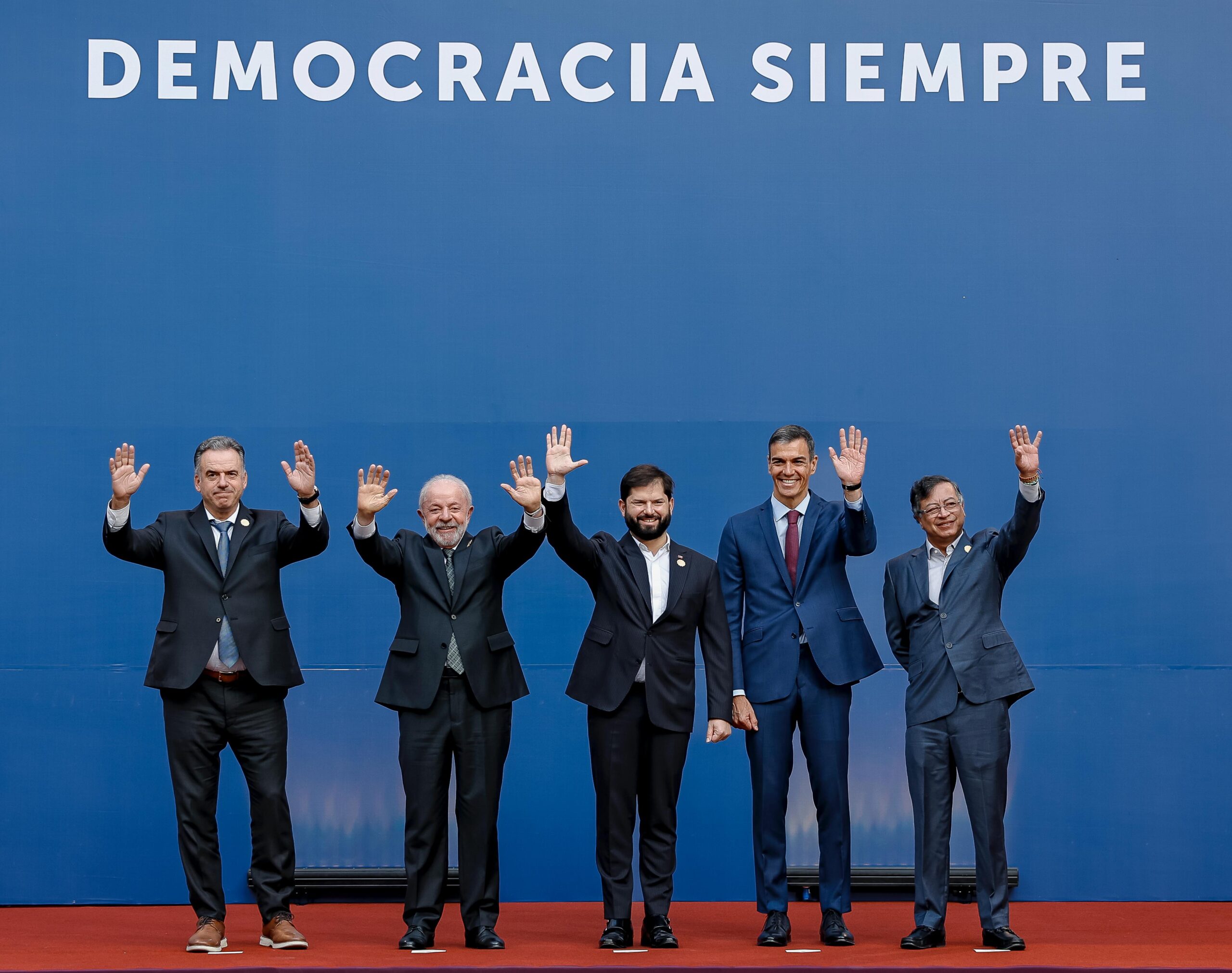
Alongside presidents Gabriel Boric (Chile), Gustavo Petro (Colombia), Pedro Sánchez (Spain) and Yamandú Orsi (Uruguay), Lula defended the construction of a progressive international front against right -wing extremism and said countries need to act together in the attempt to resume interventionist practices.
Gathered at the Palace of La Moneda, the presidents of five countries reaffirmed a commitment to a common democratic agenda based on international cooperation, social justice and the defense of multilateralism.
Read more: “It is not a gringo that will give order to this president,” says Lula
The meeting marks the second edition of the initiative originally articulated by Lula and Pedro Sánchez in 2024, during the UN General Assembly, and takes place in a new context of tension: the offensive tariff of the Government of Donald Trump and the advance of far right forces on several continents.
In the joint statement to the press, the heads of state presented the three central axes of the articulation. They are the defense of democracy and multilateralism, the confrontation of inequalities and the fight against disinformation with regulation of digital platforms.
The Brazilian president stressed that democracy is not limited to periodic elections and that political systems have lost legitimacy by failing to respond to popular needs.
“The political system and the parties have fallen into discredit,” he said, defending a new development model focused on social welfare. “Liberal democracy was not able to respond to contemporary desires and needs,” he said.
During his speech, Lula also defended concrete measures to face the structural imbalances of the global system. “There is no justice in a system that expands benefits to great capital and cuts social rights,” he said, when he argues that “super rows need to bear their part in this effort.”
He recalled that 733 million people are hungry every day and that austerity policies impose intolerable suffering on the global south. “Without a new development model, democracy will continue threatened by those who put their economic interests above those of society and the country,” he said.
Pedro Sánchez directly accused what he called “reactionary international” and warned that progressivism needs to be coordinated in a coordinated manner to face the overall offensive of the ultra right.
“Preserving democracy is a moral duty,” he said. The Spanish president also announced that the next edition of the summit will take place in 2026, under the organization of Spain.
Read more: In foreign newspapers, Lula defends multilateralism
Gabriel Boric argued that democracy should “deliver results” and stressed that no one can save himself alone. “The climate crisis, pandemic and international crime are challenges that we should face together,” warned the Chilean
Gustavo Petro’s speech has resumed the idea that democracy must be defended with conviction and based on fundamental human values, such as freedom and solidarity. He warned of the destruction of multilaterality by irrational discourses and said that, in the face of darkness, it is up to the progressives to “turn on the light.”
Yamandú Orsi highlighted the need for self -criticism in the face of the loss of credibility of the institutions and argued that democracy continues to be understood as the best form of social coexistence.
Summit will continue in the UN and articulates global proposal with the participation of civil society
The presidents confirmed the preparation of a joint proposal that will be presented at the 80th General Assembly of the United Nations in September in New York.
According to Boric, the new cycle of the initiative will include leaders from other continents and seek to “build concrete alternatives to the common challenges faced by democracies.”
During his statement, the Chilean President announced that he has already invited heads of state who agreed to add to the effort.
See the list of heads of state that accepted the invitation:
- Claudia Sheinbaum (Mexico);
- Xiomara Castro (Honduras);
- Keir Starmer (United Kingdom);
- Mark Carny (Canada);
- Anthony Albanese (Australia);
- Cyril Ramaphosa (South Africa);
- Mette Frederiksen (Dinamarca).
“We are an important, large group of leaders from different countries, but with visions that complement themselves to defend democracy,” said Boric.
He stressed that the collective effort differs by proposing structural measures, such as confrontation with inequality, combating misinformation and cooperation against transnational organized crime.
One of the central axes of the joint is the regulation of digital platforms, a theme that united the five presidents.
Lula was incisive in arguing that freedom of expression is not manipulated to protect hate speeches and attacks on institutions. “Freedom of expression is not confused with authorization to incite violence, spread hatred, commit crimes and attack the Democratic Rule of Law,” he said.
He also pointed out that data transparency and the creation of global digital governance is fundamental to ensure a free and plural public debate.
Read more: Distrust grows in the US and exposes wear and tear of Trump’s foreign policy
The meeting schedule also included a dialogue with intellectuals and representatives of civil society. Following the press statement, the leaders participated in a lunch with names such as South Korean economist Ha-Joon Chang, American philosopher Susan Neiman and Nobel Prize Joseph Stiglitz.
They then met with more than 300 Chilean organizations, including unions, research centers, popular movements and student groups.
According to Lula, this articulation with the social base is decisive to rescue democratic legitimacy: “The defense of democracy is not only for governments. It requires active participation of academia, parliaments, civil society, media and private sector.”
Gabriel Boric reiterated that the proposal built will not only be institutional, but also cultural and social.
“It is not enough to point out who thinks differently. We have to be able to propose an alternative. Democracy has to deliver results,” he said. He also stressed that contemporary democratic problems – such as inequality, authoritarianism, environmental dismantling, and blocking humanitarian aid – require articulated global responses.
Source: vermelho.org.br