Published 14/05/2025 12:48 | Edited 14/05/2025 14:53
China has publicly criticized the new commercial agreement signed between the United Kingdom and the United States, claiming that pact clauses violate the principle of non -interference and aim to harm third parties.
The demonstration was made by the Ministry of Foreign Affairs in response to the Financial Timeswhich revealed that Beijing considers the conditions imposed by Washington a direct threat to the Chinese presence in strategic productive chains.
“Cooperation between states should not be conducted against third parties,” the chancel said. The core of criticism is the inclusion of “national security” requirements that restrict the use of inputs or Chinese capital in sectors such as steel, cars and pharmaceutical industry.
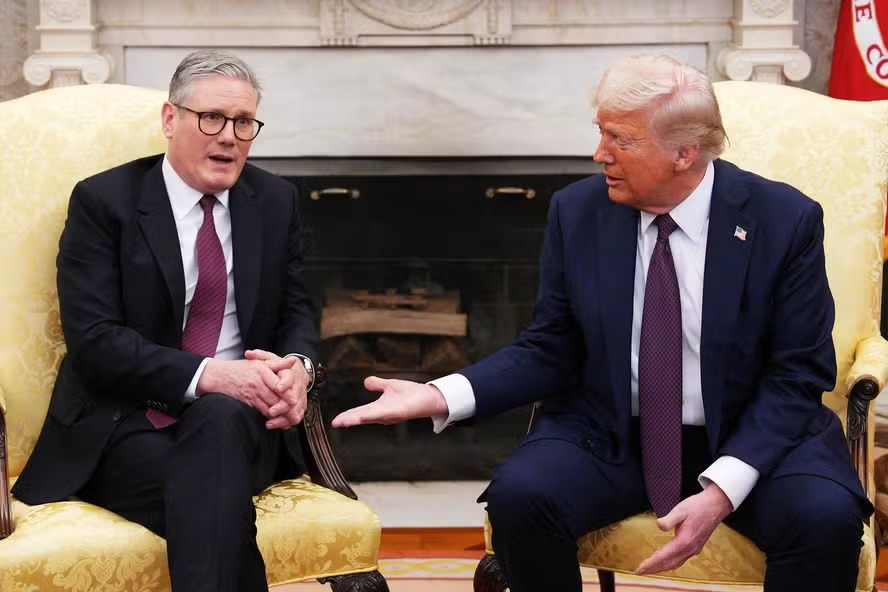
The agreement, entered into by Keir Strmer and Donald Trump last week, offers partial relief from the tariffs imposed since April, but requires the United Kingdom to implement tracking and control mechanisms on the ownership structure of its productive chains – clauses that, for Beijing, operate as exclusion instruments.
The reactions were not made in a break, but signaled strategic discomfort. Diplomatic sources in Beijing state that China monitors with concern the systematic use of bilateral agreements by the United States to press allies and limit Chinese commercial space.
This pattern, already identified in Asia and the European Union, now also reaches the United Kingdom, which had been trying to recompose the diplomatic channels with Beijing after years of tensions and suspensions of dialogue.
China’s criticism is not limited to the form of the agreement, but to the logic it inaugurates: the transformation of geopolitical criteria into commercial requirements. For the Chinese, this kind of mechanism disrespects multilateralism, breaks with the tradition of international law and compromises the possibilities of more balanced global economic governance.
The discomfort is even greater because the pact occurs at the time London rehearsed a rapprochement with Beijing.
Selective tariff relief imposes geopolitical cost to the British industry
The agreement signed by London and Washington establishes the reduction of US tariffs on British car exports-from 27.5% to 10%-but limits this benefit to an annual quota of 100,000 vehicles and conditions its application to compliance with traceability requirements and “productive chains safety”. Suspension of steel and aluminum tariffs is also subject to these same criteria, which are especially Chinese suppliers.
In addition to the industrial sectors, the pact foresees the expansion of quotas for US exports to the United Kingdom in products such as beef and ethanol. There are also mentions to future cooperation in areas such as pharmaceutical industry and advanced manufacturing, again conditioned to British alignment with the US government’s commercial security guidelines.
The result is a commercial structure that prioritizes Washington’s interests, while limiting London’s sovereign decision margin.
For Chinese analysts, the United Kingdom not only underwent an asymmetrical agreement, but has accepted a logic that compromises its industrial autonomy. Zhang Yansheng of the Chinese Macroeconomic Research Academy said the covenant clauses act as “poisoned pills” and are “worse than tariffs” because they impose long -term structural conditions on the productive sector.
The British press itself recognized that the clauses were designed to restrict the participation of Chinese companies. By giving up technical neutrality in tracking criteria, the United Kingdom assumes an automatic alignment policy to the strategic agenda of the United States. This occurs at a time when the country faces internal post-Brexit impasses and desperately seeks new commercial anchors.
China seeks to keep dialogue open, but reaffirms criticism of exclusion
Despite the forceful criticism revealed to the Financial Times, the Chinese government tried to avoid rhetorical escalation in the following days. At a press conference held on Wednesday (14), spokesman Lin Jian stated that China is willing to “open a new chapter” in bilateral relations with the United Kingdom and stressed that the two countries “must work together to bring stability to the global economy.” Speech was read as a containment movement, without retreating in the political content.
Still, the same spokesman has publicly repeated the phrase that had been said to FT: “Cooperation between countries should not harm third parties.”
Reaffirmation, now in official space, shows that Beijing maintains his critical position even when seeking to preserve the dialogue channels with London. The gesture reveals a diplomatic balance: firmness in the denunciation of British alignment to the US containment strategy, without breaking the institutional bridges already in the process of reconstruction.
Since the beginning of the year, Chinese diplomacy has been betting on the resumption of relations with the United Kingdom. The visit of Chancellor Rachel Reeves to Beijing in January has reactivated the suspended economic and financial dialogues since 2019. The pact with the US, however, imposes a new noise. By accepting antichinese clauses, London sends a dubious message that can make it difficult for a more pragmatic foreign policy.
Beijing, in turn, tries to preserve his reference position in international trade based on a distinct logic: that of a multipolar globalization, based on national sovereignty and cooperation between equals. Criticism of the United Kingdom Agreement, in this sense, is not only defensive: it is part of the dispute by which model will prevail in the coming decades.
Source: vermelho.org.br