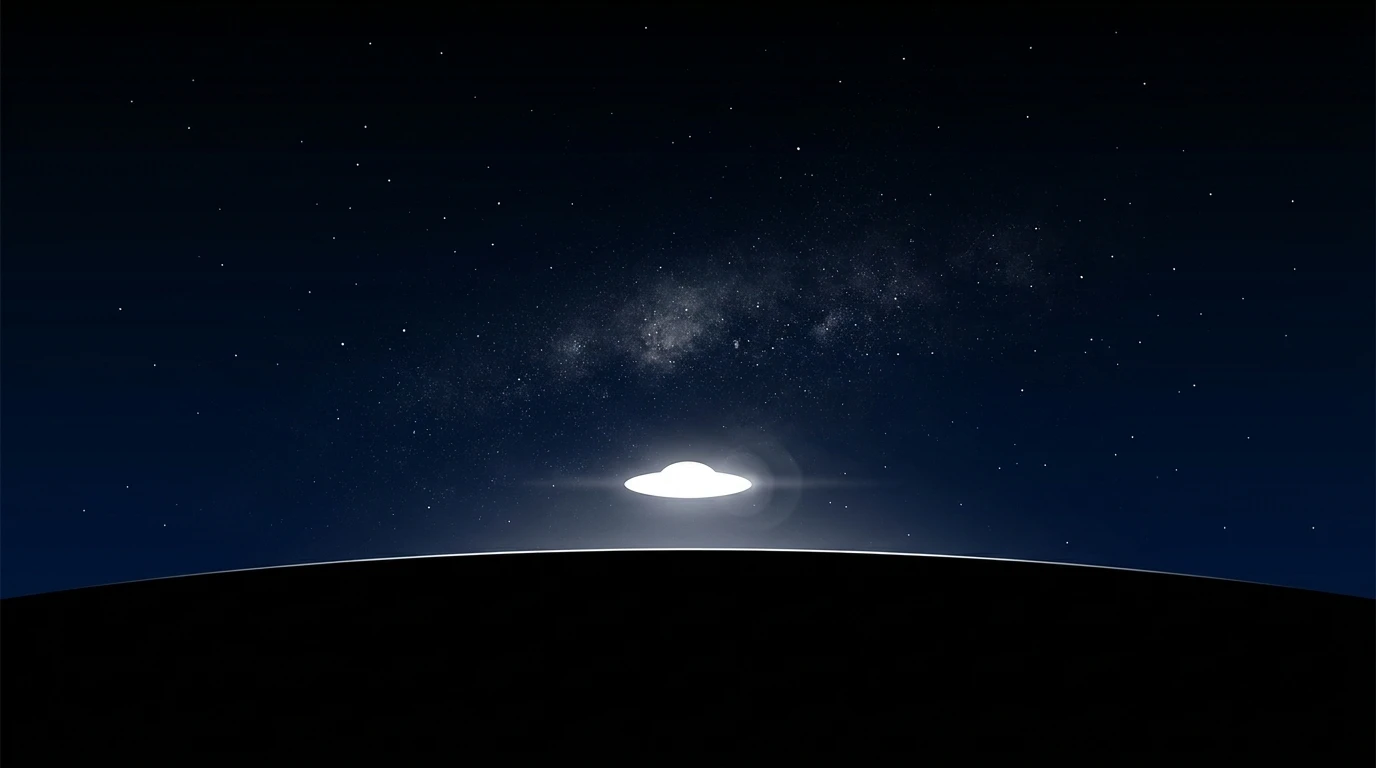
For centuries, humanity has looked toward the stars and wondered whether we are alone. Ancient civilizations interpreted strange lights in the sky as messages from gods. Modern scientists scan distant planets for signs of life. Governments investigate unexplained aerial phenomena. Meanwhile, billions of people continue asking the same fundamental question: Are we the only intelligent beings in the universe?
In recent years, this debate has gained new momentum. Declassified military footage, testimony from pilots, advances in astronomy, and the discovery of thousands of planets outside our solar system have transformed what was once considered science fiction into a topic of serious discussion.
While no definitive proof of extraterrestrial visitation has been publicly presented, a growing number of researchers argue that the possibility deserves careful examination. Some believe the real question is no longer whether intelligent life exists elsewhere, but whether it may have already reached Earth.
The idea sounds extraordinary. Yet several arguments continue to fuel speculation among scientists, astronomers, historians, and UFO researchers.
Here are five reasons some experts and observers believe aliens might already be here.
🪐 1. The Universe Is Almost Incomprehensibly Large
The strongest argument for extraterrestrial life begins with simple mathematics.
The observable universe contains an estimated two trillion galaxies. Each galaxy contains millions, billions, or even trillions of stars. Around many of those stars orbit planets, moons, and other celestial bodies.
For most of human history, scientists did not know whether planets existed beyond our solar system. Today, astronomers have confirmed more than 5,000 exoplanets, and the number continues to grow.
Many of these worlds are located in what scientists call the “habitable zone,” a region where temperatures may allow liquid water to exist. Since water is considered one of the essential ingredients for life as we know it, these discoveries have dramatically expanded the number of places where life could potentially emerge.
According to estimates from various astronomical models, there could be billions of Earth-like planets in our galaxy alone.
If even a tiny fraction of those worlds developed life, and an even smaller fraction evolved intelligent civilizations, the universe could be filled with technologically advanced societies.
This idea is often supported by the famous Drake Equation, which attempts to estimate the number of communicative civilizations in the Milky Way. Although many variables remain uncertain, the equation suggests that intelligent life may not be rare.
Supporters of extraterrestrial visitation argue that if intelligent civilizations have existed for millions or even billions of years longer than humanity, some may have developed technologies far beyond our current understanding.
From that perspective, interstellar travel, which seems impossible to us today, might be routine for a civilization with a significant technological head start.
The vastness of the universe does not prove aliens are here. However, it strengthens the argument that intelligent life elsewhere is statistically plausible.
For many researchers, the real surprise would be if humanity were completely alone.
🚀 2. Advanced Civilizations Could Be Far Ahead of Us
Human technological progress has accelerated dramatically in a relatively short period.
Just over a century ago, airplanes did not exist. Today, humans can travel across continents in hours, communicate instantly across the globe, and send spacecraft beyond the solar system.
The first powered flight occurred in 1903. Less than seventy years later, humans landed on the Moon.
This rapid advancement raises an intriguing possibility.
If another civilization developed even a few thousand years before humanity, the technological gap could be enormous. If that civilization emerged millions of years earlier, the difference might be almost impossible for us to comprehend.
Many technologies that seem magical today would have appeared equally impossible to people living in the Middle Ages.
Modern smartphones, satellites, artificial intelligence, and genetic engineering would likely have been interpreted as supernatural phenomena.
This concept leads some scientists to suggest that truly advanced extraterrestrial visitors might not arrive in giant metallic spaceships resembling those from Hollywood films.
Instead, they could use technologies that humanity cannot currently recognize or understand.
Some theories propose methods such as:
- Warp drives
- Wormholes
- Manipulation of space-time
- Quantum communication systems
- Self-replicating probes
- Artificial intelligence explorers
While these concepts remain speculative, they are not entirely disconnected from modern physics.
Several respected physicists have explored theoretical frameworks that could one day make faster-than-light travel or other extraordinary capabilities possible.
If advanced civilizations exist, they may have solved challenges that humanity has only begun to investigate.
Supporters of the alien visitation hypothesis argue that judging extraterrestrial capabilities by current human limitations may be a mistake.
After all, a civilization millions of years ahead could be operating according to scientific principles that remain undiscovered on Earth.
👀 3. Unexplained Aerial Phenomena Continue to Be Reported
One of the most discussed aspects of the extraterrestrial debate involves unidentified aerial phenomena, often abbreviated as UAPs.
These objects were traditionally referred to as UFOs, or unidentified flying objects.
Importantly, an unidentified object does not automatically mean an alien spacecraft. It simply means the object has not yet been conclusively identified.
However, some reported incidents continue to puzzle investigators.
Military pilots, radar operators, astronauts, and civilian witnesses have described objects exhibiting unusual characteristics, including:
- Sudden acceleration
- Abrupt directional changes
- Extreme speeds
- Apparent absence of visible propulsion systems
- Maneuvers that appear difficult to explain using known aircraft technology
Several governments have acknowledged that some recorded incidents remain unexplained after investigation.
This does not prove extraterrestrial involvement. Many cases may eventually be attributed to advanced technology, atmospheric effects, sensor errors, or misinterpretations.
Nevertheless, the persistence of unexplained reports keeps the discussion alive.
Some of the most compelling accounts come from trained observers, including military personnel accustomed to identifying aircraft and aerial threats.
Their testimonies have prompted calls for more transparent investigations and scientific analysis.
A growing number of researchers argue that dismissing all reports without examination is unscientific.
Instead, they advocate collecting data, analyzing evidence, and following wherever the facts may lead.
Whether these phenomena represent secret technology, natural events, or something entirely different remains one of the most intriguing unanswered questions of the modern era.
📜 4. Human History Contains Many Mysteries
Another argument frequently cited by proponents of alien visitation involves ancient history.
Throughout the world, civilizations left behind remarkable monuments, artifacts, and stories that continue to fascinate researchers.
Examples include:
- The Egyptian pyramids
- The Nazca Lines in Peru
- Massive megalithic structures
- Ancient astronomical observatories
- Legends describing beings descending from the sky
Mainstream historians generally explain these achievements through human ingenuity, engineering, cultural development, and religious traditions.
There is substantial evidence supporting these explanations.
However, some researchers argue that certain mysteries remain insufficiently understood.
Ancient astronaut theorists suggest that extraterrestrial visitors may have influenced early civilizations by sharing knowledge or technology.
According to this perspective, stories about gods, celestial beings, or heavenly messengers might represent misunderstood encounters with advanced visitors.
Critics counter that such theories often underestimate the capabilities of ancient societies and rely on speculative interpretations.
Many archaeologists strongly reject the notion that extraterrestrials were necessary to explain ancient accomplishments.
Even so, the topic remains popular because humanity’s distant past contains genuine mysteries.
New discoveries continue to reshape our understanding of ancient cultures.
Structures once thought impossible are revealed to have been built using methods that modern researchers are only beginning to fully appreciate.
The debate highlights a broader truth.
Human history still contains many unanswered questions.
For some people, those gaps leave room for the possibility that outside influences may have played a role.
For others, they represent challenges that future archaeological research will eventually solve without invoking extraterrestrial intervention.
Either way, the mysteries continue to inspire investigation.
🤫 5. If Aliens Are Here, They May Not Want to Be Found
One of the most fascinating possibilities is that extraterrestrials could be intentionally avoiding direct contact.
This concept appears in several scientific and philosophical discussions.
A commonly referenced idea is the “zoo hypothesis.”
According to this hypothesis, advanced civilizations may observe humanity without interfering, much as researchers observe animals in a protected environment.
The goal would be to allow natural social and technological development without disruption.
Another possibility is that extraterrestrial civilizations consider humanity too technologically immature for meaningful communication.
From their perspective, openly revealing themselves could create confusion, panic, or unintended consequences.
Some theorists compare the situation to contact between vastly different human cultures throughout history.
When technologically advanced societies encountered less advanced ones, the results were often disruptive and sometimes catastrophic.
An advanced extraterrestrial civilization might therefore choose caution.
Others propose that alien visitors could be operating through automated probes rather than biological explorers.
Artificial intelligence systems might monitor countless planets simultaneously, collecting data while remaining largely undetected.
There is also the possibility that extraterrestrial life forms are so fundamentally different from humans that we would not immediately recognize them.
Popular culture often imagines aliens as humanoid beings with large eyes and oversized heads.
Real extraterrestrial organisms, if they exist, could possess forms, behaviors, and communication methods unlike anything found on Earth.
Some scientists speculate that alien intelligence could exist in unexpected forms, including:
- Machine-based consciousness
- Distributed network intelligence
- Exotic biological systems
- Non-human cognitive architectures
If such entities were present, their activities might be difficult for humanity to interpret correctly.
The absence of obvious contact, therefore, may not necessarily mean the absence of extraterrestrial life.
It could simply reflect a profound difference between their world and ours.
🔭 The Great Silence and the Fermi Paradox
Despite the arguments supporting extraterrestrial life, one major challenge remains.
If intelligent civilizations are common, where is everybody?
This question forms the basis of the Fermi Paradox.
Named after physicist Enrico Fermi, the paradox highlights the apparent contradiction between the high probability of extraterrestrial civilizations and the lack of clear evidence for their existence.
Several explanations have been proposed.
Perhaps intelligent life is extremely rare.
Perhaps civilizations tend to destroy themselves before achieving interstellar travel.
Perhaps vast cosmic distances make contact impractical.
Or perhaps advanced civilizations deliberately remain hidden.
The Fermi Paradox remains one of the most important unresolved questions in science.
It serves as both a challenge to extraterrestrial theories and a motivation for continued exploration.
🌠 What Scientists Actually Believe
It is important to distinguish between belief and evidence.
Most scientists agree that the possibility of extraterrestrial life is worthy of serious investigation.
Many researchers consider it likely that life exists somewhere beyond Earth.
However, the scientific community generally maintains that there is currently no publicly available evidence conclusively proving that extraterrestrials have visited our planet.
Science relies on testable evidence, repeatable observations, and rigorous analysis.
Extraordinary claims require extraordinary evidence.
As a result, most researchers remain cautious.
They are open to possibilities while demanding strong proof.
This approach allows science to remain objective while exploring one of humanity’s most profound questions.
🌍 Final Thoughts
The idea that aliens might already be here continues to captivate imaginations around the world.
The immense scale of the universe, the possibility of ancient advanced civilizations, unexplained aerial phenomena, historical mysteries, and theories about hidden observers all contribute to the ongoing fascination.
None of these arguments provide definitive proof.
Yet together, they create a compelling discussion that spans astronomy, physics, history, philosophy, and the search for life’s place in the cosmos.
Humanity stands at a remarkable moment in history. Powerful telescopes are probing distant worlds. Space agencies are searching for signs of life beyond Earth. Artificial intelligence is helping scientists analyze enormous volumes of data. New discoveries arrive every year.
Perhaps the greatest revelation of all lies somewhere beyond the next scientific breakthrough.
Whether aliens are already here, watching from afar, or waiting to be discovered among the stars, one fact remains undeniable.
The search for answers has only just begun.