Published 09/09/2025 11:16 | Edited 09/09/2025 11:25
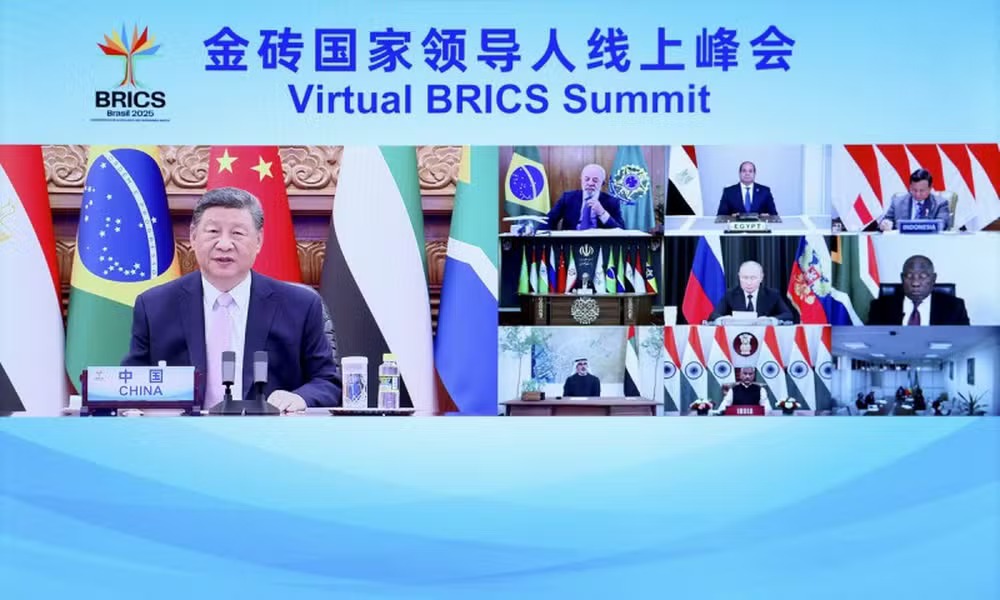
China’s president, Xi Jinping, said on Monday that multilateralism is critical to ensuring international equity and justice. The statement was made during the BRICS virtual summit, convened by Brazil, amidst the escalation of the tariff war imposed by the Government of Donald Trump against countries of the bloc.
In his speech, Xi pointed out that the ongoing transformations accelerate contradictions never seen in a century.
The Chinese leader stated that “hegemonism, unilateralism and protectionism are galloping faster” and that “the commercial and tariff wars waged by some country severely impact the world economy and impair the rules of international trade.”
For him, the defense of multilateralism must take place around UN and international law, with greater democracy in global relations and expansion of the voice of global southern countries.
XI insisted on the need to combat protectionism with openness and cooperation. He said that “economic globalization is an irresistible tendency of history” and that “either the evolution of the international situation, we have to remain committed to the formation of an open global economy.”
The president stressed that the goal is to promote “universally beneficial and inclusive” globalization, putting development at the center of the agenda and ensuring that the Global Southern countries participate “as equals and share the fruits of development”.
The Chinese president stressed Brics’s strategic weight by remembering that the group brings together almost half of the world’s population, about 30% of global GDP and one fifth of international trade.
The communist leader also said that “we more closely work together, more resilient we will be, more measurements we will have and greater effects we will produce to address external risks and challenges.”
He also defended the implementation of the global development initiative and the advancement of the cooperation of the new silk route in high quality, highlighting the complementarity of the bloc countries.
In concluding, he used a metaphor: “Strong wind tests the resilience of the grass, and fierce fire reveals true gold. Since we assumed our responsibilities and take care of each other, the Brics giant ship will be able to sing waves and navigate far and safe.”
The meeting also served that the Brazilian president, Luiz Inacio Lula da Silva, criticized Trump’s economic policy.
At the meeting, Lula stated that Brics countries have become victims of illegal practices and classified Washington’s policy as a “tariff blackmail to interfere with domestic issues.”
Lula added that unilateral measures are “transforming a deadly basic principles of free trade such as the most favored nation clauses and national treatment” and argued that the block uses its economic strength to propose a refounding of the multilateral trade system.
For the Brazilian President, the representativeness of the BRICS gives legitimacy to lead a new integration architecture in “modern, flexible and our development needs” bases.
He also reiterated the defense of digital sovereignty, stating that “without digital sovereignty, we will be vulnerable to foreign manipulation,” but without giving up international technology cooperation.
South Africa President Cyril Ramaphosa said the uncertainty of the new trade regime already affects jobs in his country and defended the largest unit of the bloc.
Russian President Vladimir Putin’s speech was not released, but Kremlin’s statement said he defended the group’s cooperation again. Represented by his chancellor, Subrahmanyam Jaishankar, India also exposed the impacts of the 50% tariff applied by Trump.
In addition to the tariff, the leaders discussed the situation in Gaza, the war in Ukraine and the preparation of COP30, scheduled for November in Belém. The meeting reaffirmed BRICS’s position as a counterpoint to Washington’s unilateralism, with the defense of multipolarity, sovereignty and cooperation between the global southern countries.
Source: vermelho.org.br