Published 12/19/2025 18:47 | Edited 12/19/2025 19:55
The second half of 2025 went down in history as the period of the largest military mobilization by the United States against a Latin American country – since the Cuban missile crisis in 1962. Under the command of President Donald Trump, Washington concentrated in the Caribbean and around Venezuela a military apparatus that surpasses, in firepower and strategic reach, interventions such as the invasions of Grenada and Nicaragua in the 1980s.
Aircraft carriers, missile-launching destroyers, nuclear submarines, state-of-the-art fighter jets and thousands of military personnel began operating in the region, in a show of force that breaks with the historical pattern of diplomatic pressure and economic sanctions. Several Caribbean islands host this military apparatus, which demonstrates the extent of Donald Trump’s commitment and fear of repeating the failures of Vietnam or the Bay of Pigs invasion of Cuba.
Also read: America for whom? The long shadow of US interventionism
Increasing the risk of possible attacks against Venezuela, the US president declared the country’s airspace as “totally closed”, without giving further details about the announcement. At least five aircraft, including Boeing EA-18G Growler and F/A-18E Super Hornet fighters, flew over the region without entering Caracas airspace.
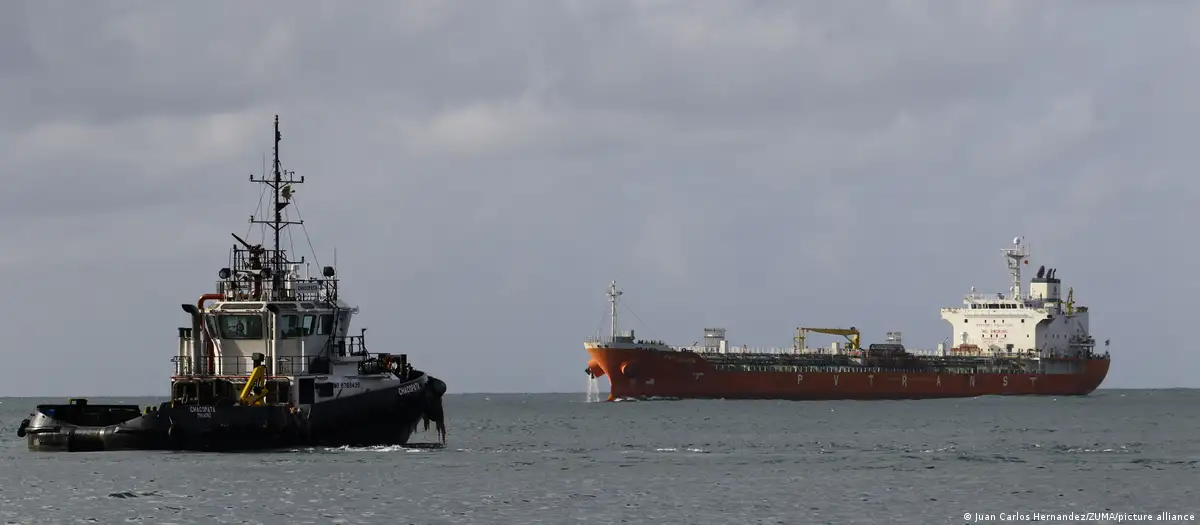
Taking aim again at the oil sector of Venezuela, the country with the largest fossil fuel reserves in the world, Trump announced this Tuesday (16), a new maritime blockade, which seeks to prevent the entry or exit of US-sanctioned ships in Venezuela. A day later (17), a new “lethal kinetic” attack against a vessel added more victims to the almost 100 people already killed since September.
From sanctions to open military threat
The offensive gained intensity after Nicolás Maduro took office for a new term in January, contested by Washington, despite all the protocol characteristic of an electoral democracy. Trump classified the Venezuelan president as the head of an alleged drug cartel and, subsequently, increased the reward to US$50 million for information leading to his capture.
In practice, the change created precedents for US military operations in other countries, under the justification of combating terrorism — as has already happened in countries such as Afghanistan, Syria and Libya, countries that remain ungoverned under the control of conflicting factions, a calculated risk for Venezuela.
The speech quickly translated into concrete actions. Since August, the US has launched attacks on vessels in the Caribbean and the Pacific under the allegation of combating drug trafficking, without publicly presenting evidence. In parallel, harsh sanctions were resumed against the Venezuelan oil sector, the country’s main source of revenue.
The logic of “narcoterrorism”
The turning point was the official adoption, by the Trump administration, of a doctrine that classifies organizations linked to drug trafficking as “international terrorists”. The change opened legal loopholes for the direct use of military force outside North American territory, replicating methods previously applied in the aforementioned Middle Eastern countries.
By associating the Maduro government with so-called “narcoterrorism”, Washington began to justify naval blockades, seizure of oil tankers and selective bombings as part of an alleged global war on terrorism.
Naval blockade and oil siege
In December, Trump announced a maritime blockade against sanctioned oil tankers entering or leaving Venezuela, in addition to declaring the country “completely surrounded by the largest armada ever assembled in the history of South America.” The measure drastically increased the risk of direct confrontation between US and Venezuelan forces.
In response, Caracas began escorting its ships with the national Navy and denounced the USA to the UN Security Council for violating international law and practicing “naval piracy”. While Caracas once raised more than 100 billion dollars (R$552 billion) per year from oil, today the value is around 20 billion dollars (R$110 billion). Although it has the largest fuel reserves, Venezuelan production represents around 1% of global production.
According to the Republican president, Venezuela is currently “surrounded by the largest armada ever assembled in the history of South America.” Therefore, the siege against the country should only be ended when North American “oil, land or any other assets” are returned. To date, however, the Trump administration has not yet made clear about US assets that would have been appropriated by the Maduro government.
International reactions and regional risk
The North American mobilization provoked immediate reactions. Russia and China declared support for Venezuela and warned of unpredictable consequences. In addition to the allies, the UN and the governments of Mexico and Germany also spoke out on Wednesday. The UN called for de-escalation, while Caribbean countries expressed concern about the transformation of the region, historically declared a “zone of peace”, into a new stage of military confrontation.
Experts warn that the simultaneous presence of large naval fleets in narrow waters increases the risk of incidents that could trigger an open conflict.
Caribbean officials, who rely on security partnerships with the U.S. to combat arms and drug trafficking, have expressed concern that the attacks could harm their economies and tourism, although they admit behind the scenes there is little they can do to stop them.
The closest point to Trinidad Tobago is just 7 miles off the coast of Venezuela, and its government is hosting U.S. Marines, allowing it to install a radar system at one of its airports, and participating in joint military exercises with U.S. forces. The first reported attack in September left 11 people dead off the coast of Trinidad. “The US military should kill them all violently,” says Trinidad and Tobago Prime Minister Kamla Persad-Bissessar, even though the violence in her country is fueled by weapons smuggled from the US, according to the United Nations Office on Drugs and Crime (UNODC).
Dominican President Luis Abinader also authorized the US Armed Forces to operate in restricted areas of his country. U.S. military aircraft can refuel and transport equipment and technical personnel, he said at a joint news conference with Defense Secretary Pete Hegseth in the Dominican capital last month. “Dominicans, our country faces a real threat, a threat that does not recognize borders, that does not distinguish flags, that destroys families and that has been trying to use our territory as a route for decades,” he declared.
Puerto Rico is a US-occupied territory, not an independent nation. It was used throughout the Cold War to support US military actions in Central and South America, and has returned to active duty in recent weeks with intense military movement.
Washington approached Grenada to request the temporary installation of radar equipment and associated technical personnel at an international airport. The request causes controversy in the country that was already invaded by the US in October 1983, after the assassination of Prime Minister Maurice Bishop, a socialist revolutionary. The airport named after the murdered leader would be the site of the US radar installation.
More serious than Granada and Nicaragua
Even in the most tense moments of the Cold War, such as the invasion of Granada or the US armed support against Sandinista Nicaragua, Washington did not concentrate such firepower in such an explicit and prolonged way around a single Latin American country.
Now, with lethal attacks, naval blockades and public threats of war, the offensive against Venezuela marks a new level of intervention, placing Latin America at the center of the United States’ global military strategy — and rekindling historical memories of a continent repeatedly treated as a zone of influence and not as a sovereign region.
Source: vermelho.org.br