Published 02/09/2026 16:48 | Edited 02/09/2026 17:17
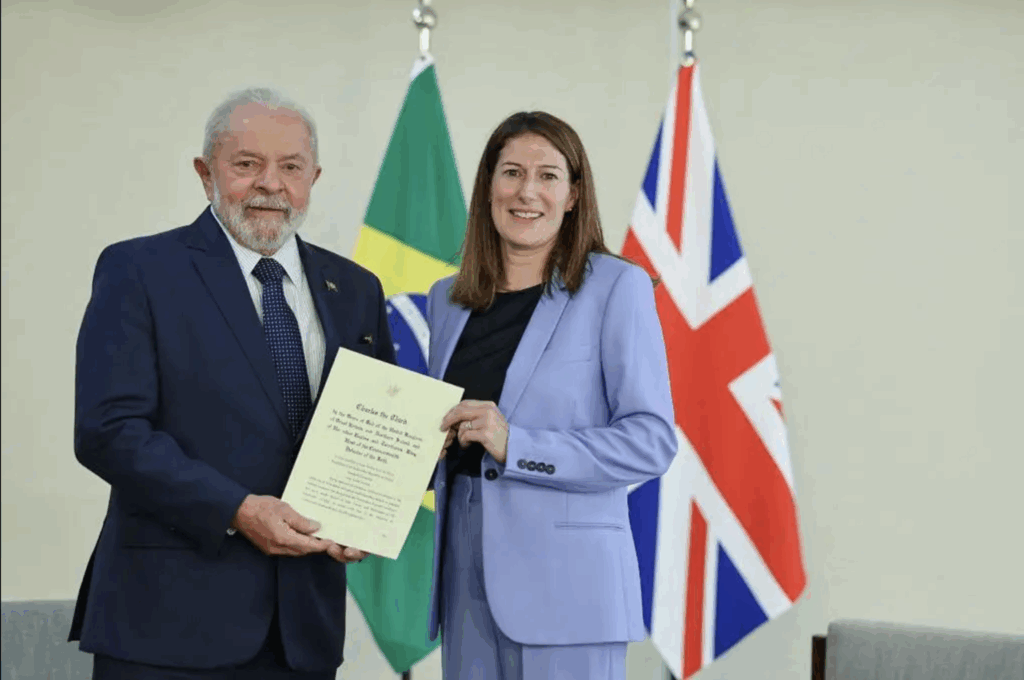
The United Kingdom declared support for the idea of a permanent seat for Brazil on the UN Security Council, reinforcing Brasília’s political weight in discussions on the reform of the multilateral system. The position was expressed by the British ambassador to Brazil, Stephanie Al-Qaq, in an interview with CNN Brasil.
The demonstration is relevant not only for its content, but for its origin: London is a nuclear power and one of the five permanent members of the Security Council, with veto power. It is, therefore, a central actor in the decision-making architecture of the international order created after the Second World War.
Brazil as a pillar of multilateralism
According to Al-Qaq, the British government sees Brazil as a key ally to strengthen and modernize multilateral institutions. For the diplomat, the current system needs reforms to function effectively again and respond to contemporary global challenges.
She made a point of dispelling the idea that the United Kingdom is an obstacle to this process. “It is not the United Kingdom that is getting in the way,” he said, highlighting that London has brought concrete proposals to international discussions on changes to the Security Council.
British support comes at a time of strong pressure on multilateralism, especially given the stance of United States President Donald Trump, who openly defends the weakening of international organizations in the name of the “America First” policy.
Dispute of views on international order
The interview highlights a clash of conceptions. On the one hand, the North American strategy relies on weakened institutions, opening space for an order based on zones of influence of the great powers. On the other hand, countries considered middle powers — such as Brazil, Canada and the United Kingdom — defend the preservation and reform of multilateral rules as a way of limiting power asymmetries.
In this context, Al-Qaq highlighted the convergence between London and Brasília. The diplomat even cited the recent defense made by Canadian Prime Minister, Mark Carney, in Davos, of coordinated action between medium-sized countries to contain unilateral pressures and preserve common standards.
Cooperation beyond diplomacy
Another central axis of the interview was the intention to deepen the bilateral partnership in strategic areas. Al-Qaq recalled that Brazil and the United Kingdom already cooperate in climate, health, science and technology, in addition to maintaining joint research and academic exchange programs.
The ambassador stated, however, that London wants to significantly expand the political and strategic relationship with Brazil, especially in the fields of defense and the fight against organized crime. For her, strengthening these areas is part of the broader effort to sustain the rules-based international system.
Advocacy: from buyers to partners
In the military area, the diplomat defended a paradigm shift. According to Al-Qaq, cooperation should not be limited to the sale of equipment, but move towards the joint development of technologies, systems and industrial capabilities.
“We are interested not only in selling things, but in building together, learning together,” he said. As an example, she cited the Gripen fighter program, developed by Sweden with strong British and Brazilian technological participation, a model that, according to her, illustrates the type of partnership that London wants to expand.
The increase in defense investments in both countries, he added, creates a favorable environment for this qualitative leap, especially in the face of new military challenges, such as the increasing use of drones and low-cost technologies in recent conflicts.
A strategic partner in times of uncertainty
Throughout the interview, Stephanie Al-Qaq emphasized that Brazil and the United Kingdom share values and a pragmatic vision of international relations. In a global scenario marked by instability and questions to the multilateral order, London sees Brasília as an indispensable actor — both to preserve existing rules and to adapt them to a new reality.
British support for Brazil’s permanent seat on the Security Council, in this sense, goes beyond a diplomatic gesture: it signals a strategic commitment to the country’s role as a relevant voice in redefining global governance.
Source: vermelho.org.br