Published 03/30/2026 14:48 | Edited 03/30/2026 18:12
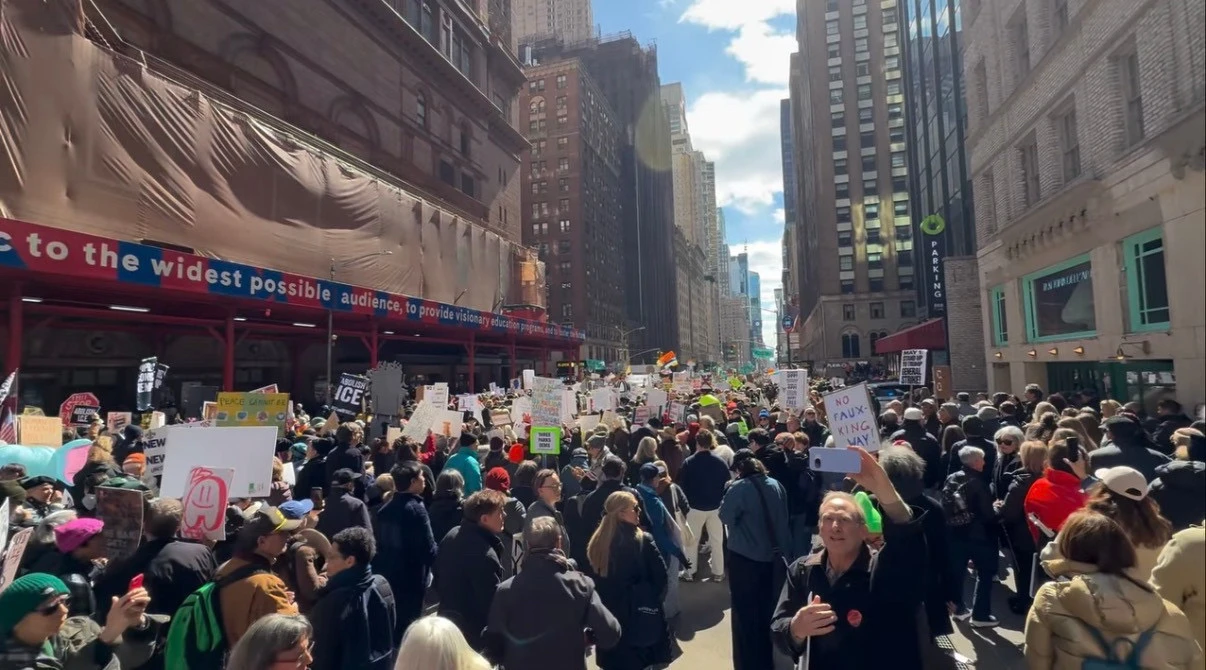
Donald Trump’s far-right government was hit by the third and most comprehensive wave of protests in the United States since the president’s election in 2024. Last weekend – Saturday (28) and Sunday (29) – went down in recent history as one of the greatest moments of popular protest. In more than 3,100 mobilization points spread across the 50 states, the “No Kings” movement brought together a front of progressive organizations, unions, immigrant defense groups, youth and civil rights NGOs, with participation estimates reaching 9 million people across the country.
The acts were not limited to large urban centers, such as Washington, New York or Los Angeles. The majority were concentrated in medium-sized cities and outskirts, demonstrating a grassroots, dispersed and capillary rejection that goes far beyond the traditional “urban bubble” of the North American left and center left.
The coalition brings together worker unions, immigrant organizations, LGBTQ+ youth, anti-racist movements and anti-capitalist groups. This articulation made it possible to mobilize everything from working-class neighborhoods in Detroit to universities and state capitols, building a broad social front, which isolates the far-right conservative sectors in North America and challenges Trump’s popularity.
High rejection proven on the streets
The main North American press outlets point out that, just on Saturday (28), protest demonstrations spread to all US states, with tens of thousands of people in New York, more than 100 thousand in Washington and around 70 thousand in St. Paul, alongside hundreds of smaller acts in Iowa, Nevada, Texas and in historical states of republicanism. The scale is compared by analysts to some of the biggest mobilization cycles of the last decade, such as the protests of 2017 or 2020, but now with a more explicit axis against the incumbent president himself.
Recent opinion polls, conducted by Quinnipiac University, indicate that Trump’s approval fell to around 38%, with 56% disapproval – the worst rating during his second term. Rejection is especially strong among independents and moderates.
“No Kings” and the critique of authoritarianism
The name “No Kings” summarizes the movement’s central demand: opposition to a government seen as authoritarian, personalist and anti-republican, which concentrates power in the Executive. The conduct of foreign policy and the internal actions of the Trump administration led protesters to the third wave of protests, crystallizing the slogan NO WAR! ON ICE! – against the war and against Trump’s immigration police – which has mobilized public acts.
The demonstrations have three axes: against attacks on Iran and the expansion of military operations without broad support from Congress; aggressive immigration policy, with mass deportations and ICE operations marked by violence – recent cases in Minnesota have become symbols of repression; and the perception that Trump (and the conservative far right) treats the State as an extension of personal interests, without respecting the rules and breaking the democratic balance.
Artists, stage and media symbols
The presence of cultural figures gave visibility and symbolic strength to the acts. In New York, Robert De Niro spoke at the march that took over Times Square, classifying Trump as an “existential threat” to freedoms and security. Beside him were Reverend Al Sharpton and New York Attorney General Letitia James.
In St. Paul, the symbolic epicenter, singer Bruce Springsteen took the stage on the lawn of the state Capitol and performed “Streets of Minneapolis”, a new song dedicated to the victims of ICE operations. The show brought together tens of thousands and was highlighted as an emblematic moment of the alliance between popular culture and resistance. Jane Fonda also participated in the movement’s events.
Repercussion in Brazil: Jandira Feghali and the connection with the fight against authoritarianism
In Brazil, federal deputy Jandira Feghali (PCdoB-RJ) echoed the protests on the networks. In a publication on Saturday (28), Jandira highlighted that “not even the fake news about the war stopped the US population. The 50 American states took to the streets today to protest against Donald Trump! Respect the sovereignty of nations!”
The massive mobilization as a sign of resistance to the “king policy” and the militarist escalation, especially on the issue of Iran. The articulation reinforces that the “No Kings” are not an isolated episode: they represent a global cycle of resistance to authoritarian policies, militarization of foreign policy and concentration of presidential power – a debate that reverberates directly on the Brazilian left.
The weekend’s protests went down in history as a concrete demonstration that American workers, young people and students do not accept being governed as subjects. The message is clear: “No Kings” – power belongs to the people.
Source: vermelho.org.br